




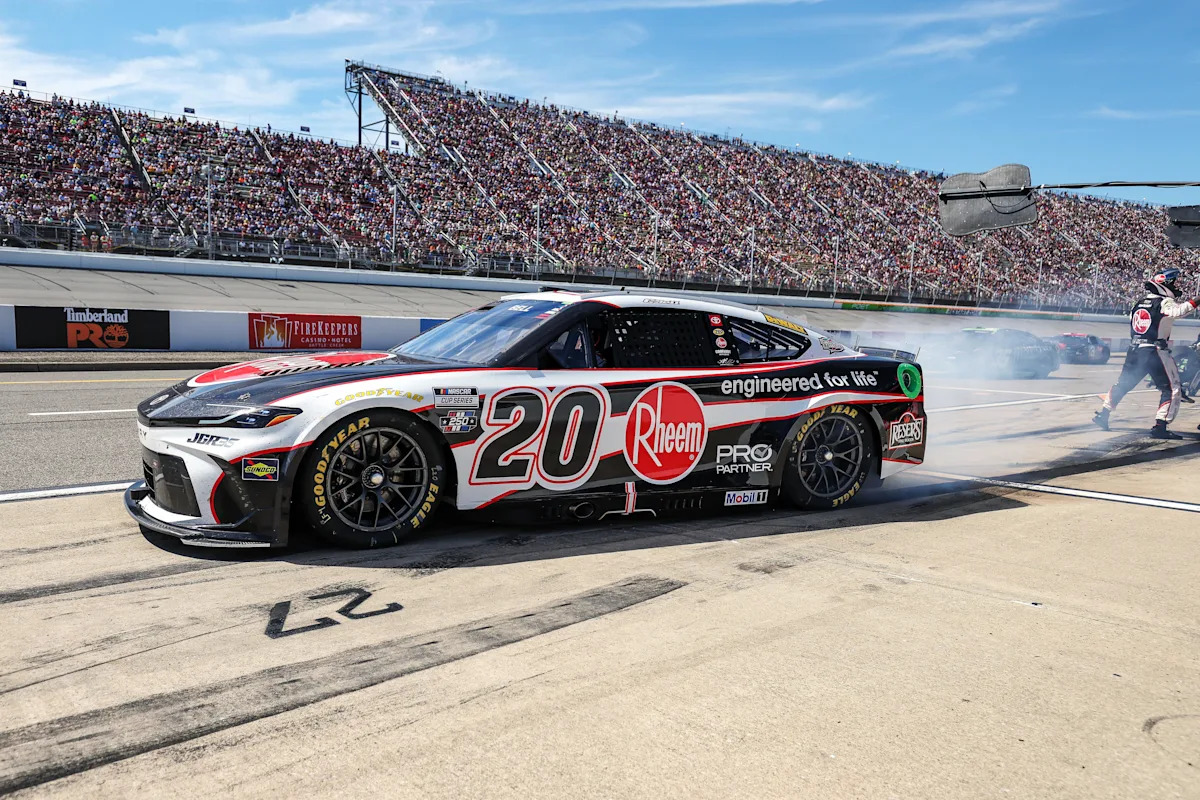
Christopher Bell and Chase Elliott were involved in a violent crash this past Sunday during the NASCAR Cup Series race at Michigan when Elliott’s No. 9 Chevrolet bobbled out of a restart on the 148th lap and turned up track, sending him and Bell’s No. 20 Toyota crashing into the outside wall on Turn 4.
“My god, that was the scariest hit I’ve ever seen,” Bubba Wallace, driver of the No. 23 Toyota, said over his radio.
Advertisement
Both cars were destroyed, but Elliott and Bell exited their machines under their own power. Elliott later took full ownership for the wreck, saying it was “totally my fault. … It was nothing intentional.”
On Tuesday, Joe Gibbs Racing confirmed that Bell suffered a fractured left wrist in the accident, but he will remain behind the wheel of the No. 20 car when NASCAR heads to Pocono this Sunday for the Great American Getaway 400 at the tricky triangle.
“After being evaluated and released from the infield care center, Bell returned home to North Carolina where X-rays confirmed the fracture,” JGR said in a statement. “Bell has been cleared and will be behind the wheel of the No. 20 Toyota Camry XSE this weekend at Pocono Raceway.”
Bell, who has never missed a Cup Series start since making the jump to NASCAR’s top level full-time in 2020, added his own comments on X.
Advertisement
“Thank you to each and everyone who reached out to check on me, I truly feel the love. I’m grateful for my team of doctors, JGR, NASCAR and all of the previous drivers who have helped pave the way for the safety standards in our sport,” Bell said. “See you in Pocono!”
The 31-year-old from Oklahoma is in his seventh season in NASCAR’s Cup Series and his sixth season racing for Gibbs. He is seen as one of the sport’s consistent championship contenders, having finished inside the top five in the standings in each of the past four seasons.
Bell hasn’t won since taking the checkered flag at Bristol last September, but has five top-five finishes this season and is 10th in the point standings — dropping three spots after his DNF at Michigan. In 2017, Bell won a Truck Series championship driving for Kyle Busch Motorsports.
Advertisement
His crash at Michigan was one of the hardest ones that NASCAR has seen in its modern era, and that’s not hyperbole. Mike Forde, NASCAR’s vice president of racing communications, put the wreck into context on a recent episode of the podcast “Hauler Talk.”
“This was the largest hit we have seen in the Next Gen era, so that’s 2022 on,” Forde said. “Delta-v is the measure of speed lost in an incident. … I can’t give out what the Delta-v number was for Bell. That data is proprietary in a way. … We share that with the team and the driver, and that’s kind of their data to do with what they want.”
From a less scientific perspective, but certainly from the view of someone who has witnessed a whole lot of racing and crashes, Dale Earnhardt Jr. reacted further to the crash on his podcast this week.
“I don’t believe that I’ve ever seen a car hit the wall harder than Christopher Bell hit on Sunday,” Earnhardt said. “I was terrified about the possibilities of him being injured. … That was just so scary. … I cannot be more thankful for the safety that we have in the cars that allowed those guys to survive that.”

NASCAR has not had a driver die in competition since Dale Earnhardt Sr. was killed on the final lap of the Daytona 500 in 2001.
Advertisement
Following the tragic death of the seven-time Cup Series champion, the sport went through a series of safety reforms, one of which was mandating the use of the HANS (head and neck support) device, a restraint designed to keep the head and shoulders of a driver in place on a frontal impact. In 2003, NASCAR also implemented the SAFER (steel and foam energy reduction) barrier at all of its tracks. Added to the walls around speedways, these barriers reduce G-forces by 30-to-80%, soaking up the impact of crashes and reducing injuries to drivers. NASCAR also made design improvements in seats, belts, helmets and cockpits, and began collecting crash data to continue to make innovations in safety.
Bell and Elliott hit the wall so hard that the red flag came out to stop the race so crews could repair the SAFER barrier that they crashed into.
This article originally appeared on USA TODAY: Christopher Bell to race Pocono with broken wrist after violent crash
Read the full article here


