




Every year, rookies find that once they enter the NFL, their previously elite skill set in college is – at best – par for the course on an NFL team. As a matter of principle, NFL players are bigger, faster, stronger, and more talented than most college players because the NFL assembles only the most elite athletes it can find.
Which is why NFL teams are obsessed with athleticism over almost anything else, and which is why we as fans pore over 40-yard dash times and short shuttle times so much. You can teach most players to recognize when a defense is in man or zone, but you cannot teach a player to outrun a faster opponent.
Advertisement
One of the many ways to measure a prospect’s athleticism is with a metric called Relative Athletic Score (RAS), which is a single composite number that allows you to quickly assess the athleticism of a player without painstakingly have to slog through 40 times, broad jump results, and bench press reps.
RAS grades football players on a 0–10 scale based on how their combine or Pro Day measurements compare to historical peers at their position.
Key Components
-
Size (20%): Height and weight.
-
Speed (30%): 40-yard dash, 20/10-yard splits.
-
Strength (10%): Bench press
-
Explosiveness (20%): Vertical and broad jump.
-
Agility (20%): 3-cone and shuttle drills.
What RAS doesn’t show (like any other athletic marker) is the potential of a player. And that’s where tape study comes in: how good is the player’s technique, does he play with intelligence, can he diagnose plays quickly, how loose are his hips, what does his foot work look like etc.
Advertisement
RAS doesn’t include the results of that tape study. Ultimately, that tape study, combined with many other factors, is summarized into a player grade. And while we don’t know how the Cowboys have graded their prospects, we have an approximation for that in the numerous big boards that are available two weeks before the draft.
So today, we’ll combine a proxy for the draft grade of a given player (the player’s rank on the Consensus Big Board at NFLMockDraftDatabase.com ) with a proxy for his athleticism (RAS) to give us both a scouting element and an athleticism metric through which to evaluate prospects.
I limited my player selection to players ranked within the top 200 players on the Consensus Big Board and then plotted their rank and their RAS score into a graph.
We’ll kick things off with cornerbacks, where 24 prospects were ranked within the top 200 and had a RAS score:
Advertisement
How to Read the Score/Color Coding
-
9.50–10.00 (blue): Elite athletic testing metrics.
-
8.00-9.49 (green): High potential
-
5.00–7.99 (yellow): Average to above-average athletic testing.
-
0.00–4.99 (red): Below-average athletic testing, often seen as a red flag for NFL success.
-
Players marked in red: Confirmed visits in Dallas, either as a 30 visit or a Dallas Day visit.
Mansoor Delane does not qualify for a RAS due to a lack of measurements. He skipped the on-field drills at the combine, ran an impressive 4.38-second 40-yard dash at his Pro Day, but skipped all other on-field drills at his Pro Day well.
Avieon Terrell has a relatively low RAS but may have been hampered by a hamstring injury that he further aggravated during sprints as his Pro Day.
In any case, a player’s athleticism should already have been integrated into his overall draft grade, but it doesn’t hurt to look at it separately.
The 2026 cornerback class offers elite athletes across all rounds of the draft. 14 of the 24 prospects above have a RAS score right at or above 9.0. It’s also notable that the Cowboys had 11 players on this list in for an official 30 visit or for a Dallas Day visit, and outside of Delane and Terrell, every one of those visitors scored a RAS of around 9.0 or higher.
Advertisement
If you’re looking at two prospects with roughly similar grades, your chances of success will likely increase if you pick the prospect with the better athleticism markers. If you don’t have the athleticism to compete at the next level, your odds of success are lower.
Same procedure for defensive ends:

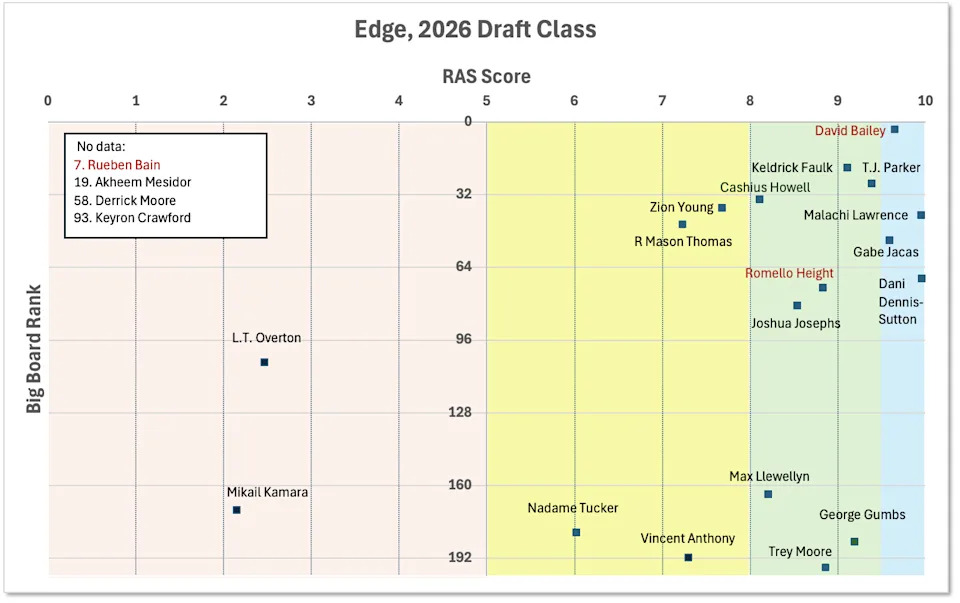
Overall, this is a tightly clustered defensive end class in terms of athleticism, with 11 of the 18 players tightly bunched in the top right of the chart. If you want elite athleticism, you’ll have to draft a DE early, most of the top guys here will likely be gone when the Cowboys are on the clock with the #92 pick. And at that point, the question becomes whether any of the remaining options are a substantial improvement over what they already have.
Advertisement
Next up: safeties.

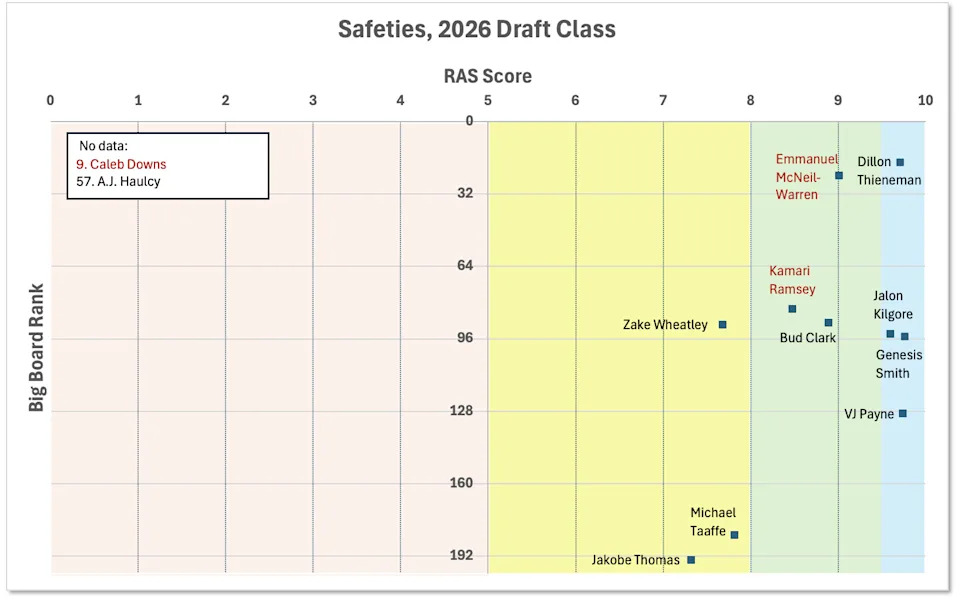
There are only 12 players on this graph, including two for which we don’t have an RAS score. That’s not a lot, and in some ways it predetermines your draft strategy. You either get your hands on one of the top three guys in the first round, or you pick up somebody in the 3rd/4th round. But the question is, will that mid-round safety improve on what you already have?

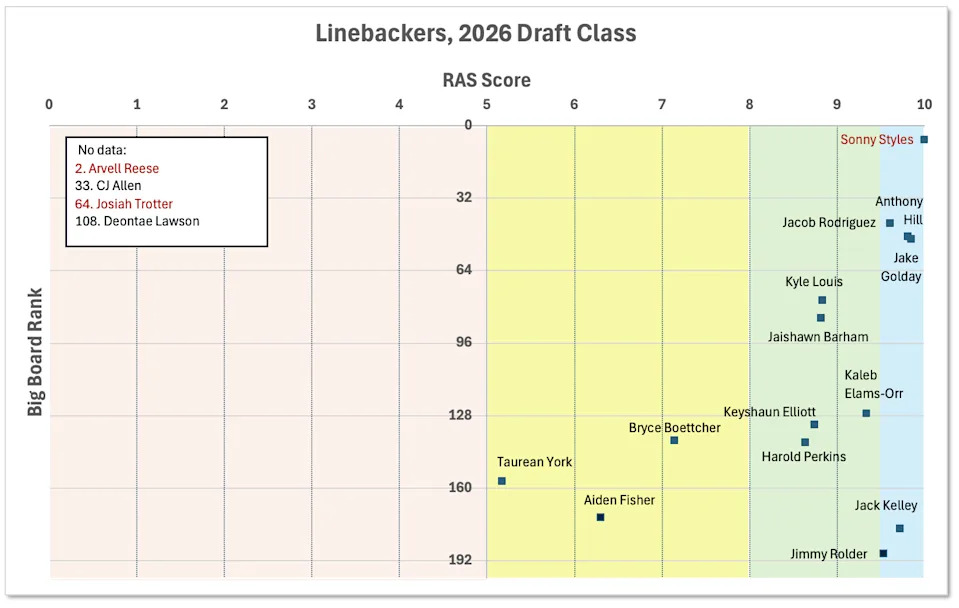
Linebackers, at least to me, is the most interesting graph here. The Cowboys can of course hope against all odds that Sonny Styles drops to them at #12. But if that doesn’t happen, there’s a jackpot of linebackers with elite athletic traits waiting for them at the bottom of the first/top of the second round.
Advertisement
Oddly though, we have yet to receive word that Anthony Hill, Jacob Rodriguez, or Jake Golday have been brought in for official visits, though the Cowboys did have a formal dinner with Anthony Hill and Jacob Rodriguez, so there is some interest for sure.
And even if the Cowboys don’t go for a linebacker early, there are still some very athletic prospects in the later rounds to choose form – or to double-dip at the position.
Overall, athleticism isn’t everything, but it’s part of the package teams are looking for. For new Cowboys DC Christian Parker height/weight/speed still matter, but there is a premium on the brain when looking for players.
“You want guys to be able to process those things quickly. But you can’t go out there with just a bunch of height, weight, speed guys, either. This is not an operation where we’re gonna roll the ball out in the Whataburger parking lot and just play seven-on-seven. We got to be able to process and do those things the right way.”
“I still think that you want a lot of athletic, fast guys because there are gonna be times where there is space, and you have to eliminate it,” he said last week on The Fan. “We’re not trotting out a YMCA basketball team. We still want to be fast and aggressive, but I will say, there’s a premium on instincts, there’s a premium on the brain. At different spots, they have to handle a different mental workload in terms of where their eyes have to be.”
Using the ‘Little Board’ format that rabblerousr has championed here on BTB, here’s what draft board full of superior athletes could look like on the defensive side of the ball. We have 31 players with an RAS of 9.0 or higher, seven players with no RAS at all, and five players with an RAS below 9.0 but who were invited for a pre-draft visit in Dallas. Note that the legend here is slightly different than in the graphs above. Red denotes a player with no RAS grade, green marks a player who’s been to a visit in Dallas, and players with a (*) have an RAS below 9.0.
Advertisement
body .sbnu-legacy-content-table td, body .sbnu-legacy-content-table th, body .sbnu-legacy-content-table { border: 1px solid #000 !important; border-collapse: collapse !important; }
|
|
1st Round |
2nd Round |
3rd Round |
4th Round |
5th Round |
6th/7th Round |
|
DE |
David Bailey |
Cashius Howell* |
Dani Dennis-Sutton |
|
|
George Gumbs |
|
Rueben Bain |
Malachi Lawrence |
Romello Height* |
|
|
|
|
|
Akheem Mesidor |
Gabe Jacas |
|
|
|
|
|
|
Keldric Faulk |
|
|
|
|
|
|
|
T.J. Parker |
|
|
|
|
|
|
|
CB |
Mansoor Delane |
Colton Hood |
Treydan Stukes |
Daylen Everette |
Ephesians Prysock |
Domani Jackson |
|
Jermod McCoy |
Brandon Cisse |
Malik Muhammad |
Will Lee III |
Charles Demmings |
|
|
|
Avieon Terrell* |
Chris Johnson |
Julian Neal |
|
|
|
|
|
|
Keionte Scott* |
|
|
|
|
|
|
S |
Caleb Downs |
|
Kamari Ramsey* |
VJ Payne |
|
|
|
Dillon Thieneman |
|
Jalon Kilgore |
|
|
|
|
|
Emmanuel McNeil-Warren |
|
Genesis Smith |
|
|
|
|
|
LB |
Arvell Reese |
C.J. Allen |
|
Kaleb Elarms-Orr |
Jack Kelly |
Jimmy Rolder |
|
Sonny Styles |
Jacob Rodriguez |
|
|
|
|
|
|
|
Anthony Hill Jr. |
|
|
|
|
|
|
|
Jake Golday |
|
|
|
|
|
|
|
Josiah Trotter |
|
|
|
|
|
|
|
Legend: Red=No RAS data, Green=Dallas Visit, *RAS below 9.0 |
|||||
Overall, as you’d expect, many of the top athletes show up at the top of the draft. But enough superior athletes slip through into the later rounds to give the Cowboys a lot of options later in the draft. And while athleticism by itself is no guarantee of future NFL success, the chances of superior athletes making it are probably better than those of average athletes.
There are 43 defensive players on this little board, all with above average athleticism. There should be enough names here for the Cowboys to find some future contributors.
Who are your top prospects from this list?
Read the full article here


