





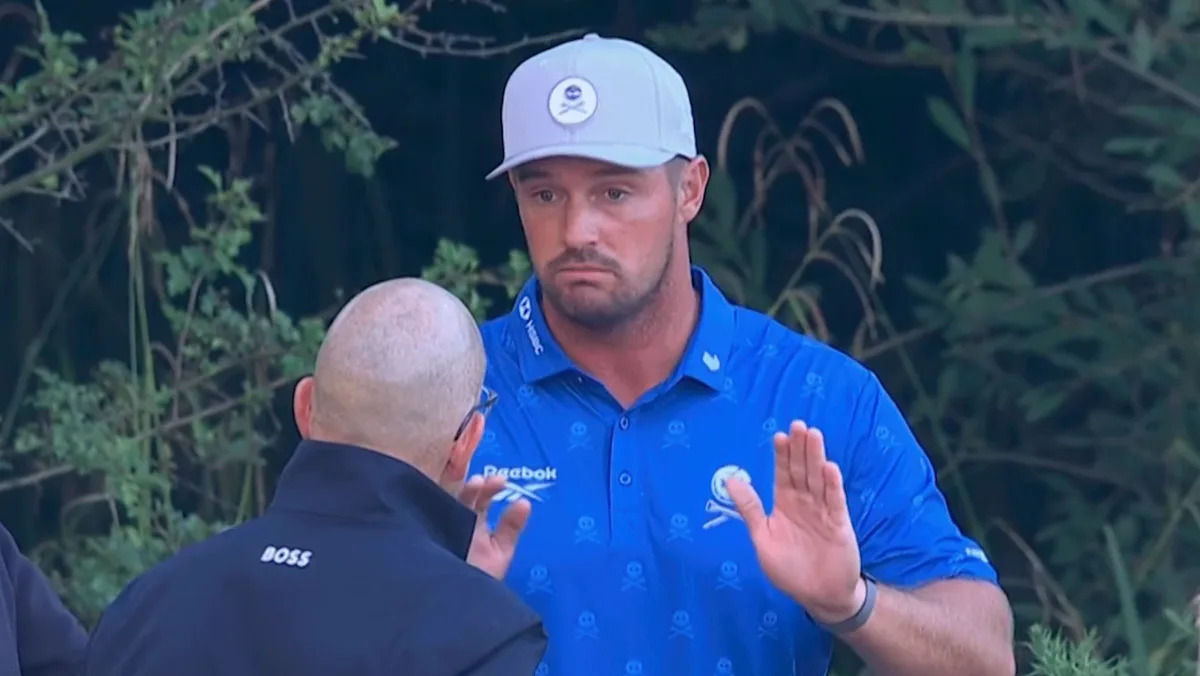
SOUTHPORT, England — Your response to Bryson DeChambeau’s walk on the wild side likely says more about how you feel about Bryson than your knowledge of Rule 8.1a.
Would the R&A have given a two-stroke penalty to Rory McIlroy (former winner of the Open Championship) or Tommy Fleetwood (native son of these parts)? No. They are beloved figures, ’round here. Each, in his own way, flies the flag of golf’s most traditional values, ones the R&A holds dear.
Advertisement
Bryson DeChambeau does not. LIV Golf does not. All that look-at-me stuff on YouTube does not. The Rules of Golf seek to remove emotion and turn every situation to a binary matter: within the rules, or not. In real life, with real people on the stage, that cannot be done, try as you might.
I am not an expert on Rule 8.1a and am ambivalent about Bryson and his me-me-me approach to his public life. It is also true that if we were all cut from the same cloth and imposing our standards for everything on the next person, the world would be a boring place, a Jos. A. Bank catalog times a billion. Watching the video of DeChambeau deep in the rough after a lousy tee shot on the 5th hole in the second round of the British Open, here at Royal Birkdale, I saw a big and irritated man stomping around, maybe losing his balance for a half-second, which didn’t help matters. I didn’t see a golfer — the star player of the LIV Golf Crushers team — improving his lie or altering the path of his backswing for his second shot. Had I been watching this whole sorry episode in real time — as an assistant to an NBC Sports spotter or something like that — no alarms would have gone off.
But I am much more likely to take, in good faith and on face value, Brandel Chamblee’s interpretation of this half-minute that rocked our brownish green world. Or the interpretation of his Golf Channel colleague, Paul McGinley. Or, and most significantly, the R&A’s interpretation of it.
My colleague Dylan Dethier, in a GOLF.com forum, posed a trenchant question to the R&A about the incident, about what happened and the two-shot penalty DeChambeau was given: Are you sure?
Advertisement
I don’t know if anybody at the R&A responded to Dylan, but I can do a little mind-reading here.
Aye!!
The folks at the R&A, based in St. Andrews, Scotland, and the stewards of this tourney, this game and its rules, do not lack confidence. They have, in spades, the courage of their convictions. Collectively, they have a Mensa-level golf IQ. As Augusta National chairmen wear bracelets with the letters WWBD stamped on them (What Would Bob Do?), top R&A officials, as a rite of passage, get a discreet tattoo featuring Old Tom Morris’s long white beard. If that conjures no image for you, check out Nick Pugh, Lucas Herbert’s caddie. (You can shop the look, in a manner of speaking, here. William Whiteley & Sons Ltd. have been suppliers of handmade grooming shears to members of the royal family for a century and then some.) What Old Tom would say here, to his R&A progeny and Bryson and every other person playing this game at its highest levels, is this: Honor the spirit, mon.
This is the spirit — or an element of it: Your golf ball is a ticking time bomb; if you do something wrong with the ball, or the area surrounding it, it will explode in your face. So treat your ball and the area around it with the respect it deserves.
Advertisement
And that DeChambeau did not do. I think that is obvious. He was cavalier. I think that is obvious. The R&A gave him every opportunity to see that for himself, that subtle but critical thing: You were cavalier where you needed to be careful.
That’s why R&A rules officials showed him the video, likely more than once, when he came in from his Friday round. That’s why they drove him out to the scene of the crime in a buggy, to give him more time to figure out the situation for himself. When DeChambeau, two-time U.S. Open winner and golf disruptor, couldn’t do that, the R&A had to do the math for him, adding two strokes to his score. He went from seven under to five under.
He could still win the tournament, of course, just as Tiger Woods could have won the 2013 Masters after receiving (I would say, generous) two-shot penalty for inadvertently taking an incorrect drop in his Friday round. DeChambeau, in the Woods tradition, likes playing with a chip on his shoulder. He’s already annoyed (I’m guessing) with Nick Faldo, a two-time Open winner. Their contretemps du jour went like this.
Sir Nick: You don’t have a proper links-golf strategy, bro.
Advertisement
Sir Bry: Strategy this, dude.
DeChambeau won his first U.S. Open at Winged Foot in 2020 with a body inspired by either the Michelin Man or Tiger Woods circa 2007. His strategy was to hit his tee shot as close to the pin as possible, and there was no lie that scared him — that’s how big and strong and good he was. A.W. Tillinghast (the course designer) and Billy Casper (winner of the 1959 U.S. Open there) had to be freaked out, if they had cable or internet access. I was kind of ill myself.
But DeChambeau did what he needed to do. You tip your cap. Not his fault that the USGA and the R&A lost the tech battle of equipment for elite players or that the USGA fell in love with (basically) denuded treeless golf courses. Faldo should have won several U.S. Opens; he was such a brilliant fairways-and-greens player. But he didn’t. DeChambeau is contending, here at this 154th Open Championship, even with the two shots.
News
What it was like as Bryson DeChambeau’s controversial Open ruling unfolded
What it was like as Bryson DeChambeau’s controversial Open ruling unfolded
Advertisement
By: Sean Zak
That number there, 154, is the most important one here. This game has been played for a long time, and so has this tournament. The whole key to Arnold Palmer’s off-the-course success was that he never put the game ahead of himself. He had an ego, as we all do. But he always understood that the game and its traditions and its values were far bigger than he. Jack Nicklaus, the same. Old Tom and Young Tom, the same. Bob Jones and Billy Casper and A.W. Tillinghast, the same.
Tiger Woods, I’m not so sure about. In 2013, at an event in Chicago, he caused his ball to move. You could see it. I would say anybody could see it. Woods was standing right over it. It was a ticking time bomb. When Woods would not call the two-shot penalty on himself, a rules official, Slugger White, had to do it for him. It was unfortunate. When Woods made the argument that an inconvenient boulder at the 1999 Phoenix Open was a loose impediment, and 20 or so grown men moved it, it was unfortunate. It was not golf, and I don’t care that the PGA Tour rules official made a ruling in his favor. Rules officials make mistakes. Rules officials get intimidated. Rules officials get influenced by real-world events. Woods should have never asked for it in the first place.
Jon Rahm received a warning from the R&A for, when you get right down to it, poor sportsmanship, for tossing a club hard at a tee after a shot he did not like. Totally completely appropriate. Why? For several reasons, and this is one of them: It’s distracting for his playing partners, in this case Tommy Fleetwood and Jordan Spieth. The ultimate purpose of the rules of golf, the ultimate purpose of the game’s emphasis on etiquette, is to try to create the same playing conditions for all players. Do Jordan Spieth and Tommy Fleetwood want to go around all day for two days wondering when Jon Rahm might have a little meltdown? It’s distracting. It’s not fair. It’s not golf.
Advertisement
My colleague Jessica Marksbury had a lovely and wonderful response to the Bryson episode, and it’s easy to agree with every word of it. In that same chat with Dylan and Co., Jess wrote this:
“Judging by the footage I’ve seen, I think Bryson deserves the benefit of the doubt. It doesn’t appear as though he was intentionally stomping around, clearing grass away behind the ball or really ‘improving’ his lie in any way. To me, it looked like Bryson handled this shot like any other pro. His reaction to the penalty, though extreme if he follows through on not playing in protest, makes sense: He feels like he’s been dealt an injustice — and a black mark on his character — and is responding accordingly. I can’t say I blame him for his feelings, but I hope he will play and try to win this tournament anyway.
“As an aside, I have to say that I also find this intense analysis of lies and player behavior in the milliseconds before a shot is hit to be sort of annoying. Golf is supposed to be a game of personal integrity, and taking a microscope to alleged infractions like this — where it’s nearly impossible for us at home to tell what happened, and when hours have passed since the initial incident and there’s plenty of room for doubt — seems like a disservice all around.”
Lovely, wonderful — and generous.
Advertisement
What the R&A did with Jon Rahm on Friday was a minor, or not so minor, contribution to making a great game better. What the R&A did with Bryson DeChambeau was more of one. In the first case, treat your playing partners with the respect they deserve. In the second, treat your ball and the environment around it with the respect it deserves. It’s like staying in a friend’s old, family beach house. That screen door is delicate. The whole thing is delicate. You’re going to treat it, and leave it, in better condition than you found it, right?
Michael Bamberger welcomes your comments at [email protected].
The post Bryson DeChambeau’s polarizing penalty was bold-faced message to all golfers appeared first on Golf.
Read the full article here