






When the Cleveland Browns selected defensive tackle Mason Graham with the fifth overall pick in the first round of last year’s NFL draft, they envisioned pairing him with 2024 second-round pick DT Mike Hall for a formidable middle wall along the defensive front.
So far, only one of these two athletes is working out: Graham. In just a three-game sample size, Graham has Pro Bowl written all over him. He is just the second Cleveland defensive player since Myles Garrett to record a sack in his first three games of any season. And he is accomplishing this from the interior of the line.
Advertisement
RELATED: 2025 WINNING CARRIED OVER
Graham already has four sacks in this young season. Cleveland has only played three games, which calculates to 1.33 sacks per contest. In a 17-game season, that would end up being 22.1 sacks for the year. From the inside.
Keep in mind, Graham isn’t an EDGE rusher, but a defensive tackle. Normally, DTs are run stoppers and gap fillers, not pass rushers. Normally their sacks occur when the quarterback attempts to escape the pocket and run into the DT. But when DT Aaron Donald was in his prime, he demonstrated that defensive tackles can become productive and consistent pocket disruptors.
Graham is doing the dirty work with excellent footwork and has a quick first step off the snap.
Advertisement
This was demonstrated in this weekend’s victory over the Carolina Panthers. The Browns led by three late in the contest and wanted to drive the field for a game-tying field goal late in the fourth quarter.
Carolina began their drive with 1:48 left in the game from their own 22. After an incomplete pass and a completion for no gain, they faced a third-and-10 needing to drive the field. On the third-down snap, Graham hit the B gap before right guard Robert Hunt could square up. Graham is in a full-out pass rush and turned his back to Hunt. Now all the guard can do is try to push Graham to his right out of harm’s way, but the Browns defensive tackle was gaining inches and ended up sliding off Hunt and eventually met and bear-hugged quarterback Bryce Young for the sack. This forced the Panthers to attempt a fourth down, and now, very long.
It just happened to be Graham’s second sack of the day, but none was more important than the one as time was winding down. This forced the Panthers to go for it on a fourth-and-16. An eight-yard pass completion didn’t come close to gaining a first down and getting into field goal range, and the Browns got the ball back.
This wasn’t Graham’s first case in the game of setting Carolina back.
Advertisement
They began their third drive of the day early in the second quarter, beginning at their own 16. After several intermediate completions and some good gains on the ground, the Panthers found themselves at Cleveland’s 43 facing a fourth-and-three. Young began in the shotgun. Immediately off the snap, Graham was met by offensive guard Corey Bullock and center Luke Fortner, who double-teamed him. Graham then disengaged and headed into the center of the field where Young had set up. Graham hit the jets and nailed Young, who was still surveying the field at the 44-yard line, for his first sack of the game.
Cleveland was now in good field position and, after seven plays, kicked a field goal, which ended up being the difference in the game.
Graham has also improved his run-stopping ability. Midway through the third quarter, he nailed RB Chuba Hubbard for a minimal gain that gave Carolina a third-and-seven. And early in the fourth quarter, he caught RB A.J. Dillon for a two-yard loss after the Panthers had driven to Cleveland’s 23-yard line. After an incompletion, Carolina’s long drive now became a field goal conversion instead of six points.
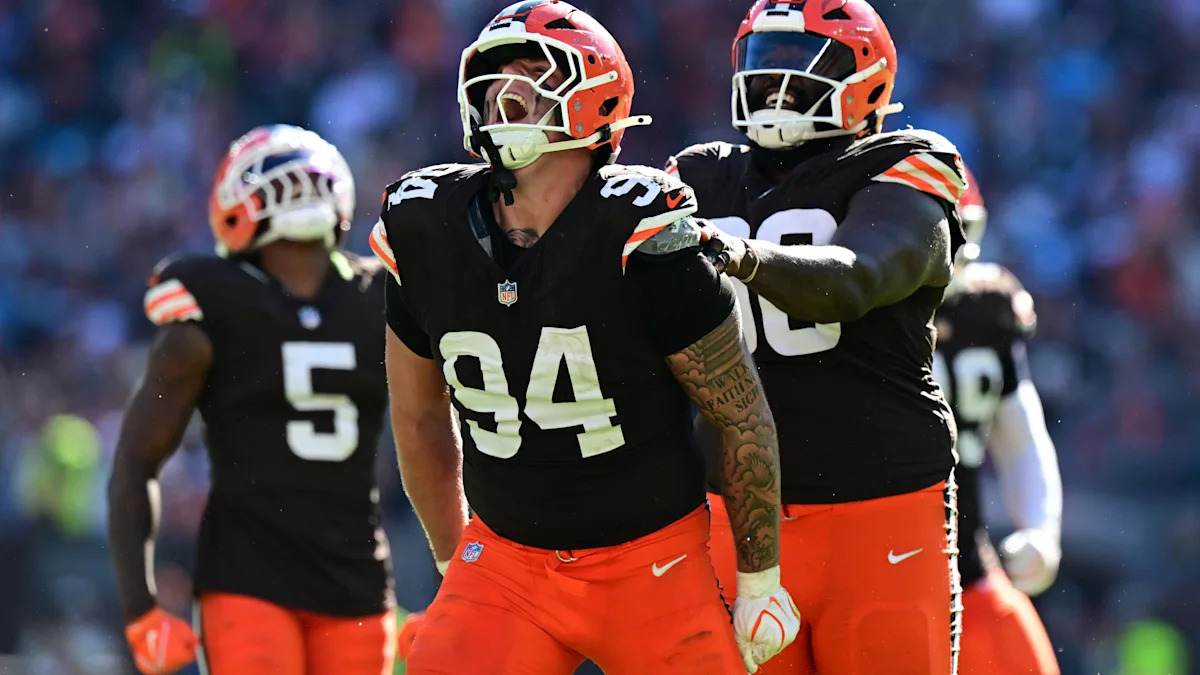
Mason Graham #94 celebrates a tackle (Photo by Nick Cammett/Getty Images) | Getty Images
Graham finished the Panthers game with the fourth-most total tackles (7). He had the most tackles for loss (3) and sacks (2), along with two QB hits and five pressures, according to Pro Football Focus.
Advertisement
The Carolina game was a great defensive effort in that the Browns pressured Young on 63% of his dropbacks, the highest mark by any NFL defense this year (in a single game), as stated by Ben Linsey of SumerSports. Five Cleveland defenders generated at least five quarterback pressures in this game.
And out of respect to the other defensive linemen, Graham has been the Browns’ top pocket-collapser through the first three games of the season. He is tied for third in solo tackles and leads the team in tackles for loss (6) and sacks (4).
His first sack of the season was in the beatdown in Week 1 against the Jacksonville Jaguars. Right after the two-minute warning before halftime, the Jaguars had a third-and-one at their own 33 when Graham broke through and tackled quarterback Trevor Lawrence. This forced a punt and ended a good drive. In this game, Graham had five total tackles with two tackles for loss and a QB hit.
Against the Tampa Bay Buccaneers in Week 2, Graham sacked former Browns quarterback Baker Mayfield late in the second quarter on a third-and-15, which also forced a punt.
Advertisement
Ever since Myles Garrett was traded to the Los Angeles Rams, this group hasn’t had a face for the defense. Can Graham become the new look of this Browns defense?
Denzel Ward is the experienced veteran with proven production and Pro Bowl hardware. Last year’s NFL “Rookie Defensive Player of the Year” LB Carson Schwesinger routinely has double-digit tackle numbers each week and has the pedigree. And defensive end Jared Verse was supposed to be this year’s big splash, yet has minimal production with no sacks and only one pressure.
This defense has kept Jim Schwartz’s personality, aggressiveness, and production. Who will rise to represent this unit? Could that be Graham?
How surprised are you by the early impact Graham has made this season?
Advertisement
Join the conversation!
Sign up for a user account and get:
-
Comment on articles, community posts
-
Rec comments, community posts
-
New, improved notifications system!
Download the SB Nation app on iOS or Android.
Read the full article here


