




NBA history spans 80 seasons, and as CelticsBlog readers well know, the Boston Celtics have won a league-high 18 championships. This month, we are recapping each of those title years.
The regular season
Advertisement
Something old and something new were the top stories in the NBA’s 1959-60 season, and both of them affected the Boston Celtics.
The “something old” was yet another meeting in the Finals with the St. Louis Hawks – the third time in four years.
“Something new” came in the form of a 7-foot-1, 275-pound goliath named Wilt Chamberlain, who some observers feared would take over the league. “Can Basketball Survive Chamberlain?” was the title of one magazine article. These proved to be overreactions, but to be fair, the NBA had never seen anyone like “Wilt the Stilt.”
Wilt Chamberlain #13 of the Philadelphia 76ers gets his shot blocked by Bill Russell #6 of the Boston Celtics during a 1960 NBA game at the Boston Garden. Copyright NBAE 2002 (Photo by Dick Raphael/NBAE via Getty Images) | NBAE via Getty Images
Chamberlain was a native of Philadelphia who spent three years at the University of Kansas, but left school his senior year to play for (and get paid by) the Harlem Globetrotters. That situation enabled the Philadelphia Warriors to claim Wilt as their territorial pick (he went to high school in Philly!) in the 1959 Draft.
Advertisement
With eight teams in the league and the Warriors then being in the East, that meant Boston would face Wilt 13 times during the regular season. The Celtics won eight of those, although they didn’t exactly stop “The Big Dipper.” Chamberlain scored 39 or better nine times, and in one of Philly’s five wins tallied 53 points and 29 rebounds while being guarded by defensive king Bill Russell.
For the season, Chamberlain topped the league with 37.6 points and 27.0 rebounds per game. He was named Most Valuable Player and Rookie of the Year as the Warriors finished 49-26.
That still wasn’t enough to surpass Boston. The league had increased from 72 games to 75, and the Celtics raised their win total from 52 the previous season to 59, a new league all-time high. And it turned out these rivals would also meet in the postseason Eastern finals.
Eastern playoffs
Advertisement
The Celtics earned a bye for the first round best-of-three while the Warriors knocked off Syracuse, 2-1. Philadelphia brought more than just Chamberlain to the table. They had forward Paul Arizin, a two-time league scoring leader; point guard and twice the league assists leader Guy Rodgers; and high-scoring forward Tom Gola. All are in the Hall of Fame today.
In Game 1, Chamberlain scored 42, but Russell countered with 30 rebounds. The Celtics led by 13 after one quarter and held off Philly the rest of the way. The Warriors evened the series in Game 2 behind Arizin’s 30 points. Game 3 was Russell’s night, with game-highs of 26 points and 39 rebounds, while Chamberlain scored just 12 points, and the Celtics cruised, 120-90.
In Game 4, Boston built a 16-point lead after one quarter and held it all the way to a 3-1 series lead. And just when the Celts were ready to close it, Chamberlain dominated with 50 and 35 as Philly roared back with a 21-point win on the parquet.
Still ahead 3-2, the Celtics returned to hostile Convention Hall in Philadelphia. Rodgers had been ice cold early in the series, but on this night he heated up with 31 points. With 11 seconds left, Rodgers was fouled and had two free throws with the score tied. He missed both. At the other end, the Celtics missed their shot, but Tommy Heinsohn stunned everyone by tipping in the series winner at the buzzer. During his announcing career, Tommy often reminisced about that night when he shut up 12,000 Philadelphia fans.
Advertisement
Since that first meeting of Russell vs. Wilt, basketball observers have debated which megastar was better, and why. That topic will be addressed here later in this series; meanwhile, here’s a preview:

NBA Finals
In two previous NBA Finals versus St. Louis, Bill Russell had twice been the difference-maker: once for the Celtics in winning their first championship, and once for the Hawks, caused by his absence due to injury. Russell was healthy for this rubber match, which could determine which team “won” the draft day trade back in 1956.
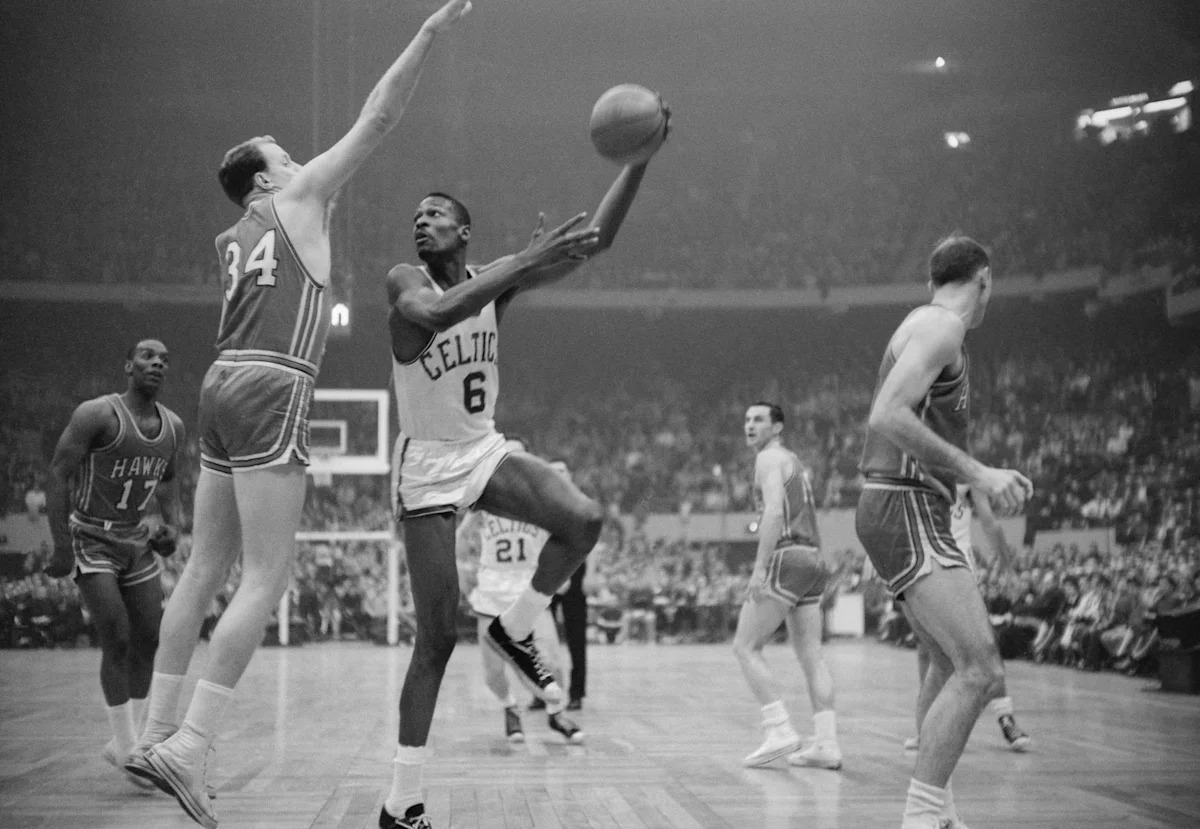
Russell was a force in this series, leading everyone in rebounds in each of the seven games played. He set a Finals record with 40 boards (plus 21 points) in game 2 in Boston – which the Celtics lost by 10. These teams knew each other so well, it seemed that either one could win a game regardless of the location, the crowd, the refs, the schedule, anything.


Bill Russell (#6) in the middle of Game 7 action vs. the St. Louis Hawks. (Photo by UPI/Bettmann Archive/Getty Images) | Getty Images
This Finals seesawed each game, Boston going up one followed by St. Louis tying the series. The Celtics could have wrapped up the title in Game 6 on the road, but Cliff Hagan (one of the players traded for Russell) poured in 36 points. The Hawks used a 36-12 third quarter to build a 90-64 lead, only to see the Cs almost steal it with a 38-15 fourth quarter comeback. Nevertheless, it was back to Boston for yet another Game 7.
Advertisement
Turning point
After an even first quarter, Boston’s running game and balanced scoring resulted in a 41-23 second quarter margin and a 17-point halftime lead. The Celtics finished Game 7 with the five players tallying between 18 and 24 points.
It was over when…
Both teams essentially traded baskets for the entire second half, which the Celtics were happy to do. Final score: 122-103. Banner #3 was in hand.
Notable facts and stats
-
Bob Cousy scored 19 points and dished out 14 assists. Bill Russell collected 22 points and 35 rebounds.
-
For the third time in four years, Tommy Heinsohn led Boston in scoring overall during the Finals.
-
Si Green, the player chosen first overall by Rochester when they weren’t interested in Russell, played for St. Louis and averaged 13 points, seven rebounds and six assists in seven games.
Banner Years continues tomorrow with a review of the 1960-61 season and the road to winning Banner #4.
Read the full article here


