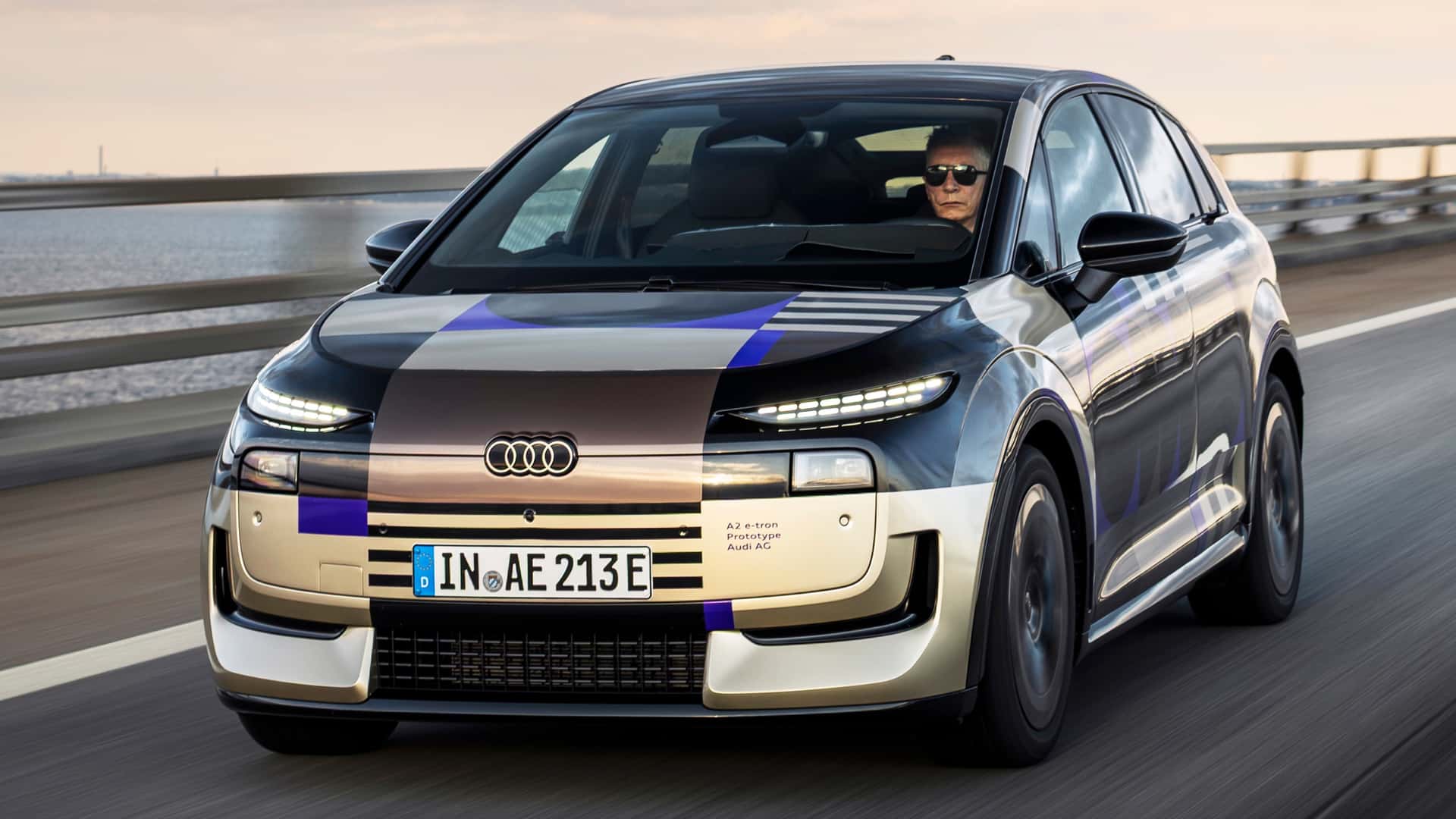
- The new Audi A2 E-Tron is a sister model of the Volkswagen ID.3 Neo.
- The single-motor, rear-wheel-drive hatchback gets a 61-kWh battery.
- Audi estimates an energy consumption of 12.8 kWh / 62 miles (100 kilometers).
One of many uber-expensive pet projects of the late Ferdinand Piëch, the original Audi A2 was a spectacular commercial failure. The overengineered hatchback, with its aluminum body and thrifty diesel engine, ended up being too costly to produce, reportedly causing the company to lose thousands of euros on every car it sold. Demand fell far short of what Ingolstadt had projected, cutting the quirky hatchback’s life cycle to just five years, during which only 176,377 cars were sold.
Now, the A2 is coming back. A far cry from its ill-fated predecessor, the moniker returns for a rear-wheel-drive EV billed as the “most efficient Audi of all time.” The Volkswagen Group has learned its lesson, and rather than developing the new electric hatchback from the ground up, it’s using the recently launched VW ID.3 Neo as its foundation. Not only does that save money, but it also shortens development time, bringing the car to market much sooner.
Audi says it has gone the extra mile to make the A2 E-Tron an efficiency champion, just like the model before it, with energy consumption estimated at a remarkably low 12.8 kWh/62 miles (100 kilometers). With a drag coefficient of 0.24, it has the most slippery body among the company’s smallest cars. However, that Cd figure is possible only when the vehicle is equipped with an optional efficiency package.
Photo by: Audi
Aero Tweaks Cut Energy Consumption By 0.9 kWh/100 km
A diagram of the A2 E-Tron’s fully enclosed underside reveals plenty of aero trickery, ranging from a front-wheel deflector to multiple spoilers at both axles. There are also so-called gap reducers and gap breathers ahead of and behind the wheels to reduce air turbulence around the wheel arches. Although there isn’t a conventional grille, a generous air inlet shutter opens when extra cooling is necessary for the battery and electronics. That can happen on a hot summer day, during hard acceleration, or while the vehicle is charging.
Speaking of the battery, the new A2 gets a 61-kWh lithium-iron phosphate (LFP) pack. It feeds juice to a rear-mounted electric motor producing 188 horsepower. Although Audi doesn’t explicitly say so, chances are there will be other versions available. For example, the ID.3 Neo also comes in lesser and more powerful flavors with 168 and 228 hp.
400+ Miles Of Range?
Although the range hasn’t been mentioned, the LFP battery can be “routinely charged to 100 percent” to get the most out of it without worrying about battery degradation. It’s reasonable to assume the A2 E-Tron will at least match the driving range of the ID.3 Neo, which goes 391 miles (630 kilometers) on a single charge in the WLTP cycle with its larger 79-kWh battery. Given how Audi’s engineers have burned the midnight oil to improve efficiency, the new A2 might even crack the 400-mile barrier, provided it gets a bigger battery than the 61-kWh pack confirmed so far.
The funky camouflage, which doesn’t hide much, to be honest, will come off this fall. The A2 E-Tron will serve as Audi’s smallest and most affordable EV when it goes on sale in Europe before the end of the year or early 2027.


38
Source: Audi
Motor1’s Take: The Audi A2 E-Tron is shaping up to be an interesting little electric hatchback with retro design cues harking back to the original, complete with a split rear window. It’s bound to be more than just a VW ID.3 Neo clone, as the styling is different enough and there are skin-deep changes to maximize efficiency.
We’re just glad it’s not another crossover. We have enough of those as it is.
Read the full article here