





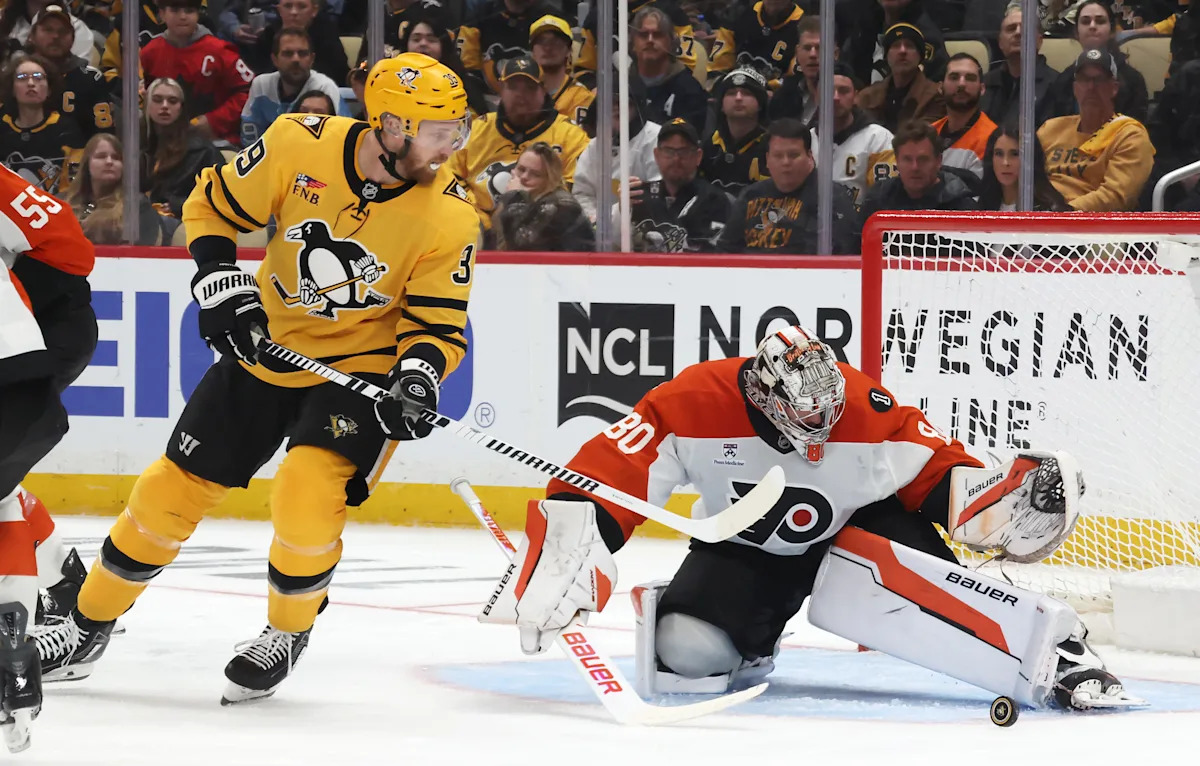
There is not any one player or person that is responsible for the Pittsburgh Penguins 3-0 series deficit. It has been a well-earned, collective group effort that everybody has to own. The Penguins have allowed themselves to get suckered into Philadelphia’s game, there is little discipline, they are not in any way adapting to what the Flyers are doing defensively, and Dan Muse has not exactly covered himself in glory in his first big moment on the big stage.
But of all the players that have come up small in this series so far, Anthony Mantha might be one of the most obvious.
Advertisement
It might also be making whatever decision the Penguins have to make with him this summer a lot easier for them.
Coming into the playoffs, Sportsnet’s Elliotte Friedman made mention that Mantha might be one of the most watched players in these playoffs (and that almost certainly includes the Penguins), and it’s not hard to understand why there would be so much interest in him.
He led the team with 33 goals and put together a career year.
He is an unrestricted free agent this summer and is going to be one of the top players available, at least in terms of production this season, in a painfully shallow pool of players.
Advertisement
A big postseason showing, on the heels of that regular season performance, would have certainly opened some eyes across the league. It would have also opened checkbooks.
While you shouldn’t let small sample sizes drive your team-building decisions, the harsh reality is teams put a lot of weight on what you do in the playoffs. Or sometimes what you do not do in the playoffs.
And the latter point is what is going to be the problem for Mantha.
He entered this year’s postseason having scored 0 goals in 14 career playoff games.
He has now played 17 career playoff games and is still stuck on zero goals, while being a complete non-factor in the first three games of the series.
Advertisement
Making matters worse, he took one of the costliest — and most easily avoidable — penalties in recent Penguins playoff history when he inexplicably launched the puck from the defensive zone into the stands over the team’s bench. It was not only a bad penalty to take just because it is such an avoidable play, but also because of the timing. There were only eight minutes remaining in the game. The Penguins were still trailing by a goal, had just scored to make it a one-goal game, and were starting to tilt the ice a little bit. There was some momentum building.
And then it was gone.
And then Philadelphia responded with a power play goal to put the game, and maybe the series, back out of reach.
Given the context of the entire situation, it was just a brutal play.
Advertisement
Mantha was never meant to be a long-term answer for the Penguins when they signed him this past offseason. The plan was almost certainly for him to get put somewhere in the top-six, build up his value by chipping in some goals for a rebuilding team, and then get dealt at the trade deadline for a second-round pick. But both he and the Penguins threw a wrench into that plan. The Penguins by being better than expected and making the playoffs, and Mantha by being their top goal-scorer, with several of them coming in big moments.
As the Penguins inched closer to a playoff spot, and he kept producing, there was no chance they were going to move him in-season.
That eventually led to discussion of a possible extension, especially given the lack of quality free agents on the open market and the amount of salary cap space the Penguins have available to them.
But it’s hard to imagine this performance is making anybody in the Penguins front office excited about the idea of re-investing him, especially given the way this series has played out. It’s almost certainly hurting his standing in the eyes of fans.
Advertisement
Is that a valid response to a three game sample size?
Or is it an overreaction given how good the season as a whole went?
Maybe a little of both. But at some point the Penguins do need to find a way to get younger and faster, and a 32-year-old winger with an injury history that’s been a non-factor in the playoffs, and is probably unlikely to repeat his regular season performance, doesn’t seem to be the way to do that.
I don’t blame the Penguins for not trading him in March, and I am not going to criticize them for that decision. Given the way the season played out and the way expectations changed, it was the right move. The initial signing itself has also been an obvious win. But it might be best to just leave it at that. The tough decision they had this summer is not looking as tough as it did a couple of weeks ago.
Read the full article here