






Now that the Philadelphia Flyers have finally completed their most important piece of offseason business, they have the clearest picture yet of what they can and cannot do going forward in terms of improving the roster.
On Wednesday night, forward Trevor Zegras finally signed his highly anticipated contract extension with the Flyers, agreeing to a four-year, $36.5 million deal worth $9.125 million annually.
Advertisement
The Flyers give Zegras a pretty good chunk of change for a more modest term than many had expected and/or hoped for, but the 25-year-old top-six forward will remain in Philadelphia until 2030 nonetheless.
At the time of this writing, the Flyers still need to re-sign defenseman Jamie Drysdale, forward Nikita Grebenkin, and prospect Hunter McDonald–all of whom are restricted free agents.
Drysdale, who, like Zegras, filed for arbitration, is set to have his case go before an arbitrator on Monday, though the expectation is that a deal with the Flyers will be struck before then.
Accounting for Zegras, now the Flyers’ highest-paid player on a per-season basis, the Flyers have $20.44 million in cap space to fit in Drysdale, Grebenkin, and McDonald, according to PuckPedia.
Advertisement
PuckPedia also has top center prospect Jett Luchanko on the Flyers’ NHL roster, so, provided he starts the season in the AHL as general manager Danny Briere expects, that will add another $941k to the table.
Flyers Should Lure Alexander Nikishin Away From Hurricanes with Matvei Michkov’s Help
Flyers Should Lure Alexander Nikishin Away From Hurricanes with Matvei Michkov’s Help Defenseman Alexander Nikishin is the perfect trade target for the Philadelphia Flyers this late into the offseason.
With Drysdale, reports have indicated that the former Anaheim Ducks rearguard will sign a shorter-term deal, similar to Zegras, with a cap hit expected to be in the range of Travis Sanheim’s $6.25 million, which would either tie him with Sanheim, or make him the highest-paid defenseman on the roster outright.
Advertisement
McDonald, 24, figures to sign a one- or two-year deal cheap enough that, when assigned to the AHL, won’t count against the NHL salary cap at all.
Grebenkin’s situation is a bit trickier to figure out, knowing that he is coming off a season-ending injury and still rehabbing with the Flyers while he awaits a new contract.
The 23-year-old Russian was arguably the team’s best fourth-liner last season before the injury and a slew of lineup changes.
Injury or not, once Sean Couturier, Luke Glendening, and Garnet Hathaway found their mojo together, Grebenkin wasn’t getting back into the lineup, for better or for worse.
Advertisement
Hathaway is gone now, though, and Glendening’s place has been presumably taken by free agent addition Noel Acciari.
Briere still views Grebenkin as a valuable bottom-six piece for the future, especially as someone well-liked in the team’s locker room.
An uneven but promising first full season in the NHL should see Grebenkin get another crack at sticking in the big leagues on a one- or two-year deal worth between $1 million and $2 million annually.
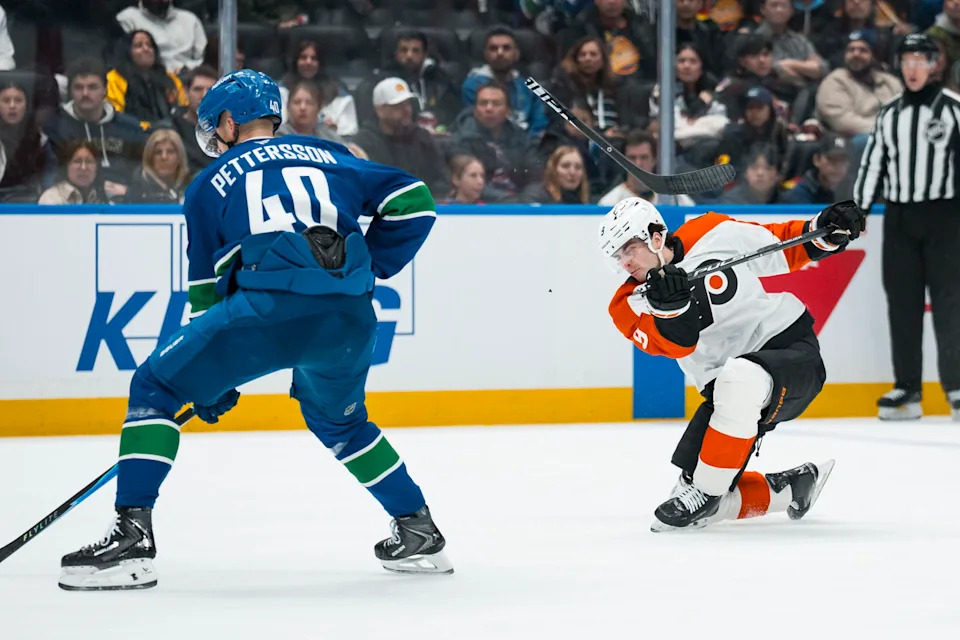
All Roads in Flyers’ Bid for No. 1 Center Point Back to Elias Pettersson
All Roads in Flyers’ Bid for No. 1 Center Point Back to Elias Pettersson At some point, the Philadelphia Flyers may have to make an uncomfortable trade for dimming Vancouver Canucks star Elias Pettersson.
Advertisement
Assuming that Grebenkin gets $1.25 million and Drysdale gets $6.25 million, the Flyers will be allocating $7.5 million to those two players, leaving them with $12.94 million in cap space to operate with after the big Zegras deal.
That, of course, would not have been enough to fit the $18 million cap hit they gave to Leo Carlsson, but it’s water under the bridge now.
What this does tell us, though, is that the Flyers are not considering another blockbuster offer sheet of the like at this time, if for no reason other than they cannot reasonably afford it.
To create the requisite cap space, they could always trade Rasmus Ristolainen and his $5.1 million cap hit to one of several interested teams, but those teams would also be aware that the Flyers need to shed his cap hit, destroying all leverage from Philadelphia’s side.
Advertisement
The 2026 NHL free agency market remains very thin at all three positions, though the Flyers may want to insure themselves going forward with a power play quarterback, such as San Jose’s John Klingberg.
In any case, regardless of what they want to do to add to the team, the Flyers still have a large chunk of cap space to work with.
Read the full article here