




Through the Class of 2026, 70 people have reached the ultimate honor of being inducted into the NASCAR Hall of Fame.
Even more have been nominated since the inaugural class in 2010, representing an expansive cross-section of stock-car racing’s best, spanning from the sport’s humble roots through today’s Hollywood-level glory.
Advertisement
MORE: Cast your vote for the Hall of Fame Class of 2027
All who have been fortunate enough to land on the ballot have a case to be deservedly enshrined in the NASCAR Hall of Fame.
But what about the names that are not currently on the list? Here are five people worthy of consideration to be on the ballot for the NASCAR Hall of Fame in future years, people who deserve to be in the conversation for enshrinement thanks to their unique and historic contributions to NASCAR racing.
Smokey Yunick
Smokey Yunick works on a Chevrolet in 1965.
Smokey Yunick is one of the most innovative minds that has ever walked through the NASCAR garage. Legends of his ability to work around the guidelines of the NASCAR Rule Book in the sport’s earliest decades glimmer with lore, from tales of extended fuel lines to extreme chassis modifications to tricked-up oil lines and more.
Advertisement
A two-time Cup champion as crew chief for Herb Thomas in 1951 and 1953, Yunick was a staple of NASCAR’s early years. The Pennsylvania native won the 1961 Daytona 500 as crew chief for Marvin Panch and again one year later with driver Fireball Roberts and car owner Jim Stephens. A car owner, mechanic and shot-caller throughout his career, Yunick was also victorious twice in Darlington Raceway’s Southern 500, winning in 1951 and 1955 while working with Thomas. The 1955 win marked Chevrolet‘s first speedway victory ever.
There’s a common saying in motorsports: “If you ain’t cheating, you ain’t trying.” No one seemed to personify that more than Yunick.
“If you’re an innovator, and you’re a smart guy like Smokey was, and there is no rule, is there really a gray area?” Hall of Famer Ray Evernham said in a 2016 documentary. “He made (NASCAR) write rules.”
Naturally, the sanctioning body didn’t take kindly to some of Yunick’s advanced methods of creativity. Officials were tasked with surveying cars within the spectrum of the rule book. But Yunick knew what the rule book said, and more importantly, what it didn’t say. That created tension between Yunick and NASCAR’s top brass.
Advertisement
Twenty-five years since his passing in 2001 — and nearly 50 since his last entry as a Cup owner in 1969 with Charlie Glotzbach — opinions are still split on whether Yunick deserves consideration for the NASCAR Hall of Fame.
“Sometimes — and I’m just going to be blunt — legend is not reality. Myth is not fact,” Hall of Fame voter Kyle Petty said May 12 at the NASCAR Productions Facility. “All the B.S. stories you hear about Smokey doesn’t mean every one of them is a fact. If it was, then Paul Bunyan should be in the freaking Loggers Hall of Fame, right? It’s a myth. Some of this stuff’s myth, and you got to call it out when it’s a myth. I can’t help that the general public has bought it hook, line and sinker. But if you talk to people that actually knew the guy, that actually raced against the guy, then he’s right where he should be. He should be part of the conversation, but not the focal point.”
Dale Jarrett, another Hall of Fame voter, told NASCAR.com he sees no reason why Yunick should be excluded from the ballot.
“When you talk about names at the beginning of this sport that made a difference, I do not understand,” Jarrett said. “Were some of the things that he did outrageous to the point that (they were) probably not legal? We could say that about everybody in this sport. That’s a lot of people that are in that Hall of Fame and others that are being talked about. It was just skirting the rules as much as they could. But with his reputation, I think he was scrutinized more than others maybe, and so maybe some other people were getting away with stuff because they didn’t have the reputation that that’s how they did things. But that wasn’t the only way that he made his race cars go fast. And I just don’t understand why someone of this importance, a name like this, that he’s not on the ballot and why he shouldn’t go into this Hall of Fame, personally.”
Advertisement
The time seems appropriate to recognize Yunick’s innovation as ingenuity that drove NASCAR toward the future by at least including his name on the ballot for discussion.
Jimmy Makar

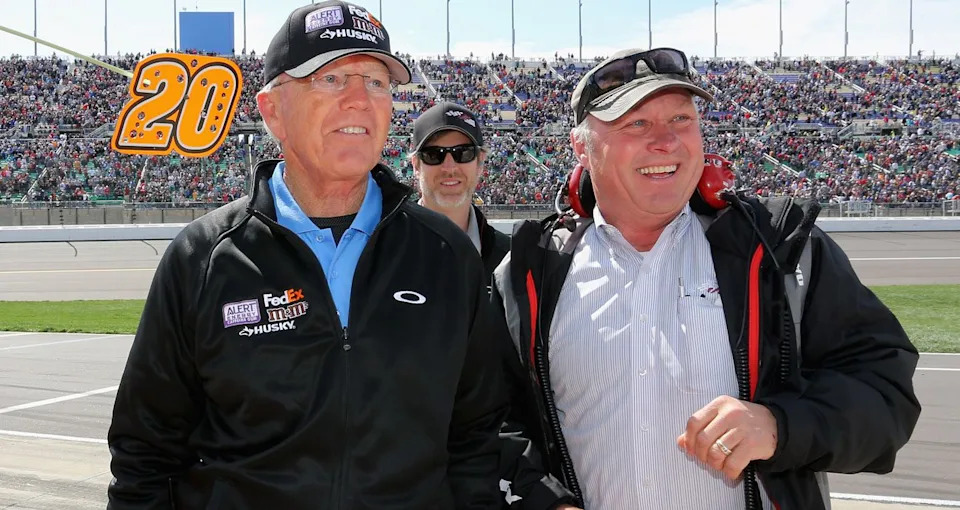
Joe Gibbs, left, and Jimmy Makar celebrate a win at Kansas in 2013.
For more than three decades, Joe Gibbs Racing has been a powerhouse team in the NASCAR Cup Series. That success is in large part thanks to Makar.
Makar was the guiding hand at JGR for decades, from its inception before the 1992 season through 2022 as Senior Vice President of Racing Operations. Dale Jarrett, JGR’s inaugural driver, was adamant before signing his contract with Gibbs that Makar’s addition was mandatory. There is an admitted obvious bias: Makar is Jarrett’s brother-in-law and is married to Jarrett’s sister, Patti. But Jarrett knew Makar’s supervision and hands-on method to building the organization was imperative if JGR was going to be successful long-term.
Advertisement
“Jimmy made every hire to start Joe Gibbs Racing,” Jarrett said. “Everyone that was there was because of Jimmy Makar.”
Jarrett was driving for Wood Brothers Racing in 1991 when Gibbs approached him with an opportunity to drive the No. 18 car in 1992. The team had sponsorship from Interstate Batteries, but Jarrett needed to be sure whoever was tasked with building JGR was reliable, dedicated and knowledgeable about what a successful race team looked like.
“And so I said, I will do this 100% for sure, if you can hire Jimmy Makar as the crew chief and the person to get this started,” Jarrett recalled to NASCAR.com. “And Jimmy’s name had come up before, just as we talked about a different people, and I brought Jimmy’s name up at that time. But now I was was making a request and demand that this is who they go hire. And to be quite honest, I think Joe Gibbs would tell you the same thing that it was — to this day — the most important hiring of Joe Gibbs Racing.”
The resulting success has firmly established JGR has one of NASCAR’s winningest teams. From 1992 through 2022, JGR collected 200 Cup Series wins and 194 O’Reilly Auto Parts Series victories, along with five Cup titles and four drivers’ championships in the O’Reilly Series. That list of wins includes four Daytona 500s, seven Coca-Cola 600s at Charlotte, five Brickyard 400s at Indianapolis and nine Southern 500s at Darlington.
Advertisement
The NASCAR Hall of Fame is a sacred Hall to enshrine those who have left lasting impacts and legacies in this sport. Makar’s contributions to one of the sport’s winningest organizations deserve to be in the conversation for a position in the NASCAR Hall of Fame.
Mike Trower
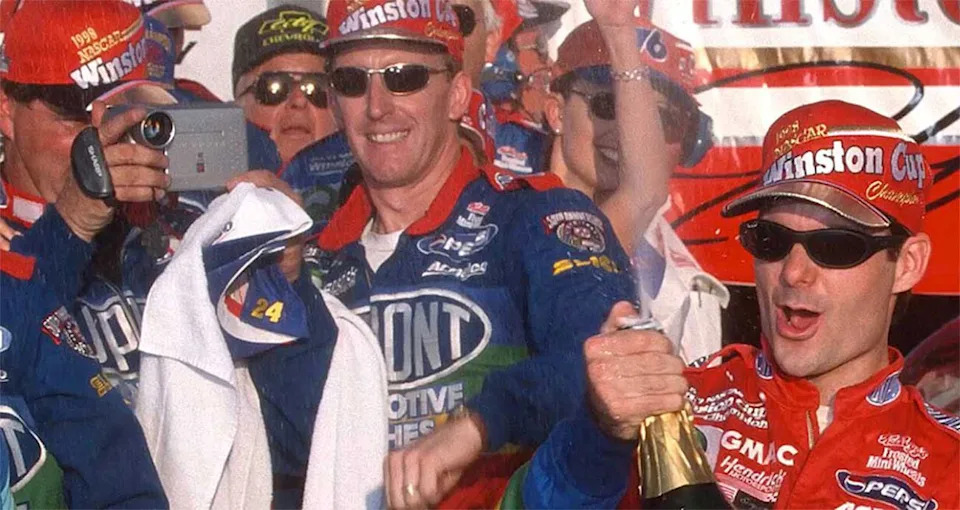
Mike Trower, center, celebrates with Jeff Gordon.
Trower’s name may be least recognized in this list of five, but his accomplishments as one of NASCAR’s foremost pioneers of modern pit-road performance should place him in consideration for a spot on the ballot.
Trower contributed to a whopping 73 Cup Series wins as a tire changer for some of the sport’s finest drivers and Hall of Famers, collecting nine wins with Jarrett, 15 with seven-time series champion Jimmie Johnson and 49 with four-time champ Jeff Gordon.
Advertisement
His legitimacy for candidacy consideration is perhaps best verbalized by NASCAR.com’s Zack Albert, himself a Hall of Fame voter: “Trower‘s name might not come first when reflecting on stock-car stardom, but for those who know, his track record and longevity as one of NASCAR‘s top tire changers during a revolutionary era in pit-stop performance have made him a legend.”
RELATED: The Legend of Mike Trower
Trower’s success sparked as an original member of Hendrick Motorsports’ No. 24 Rainbow Warriors on Gordon’s Chevrolet. What followed were five Cup championships, four Daytona 500 victories and a win in the inaugural Brickyard 400, among other accomplishments. But what separates him from any other successful pit-crew member?
Through the guidance of NASCAR’s first pit-crew coach, Andy Papathanassiou, Trower’s relentless work ethic, training and coachability refined him into an elite talent that not only produced success but longevity. Like the Wood Brothers’ led crews before him, Trower’s work on pit road pioneered a new era of speed in a stop, helping launch his drivers into race-winning contention on a regular basis.
Advertisement
Trower was led by No. 24 crew chief Ray Evernham at Hendrick, departed for Robert Yates Racing with Jarrett, then eventually worked back to Hendrick with Chad Knaus on the No. 48 team. The thread that tied it all together was Trower’s leadership in setting the standard.
“Mike was, in his day, one of the best, if not certainly the best, on pit road,” Evernham said in a 2024 interview. “Mike was good, he was steady, he was fast and he just didn‘t make mistakes. When he came to the 24 car, that immediately set the bar for what everybody else had to do. You had to keep up with Mike. The jack man, the rear-tire guy, the tire handler — Mike was our target.”
No pit-crew member has ever been placed on the Hall of Fame ballot — at least not one whose sole job was pitting a race car. If there was one who deserves to be in the conversation from the sport’s transition into today’s lightning-quick stops, Trower tops the list.
Sam Ard
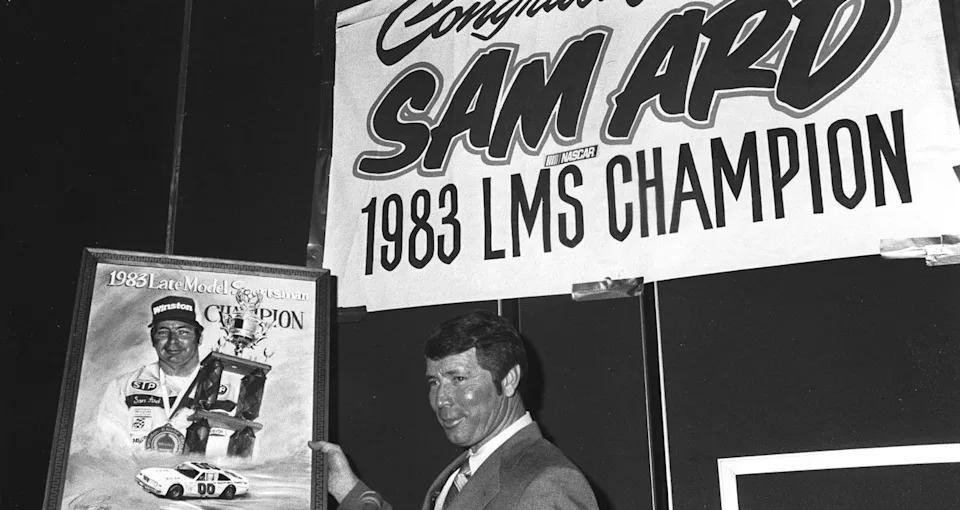
Sam Ard celebrates his 1983 championship in the series now known as the NASCAR O
Unlike the three names listed above, Ard has previously found himself on the NASCAR Hall of Fame ballot. But in each of the past two years, Ard’s name has been absent from the list.
Advertisement
Ard was a pioneer in what is today known as the NASCAR O’Reilly Auto Parts Series. A native of South Carolina, Ard was legend in Late Model Sportsman racing throughout the Southeast. And when the O’Reilly Series went national in 1982 — then known as the NASCAR Budweiser Late Model Sportsman Series — two names dominated the domain: Hall of Famer Jack Ingram and Ard.
Ingram, the series’ inaugural champion, was inducted into the Hall in 2014 with 31 series wins and two titles to his name, those championships separated by two runner-up results in 1983 and 1984. The man standing between Ingram and four straight titles? Sam Ard.
In just three seasons — 92 starts — of O’Reilly racing, Ard collected a remarkable 22 victories, 67 top fives and 79 top 10s to pair with 24 pole positions. He may have lost the inaugural series title to Ingram in 1982, but he trailed Ingram at season’s end by just 47 points as the runner-up. Tommy Houston, in third, was 622 points behind Ingram.
RELATED: Why Ard received Albert’s 2024 vote
Those 92 starts — limited to that number due to a career-ending injury in 1984 — created records that still resonate nearly 45 years after the series’ inception. Ard won 10 races in 1983, the only driver to score that many victories in a single season until Kyle Busch matched the feat in 2008 and 2016, and bested it in 2010 (13 wins) and 2013 (12).
Advertisement
The identity of the series has changed significantly throughout its 44 completed seasons, from regional, blue-collar short-track aces reaching a national stage to today’s highly sought-after second-series as proving ground for up-and-coming talent. But the story of today’s NASCAR O’Reilly Auto Parts Series cannot be told without the legend of Sam Ard.
John Holman
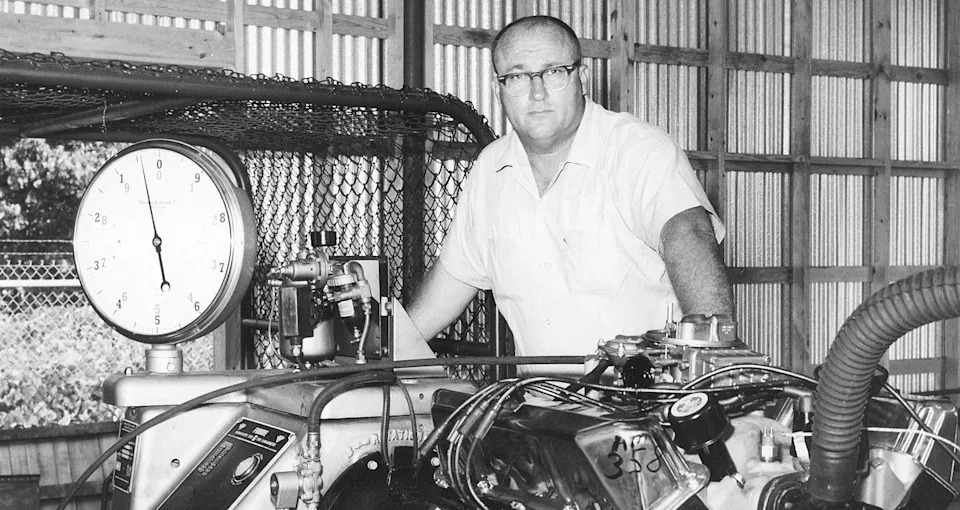
John Holman poses with a motor in 1950.
Holman, like Ard, has appeared on the ballot previously in 2019 and 2020. And like Ard, Holman’s name is forever tied to another Hall of Famer: 2025 inductee Ralph Moody.
Holman-Moody Racing, formed in 1957, was a stalwart in NASCAR’s early years, winning 96 races over its storied history, including Daytona 500 championships with Hall of Famer Fred Lorenzen (1965) and racing legend Mario Andretti (1967). David Pearson, second in all-time wins in the NASCAR Cup Series, collected 30 of his 105 career victories and two Cup championships driving Holman-Moody Fords.
Advertisement
What separated Holman from Moody was Holman’s business acumen. Holman oversaw the business end of the company while Moody was the team’s mechanical mind. The general area of Charlotte, North Carolina, became a hub for NASCAR teams because of Holman’s lasting legacy, with Holman establishing the team’s race shop near Charlotte Douglas International Airport to allows parts to be flown in daily.
Holman was a mastermind of both business and engineering, combining his expertise into Moody’s excellence as a builder that led to historic success, with wins for Hall of Famers like Pearson, Lorenzen, Curtis Turner, Joe Weatherly, Fireball Roberts and Bobby Allison from 1958 through 1971.
If Moody is enshrined in the Hall — as he most certainly deserves to be — then Holman deserves a place in the conversation to remain on the ballot.
Contributing: Ken Martin, Director of NASCAR’s Historical Content
Read the full article here