





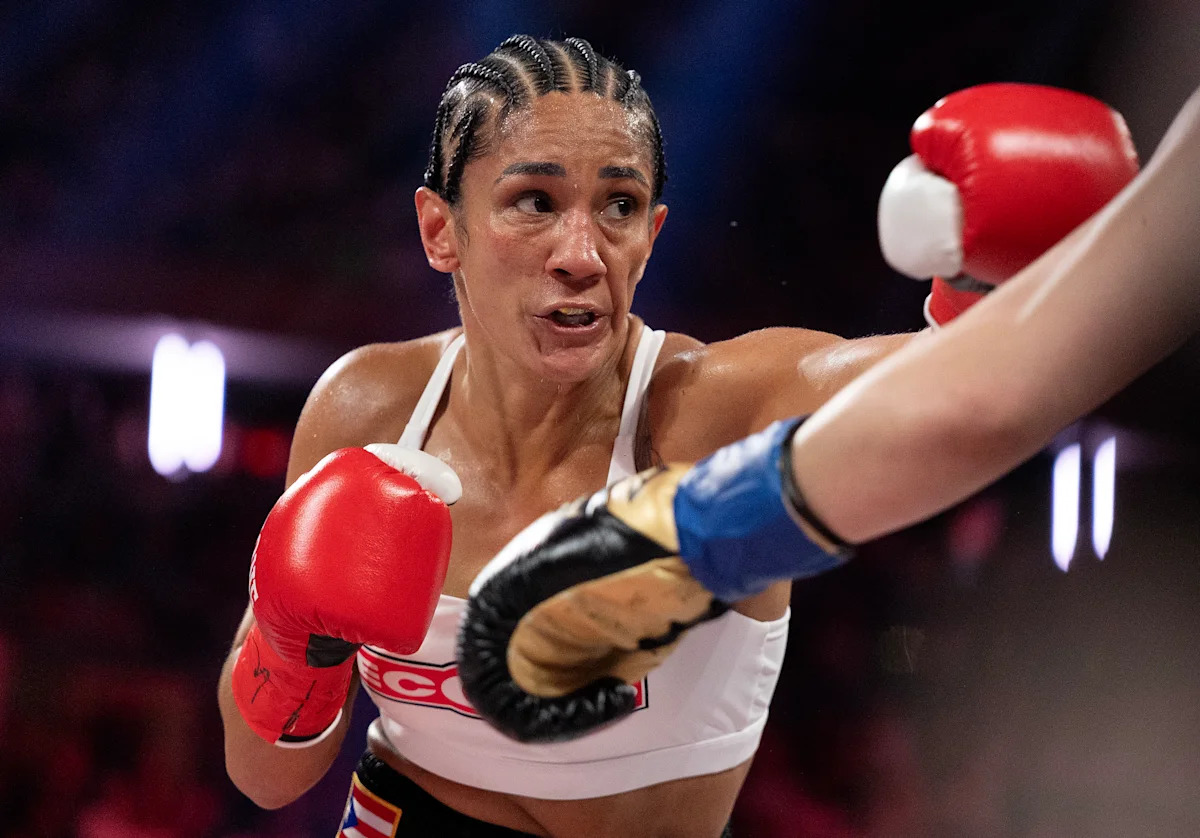
Katie Taylor will have her swan song in front of 80,000 adoring Irish fans at Croke Park next month. Her biggest rival, Amanda Serrano, recently admitted 2026 may be her last year in the sport. And the other established superstar of women’s boxing, Claressa Shields, is planning to take some time off after her win over Kaye Scott this past Saturday and start a family in 2027.
Women’s boxing is approaching a defining transition. At some point next year, it could find itself without its three biggest stars.
Advertisement
Taylor and Serrano spent years breaking down barriers. The Irishwoman was instrumental in the campaign that brought women’s boxing into the Olympics in 2012. Serrano was the first fighter to sign with Jake Paul’s Most Valuable Promotions, which has revolutionized the business of women’s boxing. The iconic duo then generated the first million-dollar gate for a women’s headliner when their April 2022 instant classic topped the bill at Madison Square Garden.
The rematch, Taylor vs. Serrano 2, brought women’s boxing to tens of millions of viewers on Netflix as the co-feature to Jake Paul vs. Mike Tyson. It was so good that Netflix welcomed them back for a trilogy on their own show eight months later.
Katie Taylor and Amanda Serrano have defined a golden era for women’s boxing.
(Al Bello via Getty Images)
It’s been nothing short of a golden era for women’s boxing. Taylor and Serrano proved that the sport could become a major commercial attraction. The question now is whether they created a lasting audience for everyone — or primarily an audience for themselves.
Advertisement
So, as Serrano heads into her title defense Friday against Lucrecia Manzur, and the era she helped herald nears its end, let’s examine five big questions facing women’s boxing.
1. Who can become women’s boxing’s next crossover stars?
A sport is only as big as the stars within it.
With Taylor and Serrano’s storied careers coming to an end, Shields will instantly become the face of women’s boxing whenever she elects to return to the sport. But who can join her? And will they be able to fill the void Taylor and Serrano leave behind?
On the men’s side of the sport, questions have emerged over whether the new era of boxing stars will cross over to the mainstream in the same way the current ones have. In Britain, Anthony Joshua and Tyson Fury aren’t just boxing superstars — they are household names. It is difficult to imagine anyone replacing that level of stardom.
Advertisement
The leading candidates to follow in Taylor and Serrano’s footsteps on the women’s side include Gabriela Fundora, Caroline Dubois and Alycia Baumgardner.
A two-time Fighter of the Year for Uncrowned, Fundora is already an undisputed champion and, at just 24, will almost certainly be at the top level of the sport for many years to come. Whether she’ll be able to cross over into the mainstream while competing at flyweight and having shown little personality outside of the ring remains to be seen.

Gabriela Fundora has been unstoppable thus far in her professional run.
(Cris Esqueda/Golden Boy via Getty Images)
Baumgardner already has the boost of multiple Netflix slots. She was an undisputed champion and is clearly marketable. She also competes in weight divisions — super featherweight and, perhaps soon, lightweight — where bigger-name opposition is available. But she is 32, so the clock is ticking on the time she has to complete her ascent.
Advertisement
Dubois is 25, the sister of WBO heavyweight champion Daniel Dubois, and one of the leading pound-for-pound fighters in women’s boxing. She has built a UK profile on Sky Sports and can continue to build on that platform — and ESPN stateside — through her alignment with MVP. Dubois may be in prime position to stand alongside Shields as a face of women’s boxing.
Shields can carry the sport in the short term, while Fundora, Baumgardner, Dubois and others build distinct audiences of their own. But Taylor and Serrano did not build crossover fame through dominance alone; they needed each other.
Finding the next generation of stars will therefore mean little unless women’s boxing can also find opponents and rivalries capable of elevating them.
2. Who are the next stars supposed to fight — and where will the next great rivalry come from?
Bouncing off our previous point, Taylor’s first fight with Serrano transformed her from a fighter with a profile in the sport into a genuine crossover attraction. Their subsequent rematches and Taylor’s two-fight series with Chantelle Cameron cemented that status.
Advertisement
Taylor vs. Serrano was the first big trilogy of fights in women’s boxing history. Serrano may have gone 0-3 in that rivalry, but she left it with a substantially bigger profile and the legacy of being involved in two Fight of the Year candidates.
Shields, on the other hand, has struggled to find big-name dance partners. Her rivalry with Savannah Marshall was the biggest of her career, and it did wonders for her, but nothing of comparable significance has emerged since. The problem for Shields is there simply aren’t enough accomplished fighters from middleweight through heavyweight. Marshall was a credible foe because of their shared amateur history, professional achievements and contrasting personalities, but once Shields defeated her, there was no obvious successor. Shields has moved through the divisions and collected titles, yet those titles have often been easier to find than opponents capable of producing major events.
Shields now has potential rivals in Lauren Price and Mikaela Mayer who could help produce major events, but it’ll require Price and Mayer to jump up in weight.
As a flyweight, Fundora will also struggle with being involved in the kind of matchups that appeal to a mass audience. There are no obvious opponents between minimumweight and bantamweight — the two divisions on either side of her — that would represent major events. Thus, she may have to pick up belts and move through the weights before a big-name rival emerges.
Advertisement
As for Dubois and Baumgardner, they have to look no further than each other. The pair are just one division apart and have already engaged in a prolonged war of words. Baumgardner-Dubois may never reach the heights of Taylor-Serrano, but it is the kind of rivalry that could leave women’s boxing with its next bona fide star.

Alycia Baumgardner, above, and Caroline Dubois appear to have all the makings of women’s boxing’s next great rivalry.
(Carmen Mandato via Getty Images)
3. Does standing on its own benefit or hurt women’s boxing?
Women’s boxing remains isolated from the natural boxing mix.
MVP’s roster is almost entirely filled with women. MVP shows on ESPN and Sky Sports feature few men’s fights, while DAZN — which broadcasts the majority of the big shows headlined by male fighters — doesn’t show much women’s boxing.
Advertisement
Making all-women’s cards the default isn’t necessarily the best way to build fighters. Take Katie Taylor as an example. Would Taylor have built the same profile if she hadn’t been featured on so many Anthony Joshua and Dillian Whyte pay-per-view undercards in the UK and eventually on Joshua-Ruiz 1 at Madison Square Garden? Allowing women’s boxing to stand alongside the more popular men’s game lets viewers discover it naturally and become fans of fighters they are exposed to.
With women’s fights dominating the top end of MVP cards, the product risks being limited to an audience that already has an interest in it, although its distribution through ESPN and Sky Sports won’t hurt it in its bid to attract new fans. Women’s boxing may, however, be better served as part of big-fight broadcasts, such as Ryan Garcia vs. Conor Benn and Anthony Joshua vs. Tyson Fury, to help grow its audience.
All-women’s cards give fighters greater attention and demonstrate they are capable of cultivating an audience, but it shouldn’t be the default model for women’s boxing. The priority should be placing women on the sport’s biggest broadcasts, where they can compete alongside the men and reach the widest possible audience.

Jake Paul’s MVP has consistently brought women’s boxing to the mainstream.
(PATRICK T. FALLON via Getty Images)
The biggest difference in women’s boxing over the last couple years has been MVP’s emergence and subsequent dominance. But has it been a net positive?
Advertisement
With MVP being such a large force, promoters like Top Rank, Golden Boy, PBC and Queensberry today carry virtually no women’s fighters in their rosters. Matchroom was previously the dominant force in women’s boxing, but it has also stepped back in recent years, and the few fighters it does have left will probably end up in co-promotional deals with MVP due to the two companies’ recent partnership.
Broader investment would give women fighters more dates, expose them to audiences across several platforms, and create competition for their services.
Any monopoly — or near enough — carries obvious risks in combat sports. Much of the criticism of the UFC is that its enormous market share allows it to pay fighters a far smaller share of revenue than athletes receive in other major sports while exercising overwhelming control over their careers.
As of now, though, there has been no suggestion that MVP has exploited its market position in the same way. It has been paying fighters more than they would’ve received with other promoters. But as it builds its brand and continues to control the space, will the purse strings eventually tighten?
Advertisement
The women’s talent pool in boxing is vastly smaller than the men’s. Concentrating most of its leading fighters under one promotional banner has therefore made the biggest matchups easier to produce. For instance, MVP controls all four belts at lightweight. It has already staged one unification fight in the division — Dubois vs. Terri Harper — and will likely make others soon.

Caroline Dubois and Terri Harper shake hands after their WBC and WBO lightweight title unification.
(Richard Pelham via Getty Images)
Possessing talent and making fights do not necessarily create compelling rivalries and major events, though. Let us not forget that the first Taylor-Serrano fight was largely built by their respective promoters, Eddie Hearn and Jake Paul, and the rivalry between them. DAZN also partnered with WWE to generate publicity for the event. On that occasion, competing promoters and major media machines collaborated to create a groundbreaking show. That cooperation was one reason the event became so big.
Women’s boxing doesn’t need MVP to become less powerful. It needs other promoters and broadcasters to invest in the sport, create some competition, and still be willing to collaborate on the biggest fights, which brings me nicely onto my next question.
Advertisement
5. How will Zuffa Boxing’s entry affect the landscape — and can it challenge MVP’s dominance?
Zuffa Boxing will inevitably make a play in women’s boxing.
Its co-owner, TKO Group, doesn’t just dominate the men’s side of MMA and professional wrestling via the UFC and WWE, but the women’s game as well, and it is expected to have the same goals in boxing.
TKO has a history of creating female combat stars. From Ronda Rousey and Amanda Nunes to Rhea Ripley and Becky Lynch, there is no doubt TKO knows how to make its athletes major attractions. And with the cross-promotion available via the TKO machine, alongside Paramount’s distribution juggernaut, it could deliver the same in boxing.

TKO has a proven track record of creating female stars.
(Icon Sportswire via Getty Images)
Of course, it’ll be challenging for Zuffa to become a major player in the women’s game initially because of how strong a force MVP is. There aren’t enough fighters in women’s boxing for Zuffa to run the league-type model it wishes to operate if MVP coexists and remains the leading force in the space. Zuffa would need to attack MVP’s stronghold and dislodge it as the leading destination for female fighters to assemble enough talent — an expensive undertaking.
Advertisement
Zuffa Boxing has already departed from TKO’s preferred business model by using funding from Saudi Arabia’s Sela to give its top male boxers above-market-value offers. It will have to do the same with the top women to make a dent. But how keen are the Saudis on women’s boxing? It certainly hasn’t been a prominent feature on Riyadh Season events or Turki Alalshikh’s Ring shows. Zuffa’s initial entrance into the sport has similarly involved almost no female participation.
Zuffa may ultimately sign some fighters away from MVP, and that doesn’t have to be a bad thing. But Zuffa’s dismissive attitude toward working with other promoters risks dividing women’s boxing’s limited talent pool between two closed rosters. That would only worsen the existing difficulty emerging stars face in finding marquee opponents.
Zuffa’s involvement should be welcomed. A closed Zuffa ecosystem that separates its fighters from MVP’s roster, however, will not be.
Read the full article here