




Long before Geoff Ogilvy was a U.S. Open champion, long before he became one of the world’s best golfers, and long before his name became attached to some of the world’s most famous golf courses, he was just an Australian boy in Melbourne, Victoria, who loved golf.
Ogilvy grew up in a remarkable place to love the game. He spent his formative years at Sandringham Golf Club, known locally as “Sandy,” later joining Victoria Golf Club and caddying at famed Royal Melbourne, which was a 5-iron to the boundary of his childhood home. He wasn’t lugging a bag so much for the money but more for the playing privileges. Every afternoon at 4:30, caddies could go out onto Royal Melbourne’s East Course. His mother would drop him off minutes before the appointed time so he could be one of the first players out. Within a couple of miles were hundreds of acres of some of the finest golf courses in the heart of the Melbourne Sandbelt.
Advertisement
“It’s like somebody said, where is the perfect place in the world to build great golf courses, and all these clubs found it accidentally,” Ogilvy said.
OCM created the fun-packed Furrows Short Course at Kingston Heath in Melbourne, Australia.
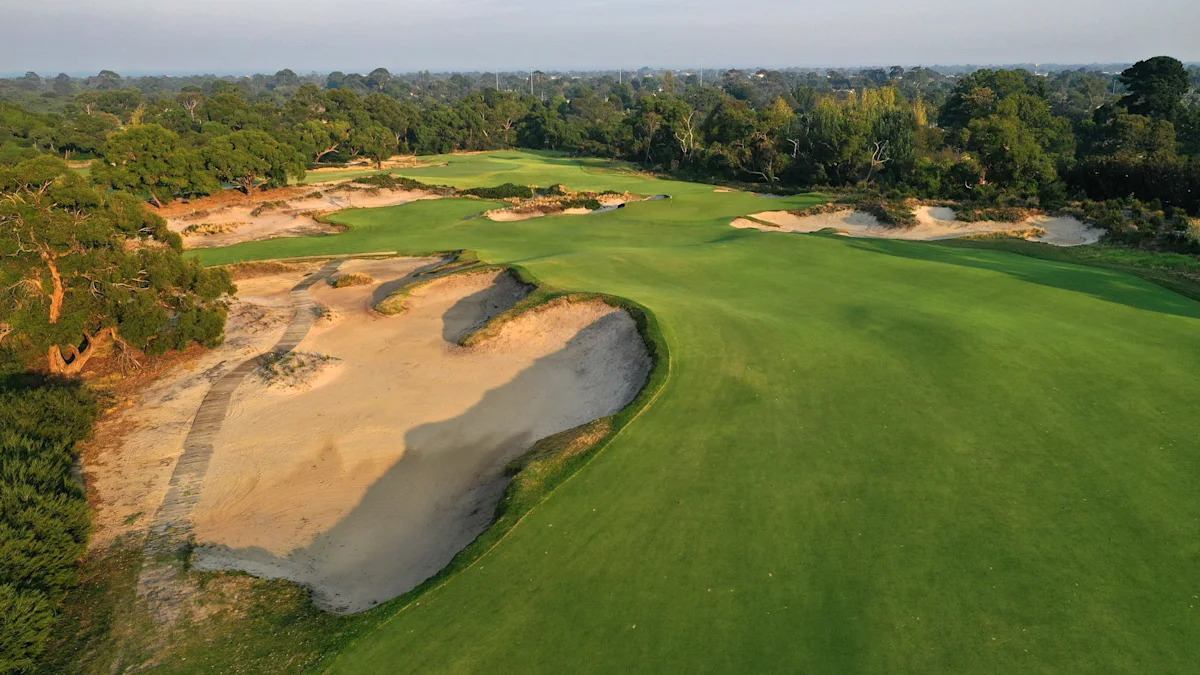
While none of them are technically near the sea as it exists today, a prerequisite to be considered a links course, they fully utilize the outstanding natural features of the area — the strong prevailing winds, the sandy and rolling terrain, and the bracken grasses that border the fairways — and evoke feelings of British, Scottish and Irish seaside links. Ogilvy compares it to how the Australian accent is often considered a happy middle ground between English and American accents.
“It’s links-style shots on parkland-looking places,” he said. “It’s really unique.”
Advertisement
At the time, Ogilvy didn’t realize how lucky he was. He just knew he loved golf. He loved hitting shots. He loved figuring out the puzzle of making pars and birdies. And, without quite realizing it, he was beginning to love golf courses.
More than 20 years ago, in an office in Melbourne, two young Australian course designers were having a similar revelation.
OCM started through Friar’s Head admiration
Mike Cocking and Ashley Mead were flipping through a golf magazine when they came across photographs of a new golf course on Long Island’s East End called Friar’s Head. Opened in 2003 and now ranked No. 2 on Golfweek’s Best list of modern courses in the U.S., the layout was designed by Bill Coore and Ben Crenshaw, and it looked nothing like an ordinary golf course. It looked wild and yet natural, as if it had sat on that land for 100 years. Cocking and Mead stared at the photographs.
Advertisement
They were working near Melbourne on renovation projects with architect Mike Clayton. Their careers were in their infancy, and the biggest golf projects in the world seemed very far away. But they allowed themselves to dream.
Maybe, someday, they would get to build something like that.
They had no idea that one day their own names would be spoken in the same conversations.


Mike Cocking, left, Ashley Mead, center, and Geoff Ogilvy, right, bring three different ways of seeing the same piece of land – that became their superpower and a differentiator.
Ogilvy’s path was different. Sure, he’d sketched holes in the margins of his geography and math assignments during class, but he never dreamed of becoming a course architect. He became a champion golfer, the winner of eight titles on the PGA Tour. He won the 2006 U.S. Open at Winged Foot without shooting a single round under par – the last player to accomplish the feat – as future Hall of Famers Jim Furyk, Padraig Harrington, Colin Montgomerie and finally Phil Mickelson took turns falling to pieces.
Advertisement
His replica silver trophy was eventually packed away in a box at his rental home in Melbourne. He had won one of golf’s greatest prizes, but he didn’t spend his life staring at it. He was already looking elsewhere.
Ogilvy known as a deep thinker
During his playing career, Ogilvy developed another reputation as one of golf’s deep thinkers. He could explain strategy, architecture and the subtleties of a golf hole with the same precision he brought to his short game. Fellow Aussie Adam Scott noticed.
“I just heard him bitch about every course we played and why a bunker was in the wrong place,” Scott recalled. “I heard it for years playing practice rounds with him everywhere we went.”
Advertisement
Ogilvy was fascinated by golf courses, not just about their difficultly but what made them special. At 16, he got his first chance to see golf outside Australia. In 1993, he traveled to Scotland with his father to visit his grandmother. They made a side trip to play the Old Course at St. Andrews. There was one problem – they didn’t have a tee time.
With hopes of walking on the esteemed “Home of Golf,” they arrived at 6:30 in the morning and waited. Four hours later, a pair of Swedish golfers invited them to join their group. Ogilvy shot 74.
He fell in love with St. Andrews, and his return trips in subsequent years opened his eyes to the value of proper course design. Ogilvy began comparing courses. Some famous courses disappointed him. He ticks off a list of those that fascinated him – Swinley Forest, Sunningdale, Pebble Beach and Riviera.
What made those places special wasn’t simply their beauty. It was the questions they posed, forcing the golfer to think, answer and execute the shot. Where should you miss? How aggressive should you be? Which side of the fairway gives you the best angle? Do you attack the flag or take your medicine? A great golf hole didn’t tell you what to do. It made you decide. Ogilvy loved that.
Advertisement
Part of his design philosophy for making courses tough for the pros but playable for members was shaped during a visit to Pinehurst Resort in North Carolina. Ogilvy remembers being seated in the Carolina Hotel having a beer with a friend when they struck up a conversation with a couple of snowbirds from the northeast who wintered in Pinehurst. Ogilvy asked them to name their favorite course in the Sand Hills. They simultaneously answered Pinehurst No. 2. Ogilvy was stunned by the response. “I find that to be one of the hardest courses in the world,” Ogilvy said.
The couple called the Donald Ross masterpiece, which has been restored by Coore-Crenshaw in 2010-11, the easiest course around because they could pull putter and run the ball on the ground to the saucer-cup greens. Elsewhere, they were stymied by thick rough and deep bunkers that required a lob wedge.
“That was a bit of a light bulb moment,” Ogilvy said.


The Fall Line has opened two courses, the East and West, in Georgia with designs by OCM.
Back in Melbourne, Cocking and Mead were developing their own careers. Cocking was a good amateur player in his own right, sharing the first-round lead at the 2001 Australian Masters and finishing T-5. He turned pro briefly before wrist surgeries thwarted his pro aspirations. Mead was an assistant course superintendent whose path to working in the design space came through the turf industry. He and Cocking have worked together for more than 25 years. Eventually, their paths crossed with Ogilvy’s, and in 2010 the three Australians formed OCCM with Mike Clayton. [Clayton was the other ‘C’ but he went off on his own in 2019 and formed Clayton DeVries and Pont with Mike DeVries and Frank Pant.]
Advertisement
The OCM partnership was unusual
It was an unusual partnership: Mead’s turf background; Cocking had an engineering degree and an artistic eye (both parents were art teachers); Ogilvy brought the perspective of someone who had spent years competing at the highest level of professional golf. Three different ways of seeing the same piece of land – that became their superpower and a differentiator.
Ogilvy never wanted to pretend he was doing the work alone. He knew the architecture business required more than a great player. It required people who understood earth, drainage, construction, shaping, geometry and aesthetics. He also brought to the table something that can’t always be learned from a textbook: what a golfer sees, what a golfer fears, what a golfer wants. And what makes a golfer stand on a tee and think: I want to hit this shot.
Their early work was in Australia, restoring and renovating courses. They re-established the odd bunker shapes at Victoria Golf Club, whose back nine rivals any course any course in the world. They created the fun-packed Furrows Short Course at Kingston Heath. Then came Peninsula Kingswood, where two Sandbelt clubs had merged into one enormous opportunity. Cocking had been a member of PK as it is known since he was 15 and was the lead designer. OCCM redesigned the North Course and worked on the South.
Advertisement
It was the firm’s first major statement, and a composite course is slated to host the 2027 Australian Open. Ogilvy remembers it as a dream assignment.
“For our first sort of big-scale job,” he said, “I got to tag along and see how the whole thing operated.”


Peninsula Kingswood in Melbourne, Australia, where two Sandbelt clubs merged into one enormous opportunity for OCM.
They had taken a good golf course and turned it into one of Melbourne’s must-play destinations. The dream that Cocking and Mead had once whispered about while looking at photographs of Friar’s Head was becoming real.
Then OCM crossed the Pacific.
Ogilvy’s fellow Tour pro, Harrison Frazar, recommended OCM when the project manager for Trinity Forest in Dallas asked him to name for consideration an up-and-coming, under-the-radar designer – someone other than Tom Doak, Gil Hanse or Coore-Crenshaw, please. OCM’s presentation dazzled, but at the last minute Coore-Crenshaw reached out that their schedule had freed up, and Crenshaw, being a Texan and a legend in the state, landed the job.
Advertisement
Not long after, Frazar was out in the field at Trinity Forest while Coore was shaping the sixth green. They took a break and were enjoying a Coke when Coore got a call from Mike Wright, the longtime director of golf at Shady Oaks in nearby Fort Worth, the course famously associated with Ben Hogan. The club wanted Coore-Crenshaw to spearhead a renovation, but Coore said their dance card was fully booked. He knew exactly what design firm the club should use.
“He called back Shady Oaks,” Frazar recounted, “and said, ‘Mike, I just realized that you need to hire Geoff Ogilvy’s group. Ben and I both feel like he’s going to be the next rising superstar.'”

A renovation of Shady Oaks, the former stomping grounds of Ben Hogan in Fort Worth, Texas, became OCM’s first major American project.
Crenshaw weighs in on Ogilvy
Crenshaw believes Ogilvy’s future in the field is exceptionally bright, and he also recognizes many of the influences that have helped shape his approach.
Advertisement
“On top of being a wonderful player, Geoff is very pensive. He’s a deep thinker,” Crenshaw said. “He’s got two good guys working for him and I think that he’s getting his feet wet in the right directions.”
Shady Oaks became OCM’s first major American project, and just as they were pushing dirt on the final green, the world shut down. COVID arrived. The OCM team rushed back to Australia before travel restrictions made it impossible. The work continued from a distance. And somehow, during the chaos, two of the firm’s most important American opportunities appeared.
One was Tepetonka in Minnesota. The property reminded them of Doak’s St. Andrews Beach in Melbourne. There were dramatic elevation changes, cedar-lined corridors and Shakopee Creek, a tributary of the Chippewa River, winding through the land. Six holes would interact with the creek. Ogilvy knew almost immediately that the property had something special. “It had us at hello,” he said.
They spent four days on what developer Mark Haugejorde dubbed an Australian walkabout, breaking for meals but hardly saying a word about the routing. On the final night of their visit, Cocking and Mead sat with laptops facing each other as if they were playing Battleship as Ogilvy looked over their shoulders at the topography of the land.
Advertisement
“I was just doing laps around the table as we went back and forth saying, ‘What if we did this? What if we did that?'” Ogilvy said.
The next morning, they presented their collaboration to Haugejorde, who couldn’t wait to break ground. [The course opened for preview play in August 2026.] The philosophy was simple. Give golfers choices. Reward courage. Punish poor execution. Create moments when a player could change the entire scorecard with one decision. We’ll see how good you are: That became part of OCM’s language.


Tepetonka Club in West Minnesota features dramatic elevation changes, cedar-lined corridors and Shakopee Creek, a tributary of the Chippewa River, winding through the land.
Medinah project changed everything
Then came the job that changed everything: Medinah No. 3.
Advertisement
The course already was rooted in championships. Three U.S. Opens. Two PGA Championships, both won by Tiger Woods. The 2012 Ryder Cup, aka The Miracle at Medinah.
Millions of television viewers had seen the property during some of golf’s biggest moments. But the course had developed an unusual problem. In 2019, Justin Thomas played the BMW Championship, a FedEx Cup playoff event, at Medinah and destroyed the place. He finished 25 under par. The professionals had found ways around the defenses. Yet ordinary golfers found the course too difficult. Medinah had become caught between two worlds. Too hard for the average player. Too easy for the best players. The club wanted change. Not a few cosmetic alterations, but a full-fledged transformation.
During COVID, OCM came up with a revolutionary routing without stepping foot on the course. “Which I think might have been an advantage because we didn’t have this awe factor around it,” Cocking said.
OCM won the assignment despite almost never getting a chance to make its pitch. The architect that presented before them had seemingly won the room over. Minds were made up. What was the point of another interview? Good thing Medinah’s superintendent convinced the club’s decision-makers to take the meeting, because OCM’s proposal wowed them even more. With nothing off-limits, they decided to blow up the final six holes. OCM rerouted them to bring Lake Kadijah dramatically into the strategy and visual experience. It was bold. It was risky. Ogilvy knew what was at stake for OCM.
Advertisement
“It was a humbling job to get,” he said, “but also quite scary for one of America’s most famous golf courses to sort of throw us the keys and say make this as good as you can.”
Medinah reopened in 2024. The members love it, but the real test was still coming. The Presidents Cup would return to Medinah this week. Twelve Americans against twelve international players representing the rest of the world minus Europe. Standing on the international side would be a familiar face in Ogilvy. Not as a player, which he did three times, but as captain. Now he was going to lead an international team around a golf course he had helped reinvent. There was something almost poetic about it.

Drone aerial of the 18th hole and clubhouse at Medinah Country Club in Chicago, Illinois.
What’s next for OCM?
By now, OCM’s reputation was spreading. Projects were appearing across the United States and Canada.
Advertisement
New courses. Renovations. Master plans. Luling in Texas. The Stanwich Club in Connecticut. Piedmont Driving Club, Druid Hills and Fall Line (which has gained a cult following) in Georgia. And then another extraordinary development: Cypress Point Club, one of the cathedrals of golf and currently No. 2 on Golfweek’s Best list of classic courses in the U.S., had quietly brought in OCM to lead ongoing design and renovation work.
For more than a decade, Coore, who is 80, and Crenshaw, who turns 75 in January, had been the architects of record at Cypress Point. While this isn’t to suggest the team of Coore-Crenshaw is retiring just yet, it would be difficult to imagine a more symbolic moment of a torch being passed. The young designers in Melbourne had once stared at photographs of a Coore-Crenshaw course and dreamed about reaching that level. Now OCM was following the same path.
Maybe even walking alongside it.
Haugejorde, the developer behind Tepetonka, offered a simple description of why he believed in the partnership: “Three great minds are better than two.”
Advertisement
At age 49, Ogilvy is in a unique time and place. His articulate and thoughtful nature about the intricacies of the game he once conquered would make him an attractive candidate for a full-time talking head position beyond the few majors that he’s worked as a television analyst in recent years. He also could focus on the PGA Tour Champions when he becomes eligible next year to scratch that competitive itch again.
But neither of those options seems to have the gravitational pull of golf-course architecture, because architecture gives him something professional golf never could. It gives Ogilvy the chance to shape the game itself. Instead of playing someone else’s hole, he can create one. Instead of figuring out the answer, he can create the question. And perhaps that is why the journey makes so much sense.
The clues were always there. They were on the fairways of Royal Melbourne, the bunkers at Victoria and hiding in the mysteries posed by Pebble Beach and Riviera. They were there every time he stood over a shot and wondered, why did they build it this way? For years Ogilvy thought he was simply a golfer who loved golf courses. He eventually realized he was something else. He was a golfer who wanted to build them.
And now, he and his design partners are no longer wondering whether they might someday get to work on the world’s great courses. They are. And that boy who doodled golf holes in the margins of his school assignments? He is finally bringing such imagination to life.
Advertisement
Adam Schupak is a senior writer for Golfweek, covering the PGA Tour and the business of golf.
This article originally appeared on Golfweek: Allowed to dream: Geoff Ogilvy and OCM design team make mark on course design
Read the full article here


