





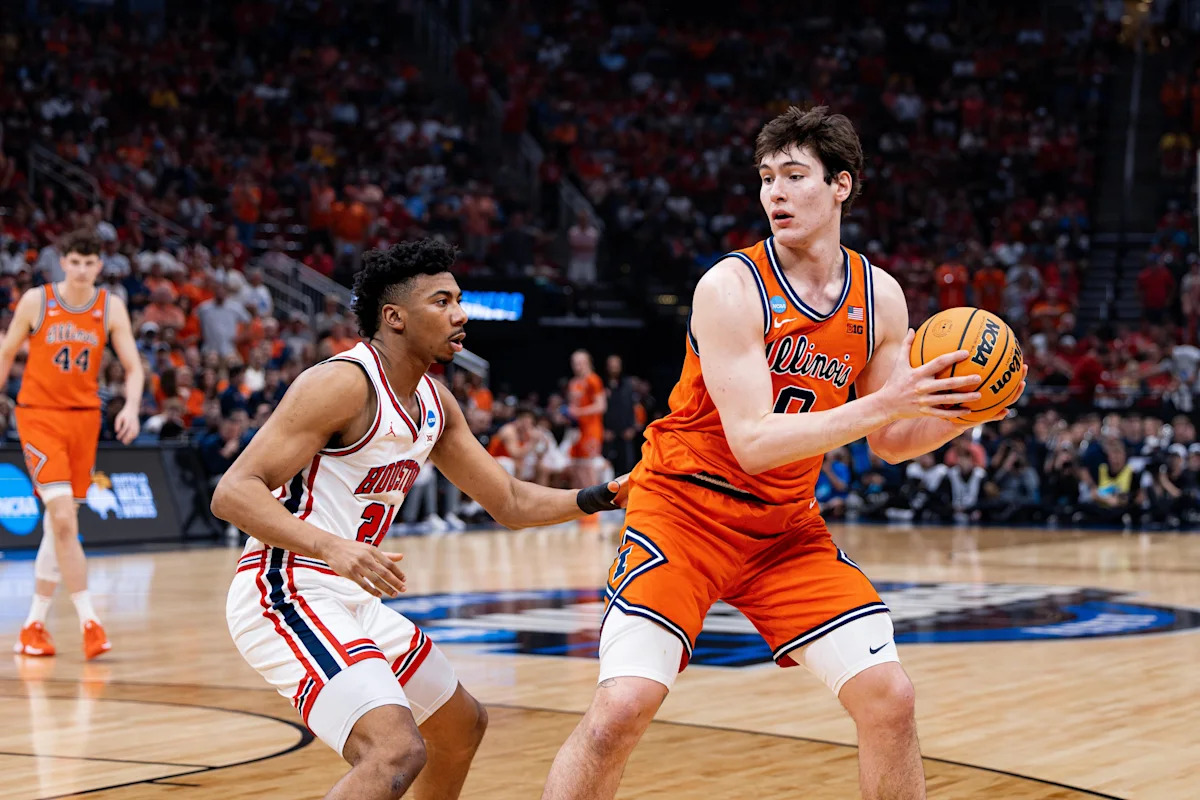
We’re deep in the offseason. A summer of hype around new recruits and NBA Draft anticipation has now become quiet. To pass time, let’s take a look at the Illini’s returning core and their closest NBA comparisons.
Mirkovic and Randle are almost identical when it comes to their body frames, with Mirk sitting at 6-foot-9 and 250 pounds and Randle at 6-foot-8 and 250. The similarities are also seen in what they do with their bodies: they both love to play bully-ball. With both of them lacking elite verticals above the rim, they instead utilize their frames to fight through contact, dominate the glass and get buckets at the rim.
EAST LANSING, MI – FEBRUARY 7: Illinois Fighting Illini forward David Mirkovic (0) splits defenders on his way to the hoop during a college basketball game between the Michigan State Spartans and Illinois Fighting Illini on February 7, 2026 at the Breslin Center in East Lansing, MI. (Photo by Adam Ruff/Icon Sportswire via Getty Images) | Icon Sportswire via Getty Images
Julius Randle combines the bully-ball aspect of his game with his ability to knock down shots from the perimeter, making 33% of his 3-point shots throughout his career. David Mirkovic does the same, stretching defenses out to the arc to contest his triples when it isn’t working for him in the paint. Mirk shot 37.5% from long-range last season, attempting around four per game. Randle also attempted around four per game last season. Obviously, neither is a spot-up shooter, but they both pose a scoring threat from the paint and the perimeter.
Advertisement
Both of them are primarily power forwards, but they both can act as point forwards. Randle occasionally initiates the offense from the perimeter and is able to grab a defensive rebound and push coast-to-coast. Mirkovic’s background as a point guard gives him similar traits, and they both possess high IQ and passing vision as power forwards.

MINNEAPOLIS, MINNESOTA – MAY 15: Julius Randle #30 of the Minnesota Timberwolves drives to the basket against De’aaron Fox #4 of the San Antonio Spurs in the first quarter in Game Six of the Second Round of the NBA Western Conference Playoffs at Target Center on May 15, 2026 in Minneapolis, Minnesota. NOTE TO USER: User expressly acknowledges and agrees that, by downloading and or using this photograph, User is consenting to the terms and conditions of the Getty Images License Agreement. (Photo by David Berding/Getty Images) | Getty Images
Additionally, they both use their physicality to excel at grabbing rebounds. Julius Randle career rebounds per game sit at 8.9, and Mirkovic snagged 8 per game in his freshman season.
Frame-wise, Z and Mo are both freakishly lengthy. Zvonimir sits at 7-foot-2 and around 245-250 pounds, and Bamba at 7-foot and 230. But that’s not where the swatting abilities come from. Zvonimir Ivisic’s wingspan is speculated to be around 7-foot-5 or greater, and Mo Bamba’s 7-foot-10 wingspan is one of the largest ever recorded at the NBA Draft combine.

GREENVILLE, SOUTH CAROLINA – MARCH 19: Zvonimir Ivisic #44 of the Illinois Fighting Illini dunks the ball in the second half against the Pennsylvania Quakers during the first round of the NCAA Men’s Basketball Tournament at Bon Secours Wellness Arena on March 19, 2026 in Greenville, South Carolina. (Photo by Jacob Kupferman/Getty Images) | Getty Images
As basketball players, they both primarily thrive at one thing: protecting the rim. They excel with their timing, reflexes and length to reject shots around the cylinder. Bamba has swatted roughly 6.5% of two-point attempts while on the floor throughout his NBA career, and Z’s 12.6% block rate ranked No. 4 nationally last season.
Advertisement
Beyond rim protection, they both carry themselves as stretch 5s on offense, spacing the floor by offering a 3-point threat from the wing and forcing bigs to leave the paint. Bamba’s career 3-point percentage sits at 35%, while Zvonimir has made 33.6% of his triples so far throughout his NCAA career.
Neither of them are seen posting-up in the paint often, but they still score in the interior by catching lobs, running the floor in transition and crashing the boards for putback dunks.

WASHINGTON, DC – MARCH 5: Mo Bamba #11 of the Utah Jazz drives to the basket during the game against the Washington Wizards on March 5, 2026 at Capital One Arena in Washington, DC. NOTE TO USER: User expressly acknowledges and agrees that, by downloading and or using this Photograph, user is consenting to the terms and conditions of the Getty Images License Agreement. Mandatory Copyright Notice: Copyright 2026 NBAE (Photo by Stephen Gosling/NBAE via Getty Images) | NBAE via Getty Images
Tomislav Ivisic and Nikola Vucevic’s styles of play are practically the same. The one thing setting them apart is the height difference: Tomislav’s 7-foot-1 frame towers over Vuc’s 6-foot-9 frame.

Still, they score in the same ways. They both love a good pick-and-pop at the top of the key to offer a shot option and make space for guards in the lane. And when they’re given the ball there, they’ll knock down most of their triples from the top of the key. Vucevic has made 35% of his career triple attempts, and Tomislav 32% in his Illini career. Last season, Tomislav attempted 4.7 3-pointers per game while Vucevic attempted 4.2 per game.
Advertisement
If the long-range shots aren’t going down, the pick-and-pop can turn into a pick-and-roll, but with a short roll. They both like to open themselves up to the free throw line for a floater instead of fighting through contact in the paint.

BOSTON, MASSACHUSETTS – MARCH 04: Nikola Vucevic #4 of the Boston Celtics attempts a shot past Coby White #3 of the Charlotte Hornets during the first half at the TD Garden on March 04, 2026 in Boston, Massachusetts. NOTE TO USER: User expressly acknowledges and agrees that, by downloading and or using this photograph, User is consenting to the terms and conditions of the Getty Images License Agreement. (Photo by Brian Fluharty/Getty Images) | Getty Images
Even though they don’t usually invite contact, they both possess shifty skills in the post for interior scoring and rely on their footwork, fakes, hook shots and creativity.
Beyond scoring, these two centers love to playmake from the elbow and utilize their vision to find cutters.
DeMar and Andrej are both 6-foot-6, though DeMar’s 220 pounds is a little heavier than Stojakovic’s 205.
Advertisement
One thing they’re both unusually skilled at is relieving pressure late in the shot clock. They like to demand the ball at the perimeter, then use their isolation skills and explosive athleticism to bail their team out for a layup or midrange.

NASHVILLE, TENNESSEE – DECEMBER 06: Andrej Stojakovic #2 of the Illinois Fighting Illini misses a breakaway dunk attempt during the second half of the Music City Madness game against the Tennessee Volunteers at Bridgestone Arena on December 06, 2025 in Nashville, Tennessee. (Photo by Johnnie Izquierdo/Getty Images) | Getty Images
That same explosive athleticism helps them soar in the air vertically. DeMar recorded a 38.5-inch vertical at the 2009 NBA Draft combine, while Andrej recorded a 41.5-inch vertical in this year’s combine. That bounce gives both of them the ability to finish violently and posterize players in the paint, as Stojakovic did multiple times last season and DeMar did frequently in his Raptor years.
Their body control allows them to finish off a lot of tough buckets in the mid-paint. Both take, and make, tough layups, floaters and short pull-ups while adjusting their bodies midair.
Advertisement
Most of their scoring comes from these types of buckets, along with midrange shots closer to the arc and free throws from fouls drawn. Stojakovic was more comfortable knocking down the triple in his first two collegiate years than his first season as an Illini. At Stanford and Cal, he averaged 3.8 3-point attempts per game and made 32.2% of them. Last season, he only took 2.4 3-pointers per game and made just 24.4% of them.

TORONTO, CANADA – APRIL 1: DeMar DeRozan #10 of the Sacramento Kings goes to the basket against Scottie Barnes #4 of the Toronto Raptors in their NBA game at Scotiabank Arena on April 1, 2026 in Toronto, Ontario, Canada. NOTE TO USER: User expressly acknowledges and agrees that, by downloading and/or using this Photograph, user is consenting to the terms and conditions of the Getty Images License Agreement. (Photo by Mark Blinch/Getty Images) | Getty Images
DeRozan on the other hand, attempted just 1.7 3-pointers per game and shot 28.8% from behind the arc during his nine seasons as a Toronto Raptor. As a Chicago Bull and Sacramento King, DeRozan attempted 2.4 3-pointers per game and made 33% of them.
They both have the capability to knock down the triple, but cannot always find the rhythm.
Advertisement
Battier has two inches and 10 pounds on Jake Davis, but they play almost identically. Both glue guys use their high basketball IQ and positioning to slide into help defense, take charges and close out on shots on one side of the court, and cut backdoor and make the extra pass on the other.

Beyond their intelligence on the court, their hustle and grit don’t always show up on the box score. They both box out, crash the glass and fight for loose balls relentlessly through toughness.
Lastly, but certainly not least, they’re both primarily known for one thing: knocking down the catch-and-shoot corner triple and being absolutely elite at it. Davis shot 40.6% from behind the arc last season, knocking down 54 out of his 133 attempts. In the 2012-13 season with the Miami Heat, Shane Battier shot 43% from 3-point range, nailing 103 of his 276 attempts.

MIAMI, FL – JUNE 6: Shane Battier #31 of the Miami Heat shoots the ball against the San Antonio Spurs during Game One of the 2013 NBA Finals on June 6, 2013 at American Airlines Arena in Miami, Florida. NOTE TO USER: User expressly acknowledges and agrees that, by downloading and or using this photograph, User is consenting to the terms and conditions of the Getty Images License Agreement. Mandatory Copyright Notice: Copyright 2013 NBAE (Photo by Nathaniel S. Butler/NBAE via Getty Images) | NBAE via Getty Images
TCR readers, do you agree or disagree with these comparisons? Offer your own in the comments below!
Read the full article here