





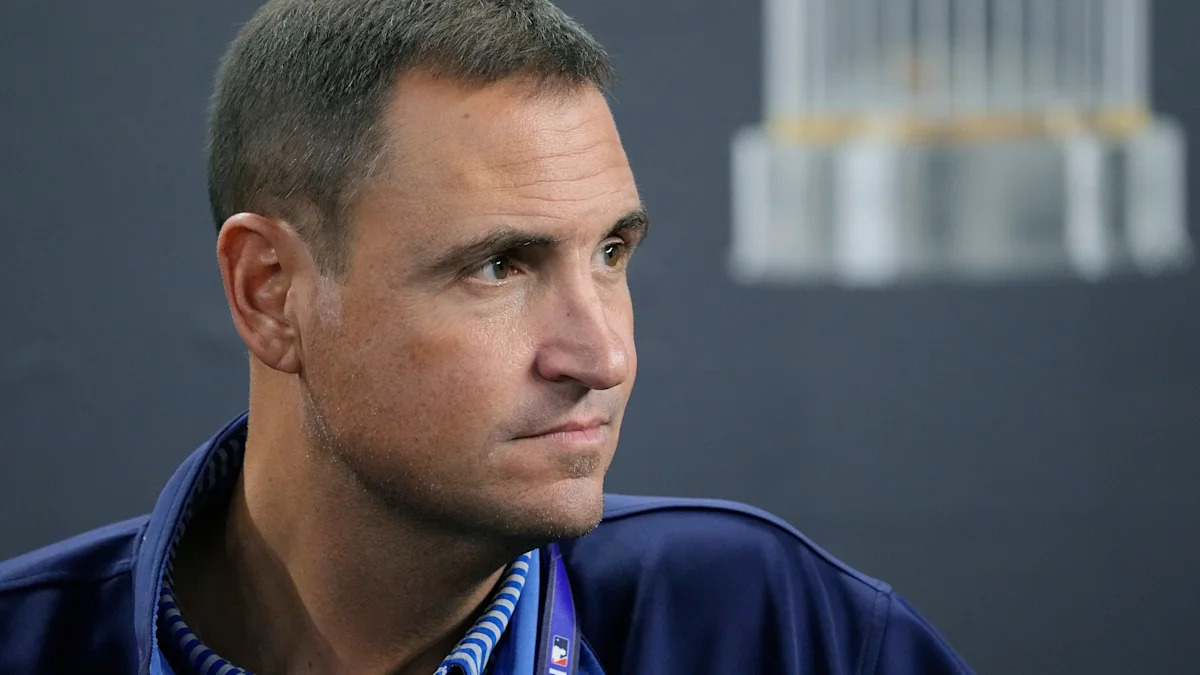
Texas Rangers president of baseball operations Chris Young addressed the media today in the wake of the team’s disappointing 80-82 finish.
I am not sure if this was broadcast live or not, but if it was, I didn’t hear it, because I was busy working. I haven’t seen the DMN or the Rangers website put up any stories about Young’s comments yet, as I’m typing this, but the beats did live-tweet things.
Advertisement
Young said, per the beats, that the Rangers have not exuded enough “toughness and [] grit” the past few seasons, and that has shown in the team’s poor road performance. Young said, per the beats, that “[t]here are some things we need to change in terms of bringing out that grit and toughness . . . that it takes for a team to go on the road, into an opposing city and play in front of opposing fans.”
This year, across MLB, home teams won 52.9% of games, and away teams won 47.1% of games. Last year, it was 54.3% and 45.7% across MLB. The Rangers in 2025 won 59.3% of their home games and 40.7% of their road games, and in 2026 won 55.6% of their home games and 43.2% of their road games. I’m not sure if the issue is grit or toughness or something else, but the Rangers have underperformed on the road the past two years (or overperformed at home).
Something else that jumped out at me is Young saying that the team needs to be more athletic, needs be better defensively and on the basepaths, needs to be younger. I thought that was an interesting comment.
Back in June, I wrote about how the Rangers were epically unsuccessful in going from first to third in the first half of this season. The extreme station-to-station aspect of their baserunning, along with their miserable performance in bases loaded situations (a 549 OPS in 139 plate appearances with the bases loaded, compared to a 746 OPS leaguewide) were two of the biggest reasons why the Rangers’ run scored lagged behind what their overall offensive performance would have suggested that they should have scored.
Advertisement
But its worth asking how it is that the Rangers ended up with a group of position players that are not particularly athletic or good defensively or on the basepaths.
Let’s look at the position player moves the team has made over the past two years, since the end of 2024.
In December, 2024, they signed catcher Kyle Higashioka. Higashioka turned 35 in April of 2025, and wasn’t (and still isn’t) particularly fast or athletic, even for a catcher — he was 62nd out of 83 catchers in sprint speed in 2025, and 76th out of 87 catchers in sprint speed in 2026.
Also in December, 2024, they traded three players for Jake Burger to replace Nathaniel Lowe at first base, desiring more power at the position. Burger is actually just a little below average in sprint speed among MLB players, but he isn’t going to be described by anyone as particularly athletic, or gifted defensively or as a baserunner, and despite how little major league experience he has, he turns 31 at the beginning of 2027.
Advertisement
At the end of December, they signed Joc Pederson to a free agent deal, in what was really the one major move they made in an effort to upgrade the offense. Regardless of the merits of making your big offseason position player move the signing of a platoon DH to a big contract, Pederson — signed for his age 33 and age 34 seasons — is near the bottom of the league in terms of athleticism, defense, and baserunning.
They did add the 36 year old Kevin Pillar as a bench player. He was, once upon a time, a very athletic player, a quality defender and baserunner. There was still some athleticism there, I think, but it was hard to notice when he was slashing .209/.209/.256. I don’t think I realize until now he never ended up drawing a walk in 2025.
There was also Sam Haggerty off the bench, and he had a little of that speed and athleticism Young was talking about, but he was also a role player, and though he came back in 2026, he got quickly released because he couldn’t hit.
When Jake Burger got hurt, and the team needed to get someone to play first base, they signed free agent Rowdy Tellez, who, well…let’s put it this way. In 2025, there were 579 players with at least 10 opportunities for Statcast to measure their sprint speeds. Tellez was faster than two of them — Sam Huff and Martin Maldonado — and tied with Giancarlo Stanton. The other 575 players were ahead of Tellez.
Advertisement
Come the 2025-26 offseason, once again, the Rangers only made one really big move in regards to the lineup: they traded Marcus Semien to the Mets for Brandon Nimmo. Again, whatever the other motivations and positives that deal provides, its a downgrade in terms of speed, athleticism and defense.
And they added 39 year old Andrew McCutchen, who once upon a team fit the speed/defense/athleticism mold, but not in 2026.
They did add Danny Jansen, who probably has above-average athleticism for a catcher. Then when Jansen and Higashioka got sidelined they signed Einar Diaz out of the free agent scrap heap. Fun fact — Diaz was 80th in sprint speed out of 87 catchers in 2026, one of the few catchers actually slower than Higashioka.
No wonder the organization was so excited about Nicky Lopez’s presence — he’s not, at this stage in his career, someone who is elite in terms of speed or athleticism or defense, but he’s average to a little above in those categories, and on this team, it makes him look like Jim Thorpe.
Advertisement
If you’re identifying position players who you think of as regulars or semi-regulars on the Rangers, Evan Carter, Wyatt Langford, and Ezequiel Duran are the only three who you fit that triumvirate of attributes Young says the team needs. Of course, Carter and Langford also have not been able to stay healthy — and one of the other things that Young said that the team needed to improve upon is its health.
Otherwise…Corey Seager is Corey Seager. You know what he is. Josh Jung is not particularly athletic, is slow, has regressed defensively, and can’t stay healthy. Justin Foscue is much the same.
Here’s the thing that kind of stuck with me when I read those quotes from Young today, though, that prompted me to sit here and pound out what is now over 1000 words on the topic.
If you feel, Chris, that the Rangers are not young enough, not athletic enough, not good enough defensively, then whose fault is that?
Advertisement
How did it happen?
How is it that you would put together a lineup on the position player side over the past two years with moves that have prioritized the team going after primarily older, slower, unathletic players who are limited defensively, and then act surprised that your team is not athletic enough and not good enough on the basepaths and not good enough defensively?
View Link
Read the full article here