





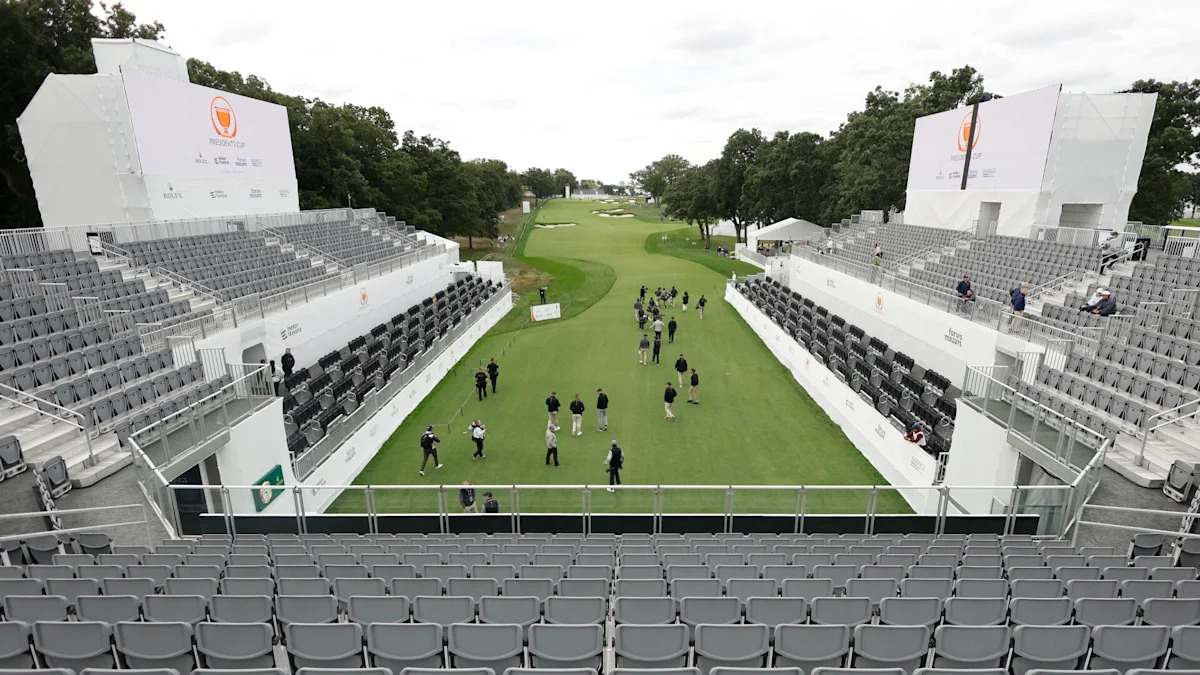
The first tee shot at the Presidents Cup is already tough enough. Now, introduce out of bounds down the left and you have what Geoff Ogilvy calls an “incredibly interesting” start to the match.
Ogilvy, of course, isn’t just this year’s International team captain but also one of the architects who redesigned Medinah Country Club’s No. 3 Course.
Advertisement
For this week’s Presidents Cup, the routing of No. 3 will be shifted, with the par-4 fifth hole serving as the opening hole. As a result, the 18th will be the 14th hole and the fourth hole the 18th hole. This means that Nos. 5-7 for members, all holes that implement a wooden, split-rail fence that runs along the left side and serves as out of bounds, will mark the opening stretch for these matches.
The original design of the layout had those holes run along an adjacent road, but with that thoroughfare becoming much busier these days, Ogilvy and his partners at OCM Golf decided to push those holes inward during their two-year redesign that was completed in 2024 and included the addition of six completely new holes (Nos. 9-14 for this week; Nos. 13-18 for members). The fence now serves the same purpose as the road once did.
The strategic philosophy of these three holes is simple: The closer one plays to the boundary fence, the better angle they receive into the green. Play away from the fence off the tee, which is possible due to significant widening and tree removal across the layout, and the approach shot becomes more difficult, with out of bounds coming more into play and mounding working to repel imperfect strikes.
The first few holes aren’t the only standouts. Ogilvy also points out a stretch that could serve as a “tipping point” for matches: Nos. 12-14, or the members’ Nos. 16-18. All three holes are set around Lake Kadijah, including the 12th, which is a 402-yard par-4 that perhaps best encapsulates the overall redesign. It’s a take on C.B. Macdonald’s original cape hole, the 14th at National Golf Links of America, where players are tasked with carrying a hazard that runs diagonally. In this case, Medinah No. 3’s 12th hole runs along the lake to the right, with the carry getting longer the more right a player aims.
Advertisement
“It always sucks you into driving it closer to the green than you would otherwise normally do,” Ogilvy said of the hole. “You can bail left but the farther left you go, the more awkward the wedge shot gets.”
Ogilvy expects the setup team to move around the tees on No. 12, making it drivable for some sessions and a more traditional short, two-shot hole for others.
Ogilvy’s only gripe entering the event is with Mother Nature.
“I’d prefer it firmer this week,” Ogilvy said. “Angles and slopes are more effective when the ball gets rolling when it hits the ground.”
Advertisement
U.S. captain Brandt Snedeker agrees: “It would take a drastic dry-out to see this place get to the intention of the design. The intention of this design was to have a ball run in the fairways, into the greens, bouncing around and kind of letting these slopes do their thing. With the amount of rain we’ve had the last ten days, it’s going to be really difficult for this golf course to dry out. It’s going to be a really hard barometer of a week of how difficult this golf course can play.”
Snedeker has also pointed out Ogilvy’s advantage in captaining on a course he helped design.
“He has his fingerprints all over it,” Snedeker said. “He knows it better than anybody is going to know it. That’s something we’re going to have to deal with.”
But Ogilvy downplays that notion.
Advertisement
“I think it’s an advantage when we turn up on Monday,” Ogilvy said. “But what touring professionals have over most other golfers is they can learn a golf course really quickly. I think by the time we tee off on Thursday, anything that I did to help out the players with what OCM did and how we were hoping people would play the course, I imagine that the U.S. team will have it worked out by then.”
Read the full article here