





Let’s begin with three sobering facts:
Fact One: My colleague Jamie Kennedy, in preparation for our “50 Things that changed golf” podcast on the founding of the Presidents Cup, uncovered a stat from when the Cup debuted in 1994 about “international” golfers. International, in this case, means players who are eligible for the International team at the Presidents Cup, i.e. not American or European. At the start of that year, there were eight (!) international golfers in the top 20 of the World Ranking. There were seven Americans, and only three Europeans.
Advertisement
As we prepare for this week’s Presidents Cup, 32 years later, there are nine Americans in the top 20, 10 Europeans … and one international golfer, Si Woo Kim.
Fact Two: During the Presidents Cup captain’s picks selection show on the Golf Channel, when International captain Geoff Ogilvy announced he was taking Christiaan Bezuidenhout with his final pick, the caption on the screen read, “two top-10s in PGA Tour events this year.” Those came in Puerto Rico and Myrtle Beach, both “additional events” held opposite signature events. Later, Golf Digest’s Joel Beall brought up the fact that even though he’s playing in the Presidents Cup, Bezuidenhout could lose his tour card.
Nothing against Bezuidenhout, a South African golfer I like and admire, but when someone with that résumé can make the team roster, all you can say is, “ooof.”
Fact Three: When Ryan Fox won the Open in July, he became only the fifth international golfer, with Cam Smith, Hideki Matsuyama, Jason Day and Ernie Els, to win a major in the last 15 years. Compare that to the 1990s, when internationals won 10 majors, or the 2000s, when they claimed 13. In fact, that 20-year stretch from 1990 to 2010 looks in retrospect like a golden age.
Advertisement
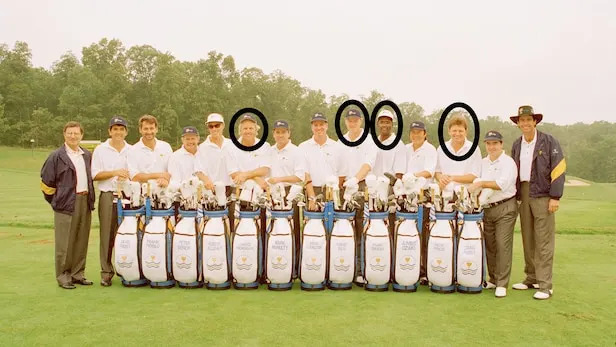
And it was a golden age that launched the Presidents Cup. When the event began in 1994, the gamble inherent to the project was that international golf would continue to rise, and this golden age was the start of a movement. To men like Deane Beman and Tim Finchem who launched the event, it probably didn’t seem like much of a gamble at all. But the wave broke, and somewhere around 2012, it started to recede.
The modern, uncompetitive Presidents Cup can be seen as a symptom, or perhaps a casualty, of the broader phenomenon. The International team’s two best results, a victory and a tie, came in the midst of that 20-year golden age, in 1998 and 2003. Since then, they have come close twice while playing at home, but most results have been relative blowouts, and the team record is 0-10.
What happened? Why have the last 15 years, which should have seen a rise in the fortunes of international golfers, instead brought diminishing returns?
And could the problem be America itself?
Advertisement
More Presidents Cup preview stories
Presidents Cup Presidents Cup 2026: Power Rankings for all 24 players at Medinah

Presidents Cup Presidents Cup 2026: The team match-play strategy every captain should adopt

Presidents Cup 2026 Presidents Cup 2026: Medinah holds vastly different experiences for team captains The LIV Golf cop-out
To start, we have to mention LIV Golf, which is a convenient but ultimately inadequate explanation for a bigger problem. While that league sprang up in the middle of the international decline, not the start of it, it’s true that it took a much harsher bite out of the International team than the American team, whose relative depth made the loss of players like Bryson DeChambeau and Brooks Koepka less critical (or the European Ryder Cup team, which mostly lost older players). The Internationals forfeited a solid core of players including Smith, Joaquin Niemann, Carlos Ortiz, Abraham Ancer, Marc Leishman and Lucas Herbert. Without the depth to make up the gap, winning the 2022 or 2024 Presidents Cups became an act of wishful thinking.
Advertisement
If anything, though, attributing the decline to LIV is a cop-out, and disguises a trend that was already well established. Among the LIV defectors, only Smith truly can be called elite, and outside of him and the veteran Leishman, the others only accumulated five PGA Tour wins between them. Even the most promising of the young bunch, Niemann, has had a poor record in majors, and aside from a flukey run by Mito Pereira at the 2022 PGA Championship that ended in a late collapse, Latin America seems no closer to producing its next major champion after Angel Cabrera’s Masters win in 2009.
You could say the same about men’s golf in Asia. Since Y.E. Yang’s breakthrough against Tiger that same year, only Japan’s Hideki Matsuyama has captured a major. And although South Korean players like Si Woo Kim, Tom Kim and Sungjae Im have forged nice careers on the PGA Tour, the lack of major victories or sustained runs into the top of the World Ranking stands in stark contrast to the state of affairs in the women’s game. Look at those World Rankings, and you’ll see 11 Asian women in the top 20, along with a surplus of major wins.

1193846919
Four players on the International team that nearly won in 2019 moved on to LIV Golf in 2022—Louis Oosthuizen, Marc Leishman, Abraham Ancer and Cameron Smith—keeping them off future International teams.
Advertisement
Darrian Traynor
You’ll also find elite major-winning women from Australia, but the highest-ranked men’s golfer from that once traditional powerhouse is Min Woo Lee at No. 30. Again, Smith seemed to be the player set to carry the mantle of Adam Scott, Jason Day, Greg Norman and Peter Thomson, but his decline since moving to LIV has highlighted the dearth of elite players from down under. (Scott will be playing in his 12th straight Presidents Cup at Medinah, and while that streak is impressive, at age 46 it feels more like a referendum on the lack of younger players ready to replace him.)
Perhaps the greatest drop-off, though, belongs to South Africa, land of Gary Player and Bobby Locke and more modern stars like Ernie Els and Louis Oosthuizen. Today, there are no South Africans in the OWGR top 70, and the biggest names among current players belong to aging minor stars in LIV.
In other words, you can’t blame LIV for what was already happening on a global scale.
Advertisement
The Development Problem
If it’s not LIV, what gives?
Frank Nobilo played in the first three Presidents Cups, and enjoyed his career peak in the midst of the International golden age. He has spent the last 20-plus years in broadcasting while maintaining his ties to New Zealand golf, and as such has had an ideal perch to watch the changes in the international game.
“The first Presidents Cups I played in, we had four bona fide No. 1s,” he remembered. “Greg Norman, Nick Price, Ernie Els, Vijay Singh. The rest of us, myself included, felt if we could bat 40 percent, we were going to have a really good chance. On paper, we felt that we weren’t lacking at the head.”

1179896758
The 1996 International Presidents Cup team included four players—Greg Norman, Ernie Els, Vijay Singh and Nick Price—who would at some point in their career be World No. 1.
Advertisement
PGA TOUR Archive
The results bore that out. The Internationals lost a deceptively close Cup in 1994, and in 1996, it came down to the last matches in America’s one-point win, which Nobilo compared to the European Ryder Cup team nearly winning in 1983 at PGA National. It proved they belonged, and indeed, just as Europe won the next Ryder Cup at the Belfry in 1985, the Internationals broke through in Nobilo’s third and final Presidents Cup with a dominant 20½-11½ win at Royal Melbourne.
The difference is in what came next. Europe went on to become a Ryder Cup power, a situation that continues to this day. Conversely, the Internationals fell off the map.
“Those players obviously got a little older,” Nobilo said of his teammates. “I think a lot of the Australian and South African players didn’t return home as much. I think we lost a little bit in the development.”
Advertisement
That word, “development,” was at the core of Nobilo’s argument, and it starts with how pathways have changed in the professional game. Almost every great international player in the 1990s played on their respective home tour before making the jump to the PGA Tour, and if they didn’t play at home, they played in Asia, then perhaps in Europe, and only then went to America. That has changed in the past 15 years, with many players starting out at the Korn Ferry Tour or American universities and, according to Nobilo, skipping certain steps in their home countries. Combine that with the fact that they rarely come home to play compared to their predecessors, and domestic development in their nations took a huge blow.
“In the most productive part of a player’s career, if that player’s coming home, he’s going to embolden the next generation of players,” Nobilo said. “That’s what Norman did, and Baker-Finch, and Elkington, Wayne Grady. Those guys kept coming back and they were helping the next generation of players get better. You could see the same in South Africa, with Gary Player, Trevor Immelman, Louis Oosthuizen, same thing.
“But when you skip a step, you’ve got to build your players differently, and I think that’s what’s been happening over the last 10 to 15 years. The players have tried to get to America a little quicker, and they’ve become Americanized, which is not bad for their game, but it has an effect on national development.”

360226
Frank Nobilo has watched what’s happened to the International team over the years and thinks that systemic issues in pro golf have caused player development to be hindered.
Advertisement
J.D. Cuban
That lack of support took a toll on national home tours, cost them depth and eventually made it hard for them to operate on the same financial level and nurture the same kind of player. Nobilo pointed to the Australian Open, and how it used to be one of the world’s biggest tournaments.
“As a teenager from New Zealand,” he said, “you were getting exposed to Nicklauses and Weiskopfs and Watsons. The best players were coming down because that was a big event. Today, there are other choices in the fall that are closer to home, and whether you’re from Southeast Asia or Australasia or southern Africa, some of the guys will stay and play in America in the fall and not go back home. And once your younger talent doesn’t see the best players in the world, it’s harder for them, in my opinion, to be motivated.”
In short, Nobilo argues that increased American hegemony in golf, while providing opportunity for international players on paper, has nonetheless had the side effect of hurting development in those countries. Why play on your home tour when the best opportunities come from going to an American college or trying your luck on the Korn Ferry Tour? That alone can short-circuit individual player development, but even for those who do make it, why come home when it’s better for your career to live in America, and continue playing in the fall there?
Advertisement
It creates a cycle that Nobilo compared to New Zealand rugby, which is facing the same problems with players playing professionally abroad.
“New Zealand doesn’t have the economy to support its rugby team,” he said. “Pride can only take you so far. So some of our best players playing overseas is only strengthening and embodying other countries, and not developing our own rugby program.”
Similarly, he thinks, America’s process of bringing international golf inexorably into its own orbit has only aided American development.
More Presidents Cup preview stories

Presidents Cup Surprised how the Presidents Cup has evolved? You can’t be more than the captains from the inaugural 1994 match

Golf Digest Logo Presidents Cup 2026: The transformation of Medinah No. 3

Golf Digest Logo The Presidents Cup has a systemic flaw. Here are two ways to make it fair The Access Problem
Advertisement
This can be a sensitive topic, and another source who wished not to be named expanded on that idea in more forceful language, tying the developmental issues Nobilo mentioned to a lack of international player access to the PGA Tour. In the last 20 years, that access has decreased significantly across the world, while at the same time the proportion of OWGR points awarded to American events has increased at the expense of international tours, exacerbating the access deficit.
Recent changes on the PGA Tour, including the possibility of fewer qualifying spots from the DP World Tour, along with the DP World Tour itself reducing pathways from Australia, South Africa and Asia (only the top player from these tours’ Order of Merit earns a spot, compared to three in past years), has led to a situation in which the PGA Tour, at the top of the hierarchy, looks more and more like a closed shop. By relegating other tours to secondary or even tertiary status without direct access to the PGA Tour, international players are forced to try to expedite their paths to Europe and especially America—again, think American universities and Korn Ferry Tour. That, in turn, depletes the home tours and kills development. And even for those players attempting to gain status on the Korn Ferry Tour, spots are tightly restricted, with only positions 6-45 and ties gaining full membership at the final stage of Q-School. The source noted that in many cases, it’s easier for a 20-year-old American college player to gain a spot on the PGA Tour than it is for an accomplished international player with several wins under his belt.
There is good news in the PGA Tour’s new emphasis on national opens, in conjunction with the R&A and Augusta National offering championship access. While the PGA Tour may have done this initially to prevent LIV from taking over those events, it’s still a net positive. The Asian Tour’s recent decision to join forces with the PGA Tour and DP World Tour also will open new pathways for their golfers to earn status in Europe. But compared to the magnitude of reduced international pathways to the PGA Tour and the damage done to international development, it still feels to some like these are patchwork solutions.

2175272340
With experience as a player and an assistant captain, Geoff Ogilvy understands the tall task ahead for the International team this week at Medinah.
Advertisement
Keyur Khamar
Even the exodus to LIV Golf, which disproportionately included international golfers at the peak of their careers, can be tied to an underlying resentment against the American golf power structure. That league’s emphasis on bringing golf events to Australia and South Africa, former international powerhouses that felt excluded in the American-centric ecosystem, was no accident. In that sense, the launch of LIV, or at least its successful signing of foreign stars, could be seen as yet another symptom.
If the International team loses for the 11th straight Presidents Cup this weekend, which seems to be the most likely outcome, there will be even more urgency to the discourse around the lopsided event, including suggestions to make it a mixed event, shelve it and even, as Golf Diget wrote over the weekend, trot out an American B-Team. Patience seems to be wearing thin. But for many who have watched the diminution of the last 15 years, the original promise of the event was not irrational at all, and the dream only faded when international golf suffered a loss to America that had nothing to do with the Presidents Cup.
Read the full article here