





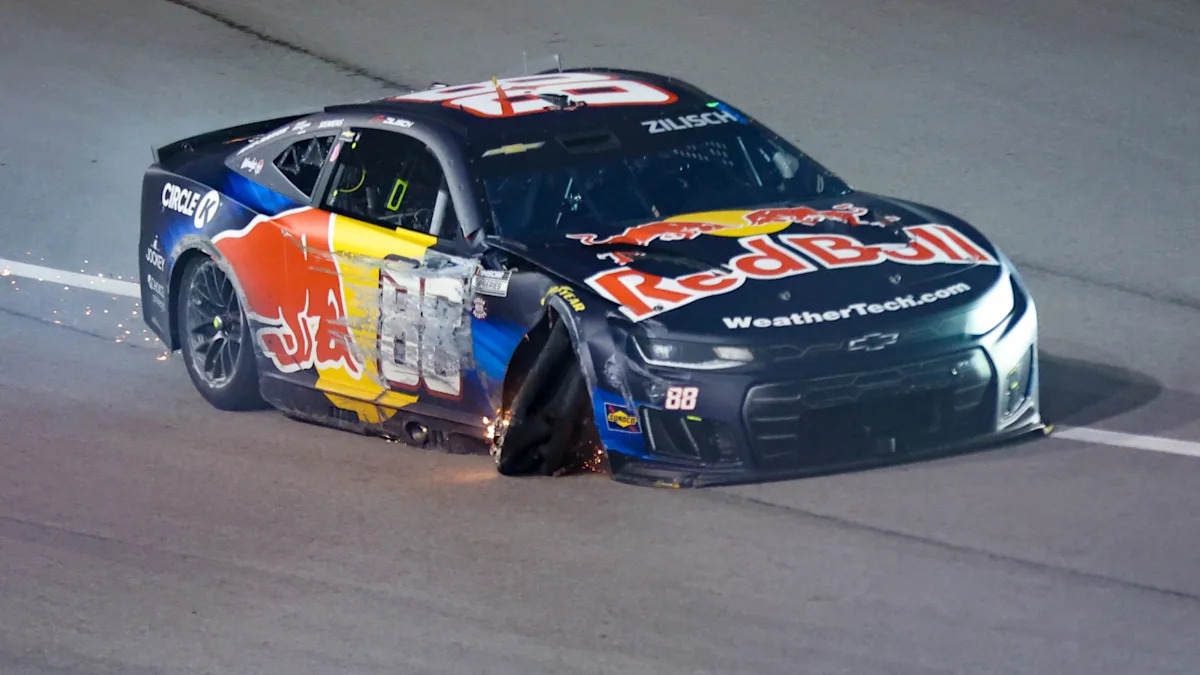
NASCAR’s Enjoy Illinois 300 at World Wide Technology Raceway was already chaotic. Then the brakes started failing.
Ryan Blaney was running sixth on Lap 155 when the right-front brake rotor on his No.12 Ford exploded. The 2023 Cup champion had been in contention for a strong result, but the failure sent him into the outside wall and ended his race with a 35th-place finish. His crew chief Jonathan Hassler later admitted the team had underestimated how much cooling the brakes needed with NASCAR’s higher-horsepower package.
Advertisement
Then, on Lap 214, Chase Elliott who was running sevent, suffered a brake failure while running seventh. His No.9 Chevrolet spun into Chase Briscoe, taking both playoff drivers out of the race.
Then, with just three laps remaining, Chris Buescher suffered another brake failure that brought out the caution and sent the race into overtime.
Those failures and minor mechanical issues have changed the playoff picture.
Only three of the 16 Chase drivers finished the Gateway race in the same position they entered it. Briscoe fell from fifth to eighth in the standings, and Elliott dropped from ninth to 11th. Ryan Blaney also lost ground to points leader Denny Hamlin.
Advertisement
And the brake failures were only part of a race that spiraled into chaos. Gateway produced 18 cautions, two red flags and a double-overtime finish. The 18 yellows shattered the track record and matched the Next Gen-era high.
For Kevin Harvick, that raises a question NASCAR may have to address.
Harvick wants NASCAR to give teams more freedom
Fox NASCAR broadcasters Josh Sims, Kevin Harvick, Jamie McMurray and Clint Bowyer chat before the Duels, Thursday, Feb. 12, 2026 at Daytona International Speedway.
Speaking on the Speed with Harvick and Buxton podcast, the 2014 Cup Series champion pointed to the rule that limits what teams can replace after practice and suggested NASCAR reconsider it before next season.
“They had an extended practice, probably need to think about next year, maybe letting them change the pads and the rotors or calipers, whatever they need to change after practice in order to go into the race.”
Advertisement
The argument makes sens. Teams had extended practice at Gateway to understand the demands of a track known for heavy braking. If the brake components show excessive wear or teams discover that their cooling setup is not sufficient, Harvick believes they should have the freedom to replace those components before the race.
Gateway proved why.
The 1.25-mile oval features long straightaways followed by heavy braking zones, putting repeated heat cycles through the brakes. The new 2026 package made that challenge even greater, with NASCAR increasing horsepower to 750 at selected tracks while reducing downforce. acknowledged earlier in the season that the extra speed and reduced aerodynamic stability were contributing to additional brake wear.
Advertisement
As of now, the teams can change brake components during the race, but under the current impound rules, they cannot simply replace the brake pads after practice and before the race starts.
At Gateway, teams had an extended one-hour practice. They could use that session to evaluate the brake package, but once practice/qualifying and the impound procedure were complete, the car was effectively locked down. If a team discovered that its brake pads or rotors had been pushed too hard in practice, it couldn’t just install a fresh set before Sunday’s race.
So, Harvick’s proposal would not mean abandoning the 750-horsepower package. His suggestion is much narrower: give teams the freedom to replace brake pads, rotors or calipers after practice, before the race, if the practice session reveals a problem.
Could NASCAR use Gateway’s failures as a reason to reconsider how much freedom teams have to protect themselves from another brake disaster?
Advertisement
Also Read:Rockingham Speedway Is for Sale at a Surprising $10 Million After NASCAR Drops 2027 Race
Related Headlines
Read more at Sportsnaut
Read the full article here