





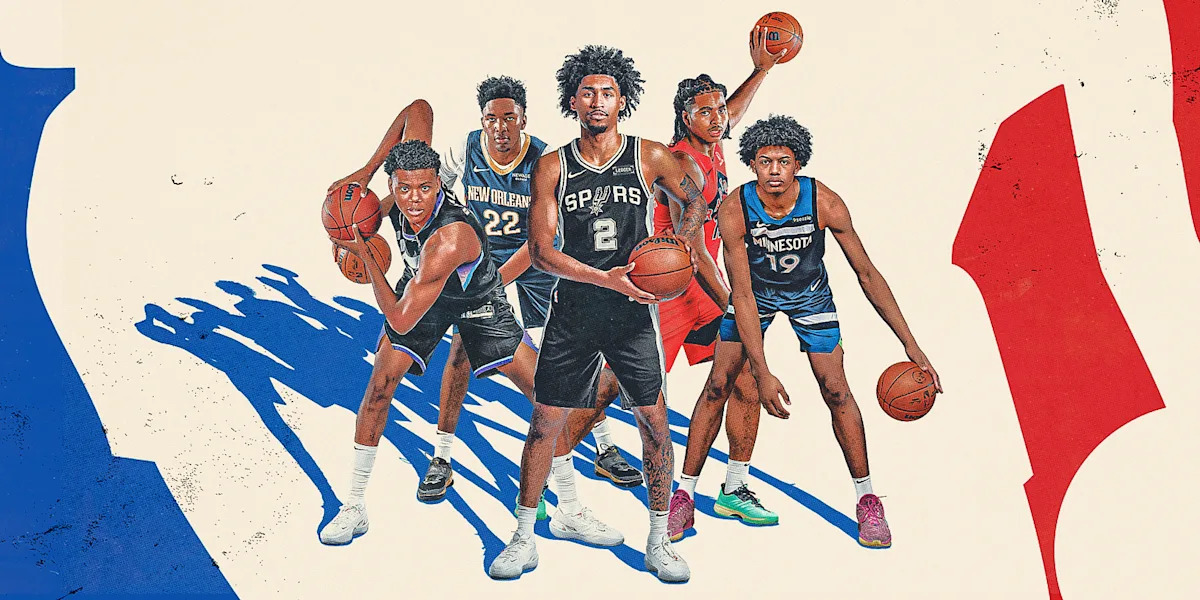
With the bulk of the 2026 NBA offseason now concluded, and with the calendar now flipped to September, it’s time to start looking ahead to what’s coming next in the NBA, both this season and afterward.
In that spirit, and in the interest of killing some time in the dying days of summer, let’s take a look at the five* most interesting players — to me! — who are entering their sophomore seasons.
Advertisement
(We’ve previously considered my five most interesting potential free agents in the class of 2027 and my five most interesting comeback players for next season.)
One note: I decided not to include the top three finishers in 2025-26 Rookie of the Year voting: winner Cooper Flagg of the Dallas Mavericks, runner-up Kon Knueppel of the Charlotte Hornets and third-place finisher VJ Edgecombe of the Philadelphia 76ers.
(Taylor Wilhelm/Yahoo Sports Illustration)
I wanted to cast a slightly wider net, but let us please take it as read that when it comes to …
-
The first rookie to average 20-6-4 since Luka Dončić (who will now get his first taste of life alongside Kyrie Irving);
-
The first rookie ever to lead the NBA in made 3-pointers last season (who will now likely have to step into a larger playmaking role following the departure of LaMelo Ball);
-
And a guy who, in his first trip to the playoffs, scored 23 points in a Game 7 on the road in Boston to help knock off the Celtics
… I am absolutely interested in what comes next.
With that preamble out of the way, we begin with … the fourth-place finisher in Rookie of the Year voting.
Dylan Harper, San Antonio Spurs
Harper profiled as a prolific downhill shot-creating force coming out of Rutgers, and the No. 2 pick in the 2025 NBA Draft was absolutely as advertised. The 19-year-old weaved through interior traffic and tall trees with ease, seemingly living in the paint and taking nearly half of his field-goal attempts at the rim and shooting better than 60% on them en route to averaging 11.8 points on 50.5% shooting and 3.9 assists in 22.6 minutes per game off San Antonio’s bench during the regular season. (He was just the fourth guard since 1990 to shoot better than 50% from the field as a rookie, joining Ben Simmons, Ayo Dosunmu and Jalen Williams.)
Advertisement
As impressive as Harper looked in coming through as a key reserve for a Spurs team that won 62 games and finished with the West’s No. 2 seed, the rookie’s performance during San Antonio’s run to the NBA Finals was even more eye-opening.
Harper scored more, shot more efficiently and got to the free-throw line more frequently with the stakes raised. He held up defensively despite frequently matching up against the likes of Anthony Edwards, Shai Gilgeous-Alexander and Jalen Brunson. He continued to get to the rim virtually whenever and however he wanted, even against some of the toughest defenses around, and showcased an incredibly feathery finishing touch around the basket.
He showed preternatural poise for a teenager, scoring a team-high 25 points in the Spurs’ unsuccessful attempt to stave off elimination in Game 5 of the 2026 NBA Finals. At times, particularly with De’Aaron Fox struggling through a high ankle sprain, the rookie looked like San Antonio’s second-best (best?) option on the ball … and maybe even like the Spurs’ third (second?) best player overall.
Advertisement
No prospect is a finished product at age 20, and Harper’s got some work to do to iron out the wrinkles in his game. (Sharpen up that 3-point shot, off the catch and especially off the dribble, and he’ll be downright lethal.) But capping his Year 1 performance with that playoff run suggests that he’s ready for more in Year 2: more responsibility, more minutes, more touches, more time on the ball and a more central offensive role. That expanded opportunity might be tough to come by, though, with Stephon Castle firmly entrenched in the starting backcourt after a stellar sophomore season of his own, with Spurs general manager Brian Wright publicly expressing “ultimate confidence” in Fox moving forward … and, candidly, with Fox likely all but untradable given the combination of his Finals floundering and about-to-start four-year max extension.
On one hand, ESPN’s Michael C. Wright reported after the Finals that it was “expected that calls from Harper’s camp for a spot in the starting lineup will grow louder going into next season.” On the other, Harper told DJ Siddiqi of RG.org this summer that whether he’s starting or coming off the bench is “not going to affect me and how I approach every day.” If Harper does continue in a reserve role, can he take a step forward as a steady-handed primary facilitator without the safety net of operating next to either Fox or Castle? (It’s not a coincidence that San Antonio’s two highest-turnover games of the postseason came when Fox was sidelined against Oklahoma City.) Can he prove that he’s ready to be the kind of night-in night-out table-setter who can get teammates organized, create scoring chances for them, and make sure he’s maximizing everyone’s opportunities, not only his own?
If he’s not quite there yet, then San Antonio’s hopes for matching or exceeding last season might take a hit. If he is, though, then the Spurs might already have another All-Star on their hands.
Ace Bailey, Utah Jazz
This time last year, Bailey — like his Rutgers teammate Harper, a highly touted über-prospect coming out of Piscataway — represented Utah’s highest draft pick and biggest swing for a star in more than a decade. Unlike Harper, though, Bailey joined a team that was both far away from winning and, frankly, largely disinterested in winning, leaving the 19-year-old to take his lumps on a team aiming to take one more bite at the “tank for a superstar” apple.
Advertisement
Bailey acquitted himself fairly well during a rookie season that featured both valleys (an early-season benching over insufficient defensive effort, a midseason hip injury that derailed him for the better part of 10 games) and peaks (a strong closing kick that saw him average just over 17 points, five rebounds, two assists and two stocks per game over his final 30 appearances, headlined by three 30-point performances in March). He led the Jazz in minutes played last season, finishing fifth among qualifying rookies in scoring at 13.8 points per game. He splashed more 3-pointers than any freshman besides Knueppel and Edgecombe, made the All-Rookie Second Team, and seemed to earn more of head coach Will Hardy’s trust as the year went along.
But Utah’s roster and the state of its short-term ambitions have both changed since Bailey got to Salt Lake City, which invites questions about his place within that context. What happens to a player hyped as a high-volume scoring prospect on a roster that now features three players who averaged more than 20 points per game last season: Lauri Markkanen, midseason acquisition Jaren Jackson Jr. and ascendant guard Keyonte George? And what happens to the top-five pick who was drafted to be the star offensive wing of the future when the team drafts a top-two pick, Kansas phenom Darryn Peterson, to be the new star offensive wing of the future?
It’s possible that Peterson’s arrival won’t functionally change the specifics of Bailey’s role. The 6-foot-8 swingman spent most of his rookie season shifting between the 3 and 4 spots, while Peterson will likely function either off the ball next to George or on it as Hardy and Co. explore his nascent playmaking chops. But with Markkanen, Jackson and George locks for the starting lineup, if the Jazz start veteran center Jusuf Nurkić, that leaves just one starting spot for Bailey or Peterson. After making 61 starts as a rookie, how would Bailey adjust to life as a sixth man? (It’s possible that Hardy goes with JJJ at center and Markkanen at power forward, opening up a spot for Bailey at the 3, but I’d bet he prefers starting off with more size and rebounding behind the All-Star forwards, and with a high-level screener and passer to help get all those playmakers open.)
Advertisement
On top of that, after four years of tanking following the dismantling of the Donovan Mitchell-Rudy Gobert era, the Jazz finally appear to be interested in trying to consistently win basketball games. (What a concept!) In a perhaps related story, two of Utah’s offseason additions were veteran wings named Josh — Josh Okogie and Josh Green — who have both demonstrated an ability to contribute as low-usage 3(ish)-and-D-type wings on playoff teams. They join fourth-year wing Brice Sensabaugh, who’s shown a more complete offensive game than Bailey flashed last season, in the competition for wing minutes; big man Kyle Filipowski will be in the mix for time at power forward, too.
All of which is to say: Bailey’s path to significant minutes and opportunities looks a lot thornier today than it did one year ago. (A bout of back spasms that ended his Summer League stint after just eight minutes didn’t help provide much clarity, either.) If he struggles to find ways to stand out on a roster that looks to have grown significantly more talented around him, he could wind up getting lost in the shuffle. If he can knock down the 3 more consistently and find more ways to contribute without the ball in his hands — he told reporters at Summer League that in every workout he’d undergone, “we start with defense” — he’ll force his way to the front of the line in that crowded Utah perimeter corps, and earn more opportunities to showcase the high-octane talent that made him a top-five pick in the first place.
“He’s just so talented and he’s not even scratching the surface yet,” veteran teammate Kevin Love told reporters last season. “There’s so many things that he does out there that you just say, ‘Wow.'”
Joan Beringer, Minnesota Timberwolves
When the Timberwolves’ wheeling-and-dealing around the 2026 NBA Draft resulted in them employing one new point guard in LaMelo Ball and [carries the three] zero power forwards, much of the attention focused on how exactly Minnesota intended to fill what was now a glaring hole at the 4. (After a “what the hell, why not” pursuit of LeBron James came up empty, they wound up landing Jonathan Kuminga; your mileage may vary on how viable a starting and playoff-caliber answer he might be.) But it’s also worth taking a look at how all that roster shuffling has impacted the other big-man spot in the Wolves’ rotation.
Advertisement
Rudy Gobert played 2,752 combined regular- and postseason minutes in 2025-26. Of the 1,780 minutes he didn’t play, 1,467 featured at least one of Naz Reid or Julius Randle on the floor — and, in case you missed it, neither one of those guys plays for the Timberwolves now. Nor, for that matter, does any non-Rudy veteran center. (I mean, if you want to call Trey Lyles a center, you can; it’s still, as of press time, a free country.)
Which means that, on a team that continues to harbor championship aspirations led by All-NBA powerhouse Anthony Edwards, the primary backup for a 13-year vet with more than 1,000 NBA games and nearly 31,000 NBA minutes on his odometer — one who, it should be noted, keeps himself in fantastic shape and has played 70 or more games in all four of his seasons in the Twin Cities — is a 19-year-old who played fewer than 350 minutes as a rookie.
That seems like a pretty big deal — and an even bigger bet on Beringer being ready to shoulder both a significant nightly allotment of minutes behind Gobert and major paint-patrolling/rim-protecting responsibility behind Minnesota’s perimeter players at the point of attack.
The Wolves seem confident in making that wager, believing that Beringer can build on the flashes he showed in spot minutes last season, on a strong stint with their Iowa affiliate in the G League (15.3 points, 11.3 rebounds, 2.4 blocks in 30.6 minutes per game) and on an impressive appearance at Summer League that led them to pull the plug after just one game:
In his limited floor time as a rookie, the 6-foot-11 Beringer showed a relentless motor in going after the ball, grabbing 16.1% of Minnesota’s missed shots (which would’ve ranked third in the NBA among qualifying players) and blocking 7.2% of opponents’ 2-point attempts (which also would’ve ranked third). He finished well around the rim, shooting 66.3% from the field on a diet primarily consisting of drop-offs after diving to the rim in the pick-and-roll, putbacks off the offensive glass, and feeds after running the floor in transition.
Advertisement
“He’s really good,” Wolves head coach Chris Finch told reporters back in January. “He’s got good feel in the drop coverage. You don’t see that often for a guy his age. He goes after absolutely everything. He challenges everything he possibly can. He has switch capability, too.”
Screen hard, roll hard, stay active in the dunker spot and hit the glass on one end; unfurl that 7-foot-4.5-inch wingspan, eat space, contest shots, move those puppies and (again) hit the glass on the other. It’s a fairly narrowly tailored role, but one befitting such a young and inexperienced player — and one that the Wolves sound very bullish that Beringer can fill at a high level.
“I think he’s going to make a huge impact defensively,” Wolves president of basketball operations Tim Connelly told reporters at Las Vegas Summer League. “He doesn’t make mistakes offensively. He’s exactly the type of work-ethic, self-motivated, tough player we’re looking for, and I think he has a physical profile that only a handful of the guys in the league have.”
If Connelly and Co. bet right, and if Beringer’s ready for the kind of role they’ve carved out for him, the Wolves’ offseason revamp could wind up paying dividends in more ways than one.
Derik Queen and Jeremiah Fears, New Orleans Pelicans
OK, so the Pelicans didn’t do nothing this summer. They changed head coaches, bringing in Jamahl Mosley from Orlando. They drafted hometown product Jaron Pierre Jr. late in June’s second round. They re-signed veteran center DeAndre Jordan for two years, in a deal that raised no small amount of confusion and consternation. They snagged swingman Bennedict Mathurin from the Clippers, and sent guards Jordan Hawkins and Micah Peavy to Memphis for some financial flexibility.
Advertisement
What seems like an issue, though — at least from the perspective of clearing a path for their Fears and Queen, their two 2025 lottery picks — is that they didn’t do more.
Zion Williamson, coming off just his third 1,000-plus-minute season since being drafted first overall in 2019, didn’t get traded. Neither did Trey Murphy III or Herb Jones, no matter how many blog posts and podcasts posited either or both as perfect-fit additions for Insert Wing-Needy Team Here. Dejounte Murray, who played pretty damn well in a 14-game cameo after recovering from a ruptured Achilles tendon, is still around, too.
So is Jordan Poole, as he enters the final season of the four-year, $128 million contract he signed four years and three teams ago. So is Yves Missi, the third-year center in whom the Knicks and Lakers reportedly had interest to round out their big-man rotations, but whom the Pels evidently view as a “vital core figure” and thus unavailable in trade talks.
Advertisement
In a vacuum, you can kind of understand the argument for Joe Dumars, Troy Weaver and Co. holding on to at least some of these guys, particularly given how rarely they’ve actually gotten to see them together. Over the last two years, the quartet of Williamson, Murphy, Jones and Murray — 80% of what you’d presume would be the Pelicans’ preferred starting lineup, at least a version of it — have shared the floor for a grand total of 149 minutes.
And, if you’re so inclined, and if you can get healthier seasons for the many Pelicans who have missed time of late, and if you get continued strong play from wonderful bounce-back story Saddiq Bey, and if Mosley can replicate his work with the Magic in improving a bottom-10 defense, you can kind of squint and see the outline of a pretty competitive team. Maybe not one likely to flirt with 50 wins the way the Pels did three years ago, but possibly one with a solid enough veteran top eight — plus other potentially useful role players like Trendon Watford — to slug it out for a play-in spot in the West.
“We have really good talent on our team and if we can stay healthy, we have a competitive team,” Pelicans executive vice president of basketball operations Joe Dumars told Rod Walker of NOLA.com last month.
That formulation, though, doesn’t seem to leave a ton of room for the 19-year-old Fears and 21-year-old Queen — both of whom showed significant flashes on the offensive end, both averaging more than 11 points and three assists per game and making the All-Rookie Second Team — to step into more opportunities to continue to develop and grow.
If Zion’s around, he’s starting. Carving out a starting spot for Queen would then mean building through a frontcourt that scored and defended at bottom-three levels last season. For all its collective shot-creating talent, ball skills and agility, the duo — which Dumars still says he wants to see play a bunch together — lacks the kind of floor-spacing 3-point shooting, rim protection and defensive rebounding prowess necessary to construct viable lineups on both ends of the floor. (There’s a reason that Missi and Karlo Matković are still here, after all.) The best spot for Queen, then, likely remains coming off the bench.
Advertisement
If Murray’s starting, too, then Fears likely continues to work as the backup point guard, joining Queen in the reserve corps … and lineups featuring the two youngsters last year got drilled by eight points per 100 non-garbage-time possessions, too.
If they’re both sharing the second unit with Mathurin — who averaged just under 16 field attempts per 36 minutes and a 28% usage rate with the Clippers last season, who (like Fears and Queen) isn’t a reliable knockdown 3-point shooter, and who’s been neutral at best on the defensive end to this point in his career — does that eat into their chances to develop as creators for themselves and others? And if they continue to profile as damaging defenders at their respective positions, will newcomer Mosley — who has made no bones about his intention to focus first and foremost on a defensive turnaround — feel compelled to curb their minutes in favor of superior stoppers?
It’ll be up to Queen and Fears — whose toughness Mosley praised during his introductory press conference in May — to prove that they’re ready to take a step forward in contributing without the ball in their hands, and that they’re able to do enough with it to carve out larger roles even amid the crowd of returning veterans. If they can do that, and if Dumars and Mosley are able to find ways to juggle the roster to create enough opportunities — experimenting with some small-ball looks, making a rebalancing trade like turning Poole’s expiring $34 million contract into a more snugly fitting piece, etc. — then maybe New Orleans will be able to balance pushing to compete now with developing the two rising sophomores they went all-in on last June. That’s a tricky needle to thread, though; how effectively the Pels can manage it bears watching.
Collin Murray-Boyles, Toronto Raptors
The 6-foot-7 Murray-Boyles was arguably the best defensive rookie in the league last season, ably defending up and down the positional spectrum as the kind of versatile undersized havoc-wreaker — 1.5 steals, 1.5 blocks and 4.5 deflections per 36 minutes of floor time — that the Raptors have long loved to employ. (In addition to alumni like Pascal Siakam and OG Anunoby, and current two-way title-holder Scottie Barnes, they just drafted another hoped-for menace in Santa Clara’s Allen Graves.)
Advertisement
The South Carolina product finished with a defensive estimated plus-minus of +1.5, according to Dunks and Threes; in the last six seasons, the only rookies to meet or exceed that level were Victor Wembanyama, twins Amen Thompson and Ausar Thompson, Evan Mobley, Dyson Daniels and Jose Alvarado. Murray-Boyles made his presence felt on the offensive end, too, shooting 58% from the field and 34% from 3-point range (albeit on limited volume) while grabbing 12% of available offensive rebounds during his floor time and finishing with a near 2-to-1 assist-to-turnover ratio.
Murray-Boyles fit smoothly into head coach Darko Rajaković’s system on both ends of the floor — creating extra possessions, not needing the ball to contribute, and making the most of the opportunities he did get. That ability to get in where he fit in translated immediately: Toronto outscored opponents by 3.8 points per 100 non-garbage-time possessions during his floor time, with CMB owning the fifth-best on-off swing among Raptors to log at least 1,000 minutes, according to Cleaning the Glass.
“I know who we have on our team,” he told reporters before the playoffs. “We have a really, really good roster, very talented guys that can score, that can put the ball in the rim. So it was just me finding where I fit in and sticking to it, just to elevate the team as much as possible.”
Advertisement
Then came the playoffs, where the 20-year-old opened eyes by elevating both the team and his own game even further. Murray-Boyles shined in the Raptors’ seven-game slugfest against the Cleveland Cavaliers, averaging 14.4 points, 6.4 rebounds, 2.4 assists and 2.4 blocks-and-steals in 27.9 minutes per game off the Toronto bench. He shot 65.6% from the field, and increased his rebounding, block, steal and assist rates. He joined fellow amoebic demon Barnes in guarding Jarrett Allen and Evan Mobley as well as James Harden and Donovan Mitchell, stepping in for the bigger but creakier Jakob Poeltl to become a staple of the Raptors’ fourth-quarter and crunch-time lineups against the favored Cavs.
While Cleveland wound up advancing, Murray-Boyles’ coming-out party — and his increased offensive output — marked him as a foundational piece of what the Raptors believe to be something special brewing north of the border.
“It has to be step-by-step […] It has to be slow and steady progress,” Rajaković told reporters at his end-of-season press conference. “He’s going to, obviously, be working on his shooting, but I’m not putting a prime focus on that.”
The first attempt to try to expand Murray-Boyles’ offensive horizons — handing him a greater decision-making and shot-creating role in the offense in Las Vegas — were scuttled by a thumb injury in a pre-Summer League scrimmage. The next ones might be mitigated by the arrival of another 6-foot-7 defensive havoc-wreaker with juuuuuuust a bit more offensive pedigree, who seems poised to step out of the hot water in which he’d previously found himself and into No. 1 option status in the Toronto attack.
Advertisement
Even so, Murray-Boyles figures to play a huge role on a Raptors team that, if and when they actually do get Kawhi Leonard back in the fold, could have a real shot at vying for the top spot in the East. He’s their backup 4 behind Barnes and backup 5 behind Poeltl. If the playoffs were any indication, he may well be their closing 5, too — especially if, as has widely been theorized, Rajaković decides to roll out a switch-everything Death Lineup with Leonard, Barnes and CMB marauding in the frontcourt.
Murray-Boyles cemented his spot in Toronto’s future plans by walking into the NBA as an immediate high-floor contributor. As he gets ready for Year 2, the big question surrounding his encore is: Just how high might the ceiling be?
“At 20 years old, we don’t know what are his limits,” Rajaković told reporters. “We don’t want to put any cap on his development.”
Other persons of interest:
Advertisement
Cedric Coward, who joins a returning Zach Edey and mega-prospect Cameron Boozer in an exceedingly exciting Memphis frontcourt; Egor Dëmin, who looked great at Summer League and has a chance to build a very fun backcourt partnership with Mikel Brown Jr. in Brooklyn; Mohamed Diawara, who could be next up on the Deuce McBride path to turning a bargain re-up into a major rotation role in New York; Maxime Raynaud, whose offensive work was one of the few bright spots in Sacramento last season; Yanic Konan Niederhauser, who’ll likely miss the first couple of months of the season recovering from a Lisfranc injury, but who showed enticing flashes as a screen-and-dive rim protector with the Clippers; Khaman Maluach, who barely played 450 minutes as a rookie in Phoenix, but opened some eyes with a strong showing at Summer League.
Read the full article here