
Subscribe
Demo

Imagine if Michael Jordan had been a few inches taller.

That’s not the hypothetical you typically hear. More often, it’s Allen Iverson. Or, it’s Giannis Antetokounmpo with Steph Curry’s jump shot. More broadly, the formula usually involves fixing a player’s lone imperfection to make them the perfect basketball player.

Advertisement

Michael Jordan was tall enough. Imagine if he’d been taller. He would have been the perfect basketball player.

As it stands, there has never been a perfect basketball player.

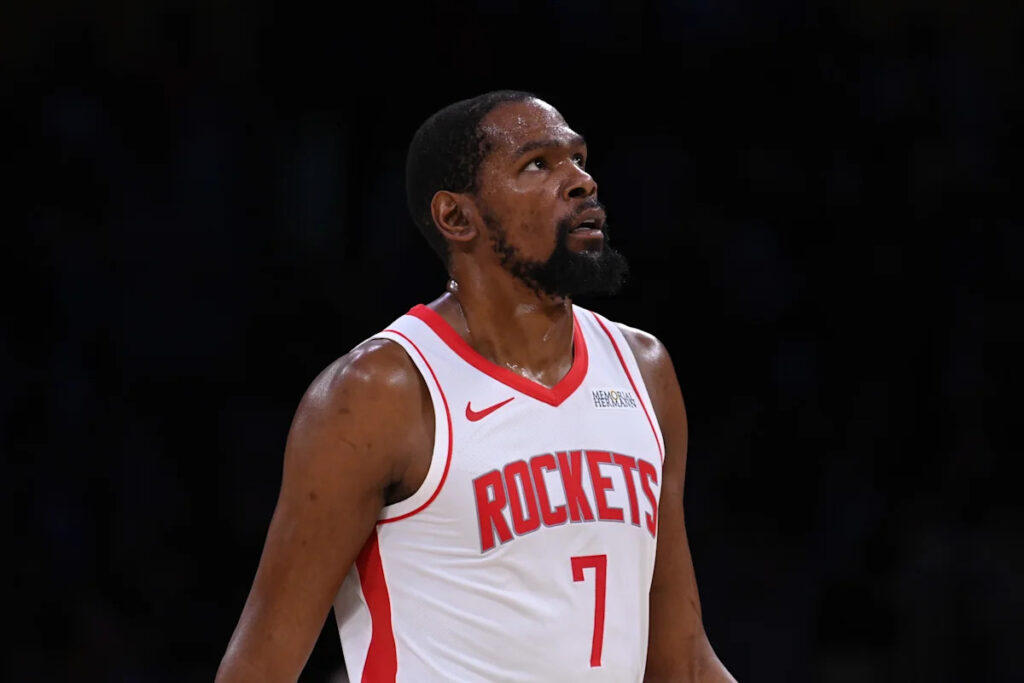
There’s no prototype, but there are prototypes. Jordan was the prototypical scoring guard. LeBron James is the prototypical point forward. The Houston Rockets’ Kevin Durant is the prototypical shot maker.

But one flaw has held him back from perfection.

Rockets’ Kevin Durant is a limited playmaker

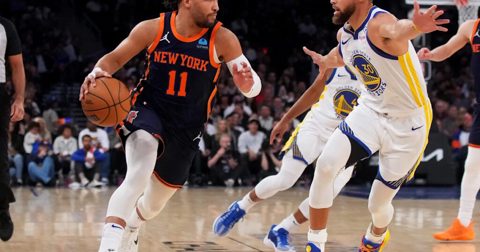
Recall the 2016 NBA Western Conference Finals. Durant’s Oklahoma City Thunder (boy, does that make you feel old) faced Steph Curry’s Golden State Warriors (maybe not that old yet).

Advertisement

Durant averaged 30.0 points per game. He was not, by any measure, bad. Yet, if you recall the series, something was markedly missing from Durant’s game.

He fired midrange shot after midrange shot. Some nights they fell; other nights they did not. Ultimately, Durant finished the series with a somewhat pedestrian 53.9 True Shooting % (TS%). What stands out in the memory is middy, after middy, after middy.

You will not recall a dazzling Durant pass from that series, because that is the hole that he has never plugged in his game.

The Warriors denied Durant’s jumper to the fullest extent of natural law, and it worked as well as it could have. Durant did not have the playmaking juice to counter. Where James would look to get teammates involved when his jumper wasn’t falling, Durant could only look to keep firing his jumper.

Advertisement

Durant isn’t a ball-hog. That would be unfair. The objective in basketball is to get the best shot, and his shot is often the best, so he ought to take it.

His career high in Assists Per Game (APG) isn’t even bad (6.4, in 2021-22 with a loaded Brooklyn Nets team), but it came with 3.5 Turnovers Per Game (TPG). It’s not Durant’s willingness as a passer that’s on trial:

It’s his ability.

Rockets’ Kevin Durant has room to improve

This is something of an aggregation piece. A quote from Durant’s trainer inspired it in this recent Rockets Wire piece about Durant;

“It’s about making sure that he develops as a passer through the double team”

Advertisement

-Jamal Lovell

The Rockets played 2025-26 without Fred VanVleet. He’s never a candidate for the “if he was taller” hypothetical. VanVleet isn’t a superstar; he’s simply solid. Turnover suppression is his single strongest quality as a player.

In his absence, Durant’s limited playmaking and turnover-proneness were on full display. For a man who’s spent his career so close to the zenith of the sport itself, Durant sure isn’t much of a playmaker.

But what if he were?

There’s another player that comes to my mind in the hypothetically perfect basketball player discussion: Blake Griffin. With the Los Angeles Clippers, he was able to assert his will through sheer outlier athleticism. An injury sapped his superpowers, and he reinvented himself with the Detroit Pistons as a far more skilled player. How close to perfect could he have been if those two timelines had intersected?

Advertisement

The point is that veterans can still learn new tricks. It isn’t too late for Durant to channel his inner playmaker. He’s not going to be 7’0″ Andre Miller with a lethal jump shot, but any growth in this area could be huge given how generally dangerous Durant is.

Imagine it. Durant spends his summer memorizing passing reads. He averages, say, 6.0 assists and 2.5 turnovers per game in 2026-27, and his signature scoring efficiency does not wane.

He’d be as close to perfect as we’ve ever seen.

Read the full article here

Leave A Reply

2026 © Prices.com LLC. All Rights Reserved.