





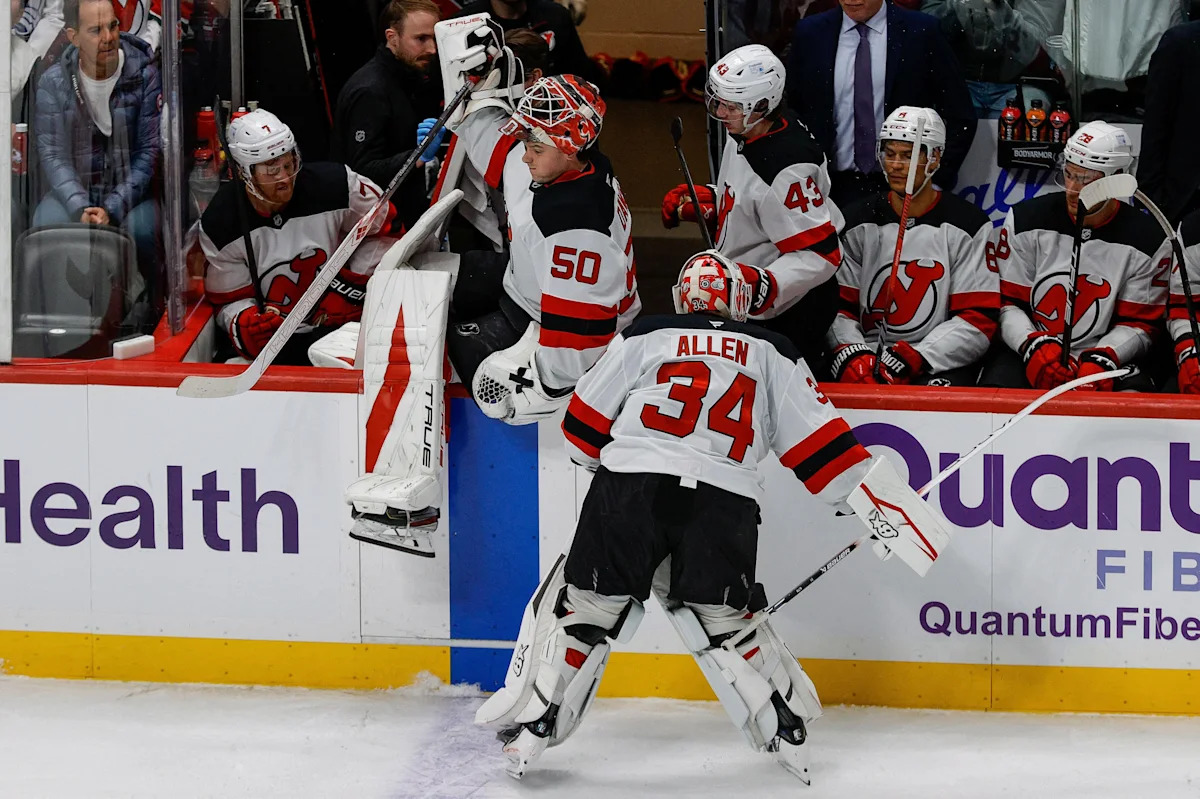
A key point in the New Jersey Devils’ struggles during the 2025-26 season revolved around one thing: goaltending. To outside eyes, it might seem like the Devils have done nothing to resolve that issue, but Sunny Mehta’s trade of Jacob Markstrom to the Florida Panthers was a true addition by subtraction situation. In Jake Allen, the Devils have a goaltender who has had two solid seasons for them, albeit in a high-end backup role. But the Devils have other goaltenders in Nico Daws and David Rittich who may be factoring into a better team goaltending outlook. Let’s dive in.
Click here for previous goals posts on forwards and returning defensemen.
Advertisement
The Goaltenders
Jake Allen
Goal: Handle a 42-Game Workload Without Getting Injured
The number one issue for whether the Devils’ current goaltending situation will work out revolves around Jake Allen’s ability to play a high number of games. If Allen can play half of the NHL season without getting hurt or seeing any major performance dips, it might not even be necessary to carry three goaltenders. Since the 2018-19 season, when Jake Allen was the 28-year old starter for the St. Louis Blues, Allen has only played 42 games once: in 2022-23, when he had an .891 save percentage and a 3.55 goals against average behind a horrendous Montreal defense. Since joining the Devils in 2024, Allen has a .904 save percentage and 2.77 goals against average in 77 starts and 81 games.
Advertisement
The most recent season, in which Markstrom was hurt for much of October, was Allen’s most games played since that 2022-23 season. Allen had a .903 save percentage and 2.74 goals against average in 36 starts and 37 games, which is right in line with the rest of his Devils tenure. But, diving into that a bit more: Allen had a .912 save percentage when he was the primary team goaltender in the first half of the season. Due to Markstrom’s injuries, Allen played 21 games out of the team’s first 40, and he had an 11-8-1 record (with another team win when he was pulled due to cramping). Over the rest of the season, Allen played 16 out of the team’s 42 games and had an .891 save percentage with a 6-9-1 record.
Per Natural Stat Trick, Allen was very good throughout the entire season, with 15.71 goals saved above expected. 11.92 of those goals saved above expected came in the first half of the season, with the rest coming in the second half. This, of course, indicates that Allen had a much tougher per-game workload than Markstrom had. Compared to Markstrom, Allen had a higher goals against average (3.04 vs. 2.87) in the second half despite having a better save percentage (.891 vs. .883). Maybe if the Devils give Allen the kind of defense they were trying to pull Markstrom across the finish line with, he can last a season without breaking down at all.
Nico Daws
Goal: Make It Unnecessary to Carry a Third Goaltender
Advertisement
In Nico Daws’s career, the 25-year old German goaltender has a 24-24-1 record with an .898 save percentage and 2.96 goals against average. All things considered, that is well within regular backup range in today’s NHL, which featured a league average save percentage of .893 in the 2026-27 season. But I am interested by whether Daws can be more than just a 20 or 30-game backup if he is used in a rotation that does not either have him sitting for long stretches or playing every single game for periods of time. That has been his career experience so far, for the most part.
When Nico Daws was first called up in the 2021-22 season, he played a few games here and there in October and February, putting up a .918 save percentage in six games with a 3-1-0 record. Daws was kept up in March and April, and from that last game in February, he played 20 out of the team’s 23 games. During that stretch, he only had an .891 save percentage with an 8-11-1 record. Breaking that down by stretches before a rest game looks like this:
-
First nine games: .901 SV%, 4-5-0
-
Next five games: .872 SV%, 2-3-0
-
Next five games: .892 SV%, 2-3-0
-
Last game: .885 SV%, 0-0-1
After getting hip surgery following the season, Daws’s usage pattern did not change in the 2023-24 season. Again, he was leaned on for long stretches that saw his performance dip over time. He had a relatively normal first eight appearances with an .895 save percentage and 3-5-0 record. Then, he played seven games in a row in February. Over the first four, he had a .942 save percentage, including his legendary Metlife Stadium performance when he stopped 45 of 48 shots. Most organizations would probably remember to sit a goaltender right after that game, considering his recent hip surgery, but he pressed on for three more games where he had an .800 save percentage, including two games giving up five or more goals.
Since being relegated to third goaltender status in the Markstrom-Allen regime, Daws has had a .925 save percentage and 2.02 goals against average in nine games with a 5-2-0 record in seven starts. In this period, Daws has only had to make consecutive starts once: the team’s 4-0 loss to Boston at the end of the last season in which Daws had an .846 save percentage.
Advertisement
Of course, Daws will have to make occasional consecutive starts if he’s going to share the net with Jake Allen alone. But the more Daws can reduce the need for a third goaltender, the more he can establish himself as a true NHL goaltender and possibly never get sent back to the AHL throughout the rest of his career. Sheldon Keefe might really just need to purely alternate their starts.
David Rittich
Goal: Play Every Game Like It Could Be His Last
David Rittich is in a different spot of his career than Jake Allen or Nico Daws are. Allen has a long-term contract and Daws is only 25. Rittich, by comparison, is 34 years old and coming off of two seasons where he had a save percentage under .900. Of course, Rittich has had positive goals saved above expected numbers in two of the last three seasons, but he has been incredibly inconsistent. He has been so inconsistent that I am not sure how much value he brings to a three-goalie tandem if he cannot play to a level that demands regular starts. And even then, I am not sure how much appetite I have for an all-or-nothing goaltender after experiencing Jacob Markstrom for two seasons. From HockeyViz, Rittich has clearly had very strong and very weak periods since joining Los Angeles in 2023-24.
Further negative streakiness could largely end Rittich’s career at this point, so he needs to make certain that he is at the top of his game every time he steps on the ice for the New Jersey Devils this season. With a contract that is under the threshold to be buried in its entirety in the AHL, Rittich has no protection from waivers. It would cost the Devils nothing. So, if Jake Allen and Nico Daws look like they can play 84 games without him, why would they keep him in the NHL? And if they need a spot starter, and Jakub Malek outplays him in the AHL (if Rittich goes unclaimed), why would they be certain to use Rittich as the third goaltender?
Advertisement
Goaltending is a fun position, though, in the sense that performance usually dictates opportunity. If Rittich plays like he did in the first half of his Islanders tenure, he could make something out of this situation and extend his career further.
Roster Hopefuls
As I noted in last week’s article, the Devils’ defensive depth is stacked. And with the length of that article, I thought it would be wise to separate them a bit into returning veterans and hopeful depth. We are starting off here with Declan Chisholm.
Declan Chisholm
Goal: Prove Sunny Mehta Right
Sunny Mehta is a big fan of Declan Chisholm. It does not even sound like Mehta believes Chisholm should be the seventh defenseman on the team, saying on Spittin’ Chiclets that “at times, he’s kind of dynamic offensively.” And as JP Gambatese pointed out when he was acquired, microstat tracking indicates that Chisholm does actually do a lot of good things with moving the puck in transition. Of course, Chisholm only played 26 games last season for Washington after playing 66 for Minnesota in the previous year, so I do not think we should pencil Chisholm in above Brenden Dillon just yet. But in Chisholm we have one of Mehta’s first big proclamations: that this is a guy who has been overlooked by just about everyone else and just needs a proper shot to show how good he is.
Advertisement
Let’s see if he can do it.
Vladislav Kolyachonok
Goal: Force a Platoon with Dillon or Chisholm
Personally, I have just as intrigued by Vladislav Kolyachonok, who was signed in free agency, than I have been by Declan Chisholm. Both players have been about as productive as the other in the NHL so far, but Kolyachonok has two things going for me: he’s a year and a half younger and seems to have a little more luck getting the puck into the net. Kolyachonok has five goals in 87 NHL games, averaging only 13:58 per night, while Chisholm has six goals in roughly 800 more NHL minutes played. Kolyachonok largely does this through seeing-eye shots (which is a skill), but he has scored some good-looking goals as well.
Advertisement
What Kolyachonok does not have going for him as much is that Chisholm has played enough to actually have more sample size in his analytic profile. So while Kolyachonok looks good in his minutes so far, that could change if he were more exposed over a larger sample. Still, I would like to see it put to the test at some point, but his best hope is to play well enough in camp that he gets a handful of games on the third pairing in the regular season.
Seamus Casey
Goal: Force a Defenseman Trade
Unlike players acquired by Sunny Mehta, Seamus Casey does not have a good analytic profile in the NHL, per public models. He has weak shot impacts, but has not played very much: not many conclusions can really be drawn from this data yet, even fewer than can be said about Chisholm or Kolyachonok. Also unlike players acquired by Sunny Mehta, Seamus Casey is a true blueline goal scorer, and he already has eight points in 16 NHL games.
Unfortunately, Casey’s time outside of the NHL has not been so smooth. Over the last two seasons, Casey has only played 59 games in the AHL due to injuries, putting up 37 points in that span. Frankly, you would want to see more. But Utica has been an utter mess under the neglect of Tom Fitzgerald and Dan MacKinnon, and it’s rather difficult to judge anyone’s production there, especially for an oft-injured player like Seamus Casey.
Advertisement
Now with Mehta and Birch at the helms of the NHL and AHL teams, Casey actually has one thing going for him in Mehta’s excitement for Declan Chisholm. The right side of the defense is more ironclad. No matter what you think of him, Dougie Hamilton is a Sunny Mehta player, and he isn’t being traded regardless of what goes on elsewhere on the roster. Brett Pesce and Johnny Kovacevic also have full trade protection this season which weakens considerably in the offseason. But if Seamus Casey plays so dynamically that Sheldon Keefe could be convinced to give him games, we could be looking at some Chisholm-Casey third pairing games this year instead of Chisholm-Kovacevic or Dillon-Kovacevic.
Of course, Seamus Casey is waivers-exempt. If he plays any NHL games this season, he will lose his exemption next year. So with how many NHL-capable defensemen there are in the mix for the Devils this season, he is going to have to show out in training camp to get that kind of play. And if he does get that far, the only way he sticks on this roster is by playing so well that Sunny Mehta trades a left-handed defenseman to make him the extra defenseman on the roster.
Anton Silayev
Goal: Throw a Wrench Into All of This and Push for a Top-Four Role
Advertisement
I have no expectation that Anton Silayev will be an NHL defenseman this season. However, I believe that he is already good enough to be one. Silayev has already played 187 regular season games in the KHL along with 19 playoff games. He only turned 20 in April, though. At his age, coming off a season where he played lesser minutes because of a new coach that overprioritized veterans, it may be in his best interest to start off with the Utica Comets where he can play 21, 22, or 23 minutes per game, possibly even mixing in some power play time in there.
But I think Anton Silayev was a tenth overall pick for a reason. If he comes into camp looking like a massive mobile beast on the blueline, I do not think the Devils should stop him from playing NHL minutes. But we do have to be aware of the realities on the blueline. As it is, the only truly tradeable contracts who are not obviously valued by Mehta are Brenden Dillon and Jonas Siegenthaler. All players listed above here, other than Seamus Casey, are waivers-eligible. The Devils might be able to sneak Vladislav Kolyachonok to Utica, but they won’t have any luck trying that with Declan Chisholm. If Silayev’s play demands a roster spot, a trade will be necessary.
But Silayev should only get this chance now if he can be given top four minutes. If Jonas Siegenthaler stays above him on the depth chart, there would be no reason to have Silayev play 16, 17, or 18 minutes per night, especially as Luke Hughes possibly pushes up to 24 or 25 minutes per night. The Devils can get Dillon, Chisholm, or Kolyachonok to provide something between fine and good third-pairing play, so they do not need to ask Silayev to possibly stunt his development by playing that role.
But be aware, he’ll be here sooner than later.
Advertisement
Your Thoughts
What do you think of the goals I set for the players in this article? Do you agree or disagree with them? Do you have any extras? Leave your thoughts in the comments below, and thanks for reading.
Read the full article here