





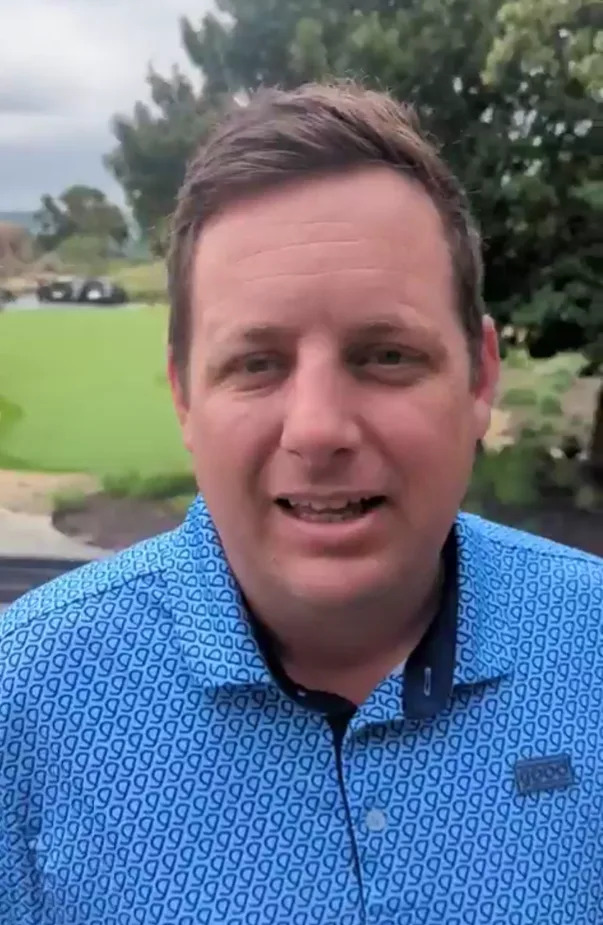
Not long ago, Good Good CEO Matt Kendrick told Golfweek, “Every day, it’s like we literally wake up and go, we have the best job in the world in doing what we get to do.”
But with plans for a major Golf Channel program tie-in and a PGA Tour event now wiped from the group’s resume, Kendrick and President Joe Flannery are no longer in those jobs, following the latest carnage from a failed ad campaign that appears to have caused irreparable damage to the lifestyle and golf brand. A memo to staffers Wednesday said the pair “decided to step down” from their positions with the company.
Advertisement
Nahid Giga, who is on the board of Good Good, has been installed as the interim CEO. Giga was an early investor in the brand.
In the video, music plays and a close-up shot of a driver in someone’s backswing appears, with “Good Good Studios presents: The Driver” appearing on the screen. Then, Good Good’s Garrett Clark sees a woman reaching for his driver, runs at her and shoves her to the ground. Standing over her, he threatens her by saying, “Do not touch my new driver.”
Former CEO blasted Callaway’s handling of controversy
Soon after Callaway severed ties with Good Good, the controversy took a dramatic turn late last week when Kendrick publicly accused the manufacturer of trying to shift blame for a campaign that dominated golf industry headlines for over a week.
Advertisement
In a series of early-morning posts on X, Kendrick unloaded on the equipment giant, suggesting Callaway had approved the now-infamous advertisement before distancing itself from the backlash after criticism mounted.
“Interesting that Callaway Golf asks us to make an ad then approves it then asks us to take the fall then drops us in a coordinated media blitz and covers it up by giving a million dollars away thinking everyone will be ok with it,” Kendrick wrote at 3:38 a.m. ET. “30 for 39 will be legendary.”
The remarks represented Kendrick’s sharpest criticism of Callaway’s handling of the situation, which began after the company pulled a promotional video featuring members of Good Good. The advertisement sparked widespread criticism across social media and golf media circles, prompting Callaway to remove the content and issue a charitable pledge of $1 million that many viewed as an effort to redirect attention from the controversy.
Callaway golf clubs are displayed at a sporting goods store. Callaway Golf and Good Good Golf apologized after a promotional video for a co-branded driver drew widespread backlash for depicting a male golfer shoving a female golfer to the ground.
Kendrick insisted he didn’t see the Good Good ad
Kendrick continued engaging with users throughout the morning, including one exchange in which he appeared to entertain the idea of legal action. When a commenter suggested Good Good should sue Callaway, Kendrick replied that he was “not opposed.” Although the post was later deleted, screenshots quickly spread across social media, adding fuel to a story that has shown little sign of fading.
Advertisement
Hours later, however, Kendrick struck a noticeably softer tone.
Speaking with Front Office Sports’ David Rumsey, Kendrick downplayed the lawsuit talk, describing the comment as an off-the-cuff response made in the heat of the moment. He told Front Office Sports that Good Good is “not thinking about” suing Callaway and clarified that the company is instead focused on moving forward.
Kendrick also revealed new details about the production of the advertisement, saying he never saw the final video before it was published. According to Kendrick, Good Good has since “removed the people responsible” for the ad’s creation, a significant admission that shifts some responsibility back toward the content creator group while continuing to raise questions about the approval process between the two partners.

Former Good Good CEO Matt Kendrick speaks with Golfweek at the Good Good Lonestar Shootout, which took place in Austin, Texas, at Horseshoe Bay Resort.
The latest developments added another layer to a dispute that has exposed tensions between one of golf’s fastest-growing media brands and one of the sport’s largest equipment manufacturers. What initially appeared to be a short-lived social media controversy has evolved into a public war of words filled with accusations, deleted posts and conflicting accounts of how the advertisement made it to market.
Advertisement
For now, both sides appear eager to avoid a legal confrontation. But Kendrick’s latest comments underscore that the relationship between Good Good and Callaway remains strained, and the story continues to generate far more attention than either company likely anticipated when the campaign first went live.
Callaway CEO Chip Brewer, in a statement last week, offered apologies for the video.
“The content was inappropriate and does not reflect our values,” Brewer said in the statement. “To be clear: we are unequivocally against discrimination, domestic violence, or threatening behavior of any kind.”

Fans gathered at the Good Good Desert Open in Grass Clippings Rolling Hills on Feb. 4, 2026. It is the third time the digital-first golf brand has hosted the event.
How did Good Good Golf rise to fame?
Good Good’s rise from YouTube sensation to one of the most influential brands in modern golf was fueled by a series of savvy business moves and high-profile partnerships. Along the way, the group has collaborated with some of the game’s biggest names, including Bryson DeChambeau, Rickie Fowler and Jack Nicklaus, helping transform creator-driven content from a niche corner of the internet into a legitimate force within the golf industry.
Advertisement
The Dallas-area company continued its expansion into the professional game in 2024, adding PGA Tour players Beau Hossler and Joel Dahmen, along with PGA professional Michael Block, to its growing roster of sponsored athletes. While the group’s lineup has evolved over the years, its core personalities, including Garrett Clark, Matt Scharff, Thomas “Bubbie” Broders, Stephen Castaneda and Brad Dalke, helped build one of the largest audiences in golf media. Other prominent creators, most notably Grant Horvat, passed through the Good Good ecosystem before branching out on their own.
The brand’s momentum only accelerated in 2026. Good Good announced an expanded relationship with NBC Sports while also purchasing an ownership stake in TGL’s Los Angeles Golf Club, further cementing its ambitions beyond digital content. At the same time, the company seemed destined for big things due to its partnership with Callaway Golf, a relationship that spanned three years and included the sale of co-branded equipment, apparel and accessories.
Behind that growth was significant financial backing. Good Good secured a $45 million investment round led by a group that includes Peyton Manning’s Omaha Productions, providing fresh capital to accelerate expansion plans, create larger-scale content initiatives and develop live events.
That investment netted results. Among the company’s marquee productions was the Good Good Lone Star Shootout, a made-for-media competition staged at Horseshoe Bay Resort near Austin. The event reflected Good Good’s vision: blending creator-driven entertainment, professional-caliber competition and fan engagement into a format designed for golf’s next generation of consumers.

Garrett Clark of Good Good plays his shot from the 13th tee during the 2025 Tour Championship Creator Classic at East Lake Golf Club in Atlanta.
Deleted ad started Good Good’s downward turn
But after a video posted August 21 drew widespread backlash among golf fans and social media at large, Good Good deleted it. In the wake of the public reaction, Golf Galaxy and Dick’s Sporting Goods removed all Good Good merchandise from their stores and online retail platforms. Golf Galaxy was also set to be the presenting sponsor of Golf Channel’s Big Break reboot in conjunction with Good Good, but the show was shelved after Golf Galaxy requested its branding be removed.
Advertisement
Soon after, PGA Tour CEO Brian Rolapp commented about the YouTube Golf brand’s advertisement snafu, saying during a news conference at the Tour Championship that the video was “concerning,” and that Good Good’s “initial response was disappointing. Later that week, the PGA Tour announced that Good Good has withdrawn its title sponsorship of the November tournament.
Kendrick saw Good Good competing with club makers
Kendrick’s departure marks the latest point in a sharp turn from the company’s rapid ascension. Prior to his involvement in Good Good, the Dallas-area resident was the CEO of House of Outdoors, a commerce company that worked with outdoor-focused products and properties, as well as Made by Influence, a company that focused on connecting influencers and athletes with brands in the apparel space. He was founder and CEO of PRNT, a similar company with ties to influencers based in Oklahoma City, as well as Fubelly, which helped diners find restaurants.
During the Good Good event in Austin in 2025, Kendrick told Golfweek that not only was the brand looking to handle bigger events — like the signing of a PGA Tour sponsorship deal — but it was conceivable the brand might eventually compete against some of the partners it held.
Advertisement
“We look at ourselves as a media and a product company at the end of the day, so it’s two different things. And, like, both of them are high revenue-generating sides of the business. I think products to me is where we start getting ingrained into the golf industry, and that’s when we maybe get taken a little bit more seriously. I know that’s going to take time to change people’s minds about us just being a YouTube channel in there,” Kendrick told Golfweek. “It’s different, and that’s great. But at the end of the day, we’re still trying to build great products, and we’re going to try to build the best products in the golf space. That’s not just us slapping our logo on something and putting it out there.
“We know how important it is for stuff to be quality because we live in such a public view. And so, if we put out a bad product like, we’re going to hear about it. You can just get on and comment on anything. We want to be known as one of the top five brands in golf, one day. That’s what we want to be known as, and so if that’s competing with TaylorMade and Titleist and Callaway at some point, like, that’s, that’s how we view it. We just do it differently.”
Kendrick also told Golfweek that although he was happy to have added partnerships with traditional media companies, he still felt the original tie to YouTube was what made Good Good so strong.
“I wouldn’t change anything. I think YouTube is one of the best ways to build a business from the ground up in this world and as time goes on, everyone needs to realize they have to be a content creator in some way. And you know, YouTube is a great way to do that, especially in the golf space. Putting out long-form content, YouTube’s a great platform for that, and it will always be the foundation of what we do. It’s not the only thing we focus on. That’s why we have the relationships with NBC and others, because I believe that we’ve got to go find people,” Kendrick said. “We need to go meet people where they are, and so not every golf fan is watching YouTube. And that’s fine. We don’t need every golf fan to watch YouTube. We would love them to watch our stuff, but it’s great to have great relationships with others and be able to do things like this, and then we can go find the other audiences and meet them where they are. I know that there are a bunch of people watching the Golf Channel, so that’s why we want to show this product on there and get them exposed to what we’re doing and continue to grow the brand even more.
Advertisement
“And so we’re not stuck on just YouTube. I can’t thank NBC enough for helping and seeing the vision, what we see, and they’ve benefited greatly from it as well.”
Tim Schmitt is the managing editor of Golfweek.
This article originally appeared on Golfweek: Who is outgoing Good Good CEO Matt Kendrick and what was his vision for the brand?
Read the full article here