





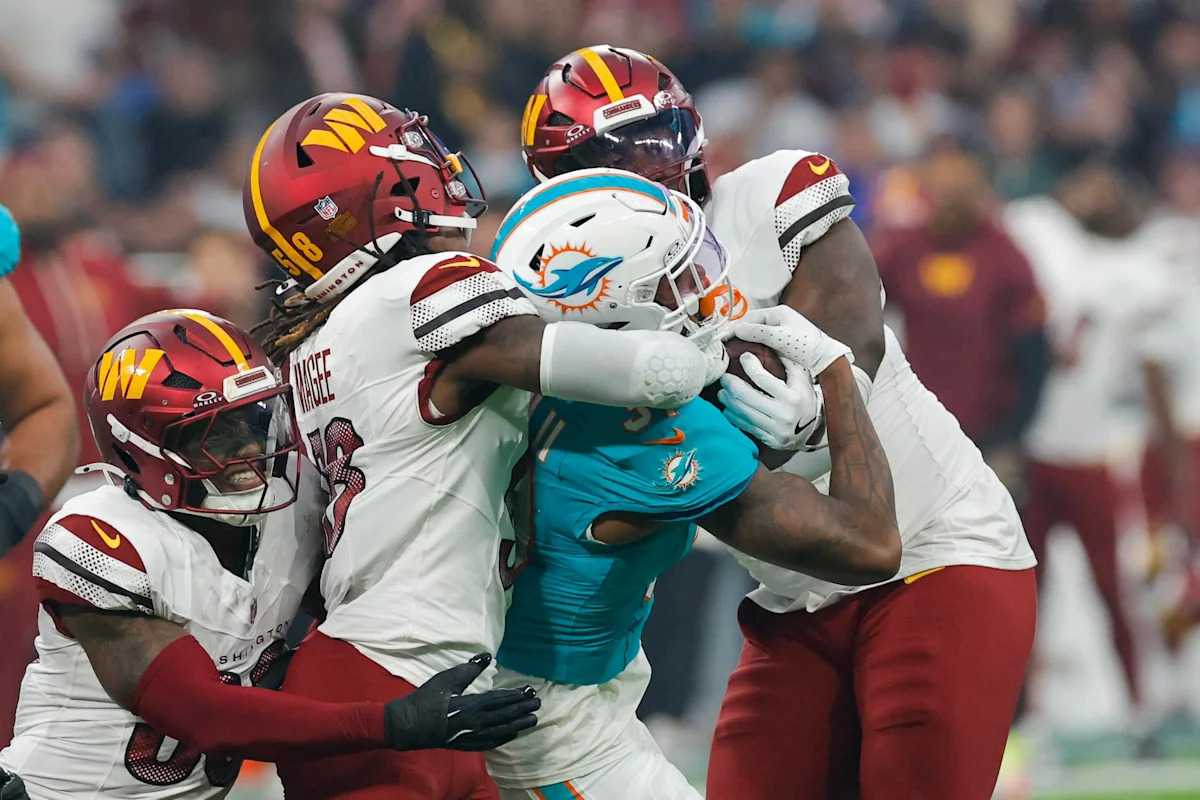
In this week’s Reacts survey, we asked what Hogs Haven readers were interested in with respect to the scheduled joint practice at Ashburn and preseason game in Landover vs the visiting Miami Dolphins next week.
The results underscore the relative sophistication of the survey respondents and reflect recent NFL trends in training camp and preseason preparation.
Visit our partners at FanDuel
These poll results are indicative of a greater truth: the traditional NFL preseason game is dying. In its place, a more efficient, high-stakes alternative has taken over the month of August: the joint practice.
Advertisement
For decades, NFL training camps were isolated grinds. Teams stayed on their own campuses, hitting the same teammates for three weeks before playing highly scripted preseason games where starters barely saw the field. Today, the landscape is completely different. Joint practices, where two franchises meet at a training facility for a few days of controlled, intensely competitive scrimmages, have become the focal point of the summer.
The numbers trace a clear shift in league philosophy. In 2014, roughly one-third of the league participated in joint sessions. By 2019, that number had climbed to more than 20 teams. In the wake of the 2020 pandemic disruptions, the trend accelerated rapidly. When the NFL officially reduced the preseason from 4 games to 3 in 2021, joint practices shifted from a useful option to a near-absolute necessity. By 2024, a record 28 of the 32 NFL teams scheduled at least one joint practice, with several teams booking multiple sessions across the month.
The primary driver of this growth is control. In a standard preseason game, a head coach cannot control the environment. They cannot, for example, risk their starting quarterback taking a blindside hit from an opposing defensive end who is on the roster bubble and trying to make an impression on his coaches. Joint practices do a lot to solve this issue. Coaches are able to agree ahead of time on specific rules such as no tackling of the quarterback, quick whistles on run plays, and specific situational drills like third-and-long or two-minute drills.
This environment allows starters to get high-quality, game-speed repetitions without the standard game risks. A starting offense can run 40 plays against a premier first-string defense from the opposite conference—something that never happens in modern preseason games where starters sit on the bench to avoid injury. Coaches get film of their top players executing the actual playbook against unfamiliar schemes and elite talent.
Advertisement
Dan Quinn discussed some of the benefits of joint practice during his press conference prior to Saturday’s practice:
One, I like it for the competitiveness. You know, going against the same guys, you starting to learn formations and players and people. So, [I] like [joint practice] for the sake of [going] against I new group.
I also like it for the evaluation of that too — of seeing who steps up.
And then, in the practice itself, it might be a little bit more creative than the actual games, meaning…where you may not show some of those in the games, but in the practice you may work [on them] a little bit more.
I like that we get skill work, one-on- ones, and then, in the team period, some scripted, some not.
[Also, is the evaluation versus another team]; are we behind in an area? Is this an area that needs more attention? Or, this is taking longer than we [want] to get ready.
Fans have noticed this shift in quality, causing a surge in interest that is reflected in our Reacts survey results this week. Public attendance at these sessions has skyrocketed. Fans realize that if they buy a ticket to a mid-August preseason game, they will spend three hours watching third-string players who may not make the final 53-man roster. Conversely, attending a joint practice guarantees a great seat to see elite matchups, like an All-Pro wide receiver going head-to-head against a lockdown cornerback in one-on-one drills.
The media coverage reflects this fan demand. Local radio stations now broadcast live from the sidelines; national insiders track daily wins and losses, and social media clips of practice touchdowns generate millions of views. For the modern fan, joint practices offer raw, unfiltered access to the highest level of football competition weeks before the regular season begins.
Advertisement
On Saturday, DQ addressed whether joint practices are more critical to creating controlled competition for starters than preseason games:
I think there’s probably some balance where it’s not just one or the other, but having two of them [joint practice & preseason game] certainly helps. And so, for us, [facing] Miami [and] Baltimore with a game sandwiched in between, I like how that flows. But as far as who plays what and how much, I think that’s a good ‘next week question’. But what I can say is that there’s a lot of value in these [joint practices] and I can see, moving forward, why they’re good for the league, [and] good for us — not as an alternative to a game, but [as an] addition to it.
The model, of course, is not without issues. The most prominent risk of joint practices is the inevitable outbreak of fights. When two groups of highly competitive athletes compete in the summer heat after weeks of practicing against their own teammates, tempers flare. Most Commanders fans above the age of 20 will probably remember that, during a 2015 joint training camp session in Richmond, Virginia, tension boiled over between Jay Gruden’s Washington squad and Bill O’Brien’s Houston Texans. A series of skirmishes escalated into a massive, multi-field brawl involving large groups of players from both teams. Unable to restore order and fearing potential injuries, Gruden and O’Brien chose to completely separate the teams and finish the day on isolated fields. Following the incident, which was featured prominently on HBO’s Hard Knocks, Gruden lamented the wasted opportunity for productive work.
Furthermore, the risk of injury is never completely zero. Even without live tackling, players still suffer non-contact tears or collisions at full speed. When a star player goes down during a joint session, critics quickly question the wisdom of putting players in such a high-intensity environment before September.
Advertisement
Washington fans were reminded, this week, of the fact that practices are not without risk. On Saturday, starting left tackle Laremy Tunsil suffered a torn tricep in a one-on-one drill versus Odafe Oweh.
However, it seems that the benefits continue to outweigh the drawbacks for NFL front offices. The controlled environment protects players better than live game action, while still providing the evaluation data that general managers need to cut the roster down to 53 players. As long as the 3-game preseason model remains (or when the 2-game model is inevitably introduced along with the 18-game season), the joint practice will continue to rise in importance as a centerpiece of the NFL summer.
Joint practice
The Commanders joint practice with the Dolphins is scheduled to take place on Wednesday, August 12th. It will get extensive coverage by local media, and Hogs Haven will provide the usual updates throughout the day.
Advertisement
First preseason game
Washington’s first preseason game is less than two weeks away; it will be a home game vs the Miami Dolphins on Friday, August 14th at 7:00 p.m. ET.
Week 1 game
The Commanders open the season on the road against the defending NFC East champs, the Philadelphia Eagles. The game will be played on Sunday, September 14th at 4:25 p.m. ET.
Visit our partners at FanDuel
Read the full article here