





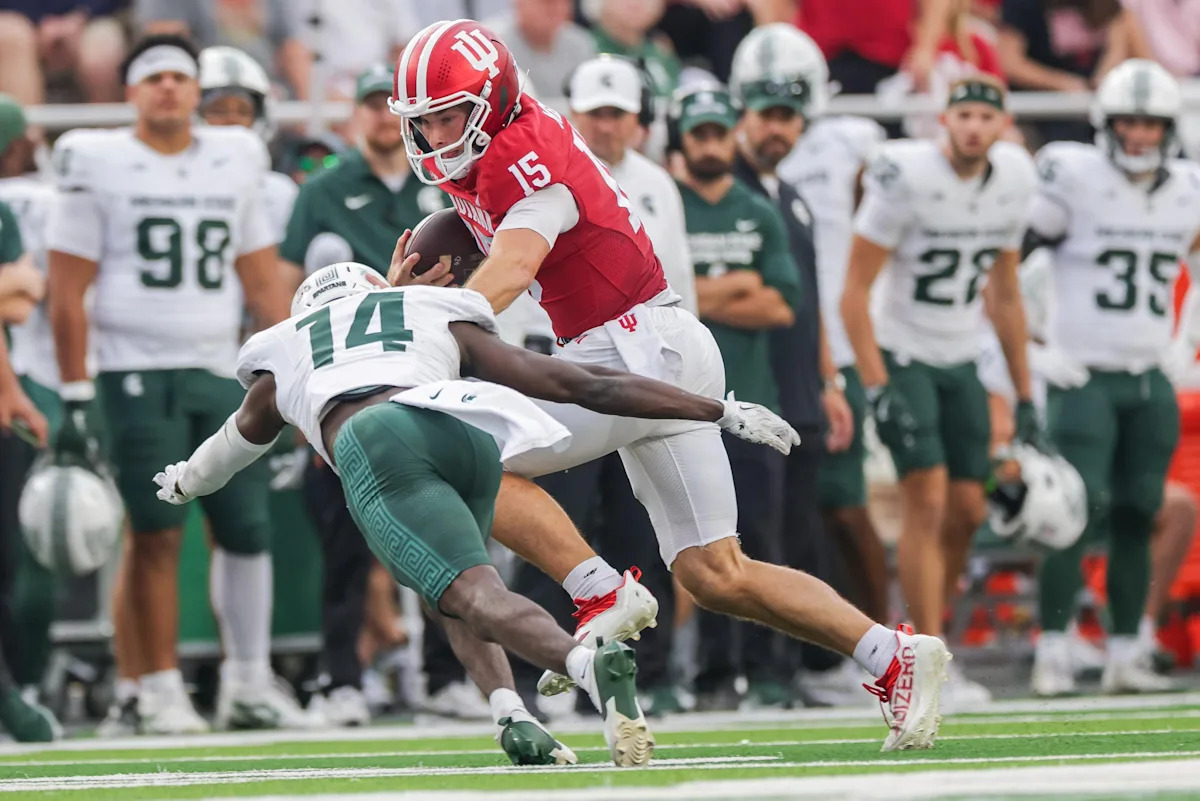
Up next in Silver and Black Pride’s Mendoza Mania series is the only 300-yard performance from Fernando Mendoza’s final College Football season, as the Indiana Hoosiers took down the Michigan State Spartans 38-13 in Week 8.
Statistically, this was the No. 1 pick of the 2026 NFL draft’s best performance of the season, completing 24 of 28 pass attempts (85.7 percent) for 332 yards and four touchdowns with no interceptions. According to Pro Football Focus, one of those incompletions was due to a drop, and he tossed a couple of “big-time” throws to make the outing even more efficient and impressive.
Advertisement
So the negative plays were few and far between in this outing, allowing us to focus on the positives in this breakdown of the new Las Vegas Raiders quarterback’s performance and to dive into how his arm strength stood out in East Lansing, Michigan.
Beyond bombing the ball down the field, one way that Mendoza showed off his arm strength in this game was by putting velocity on his short to intermediate throws to beat coverage.
It’s third and 12 here, and Indiana runs a variation of four verts from a two-by-two formation. The outside receivers run go routes that they can convert into curls, as Elijah Sarratt does at the bottom of the screen, and the slot receivers run seam routes. However, Michigan State plays quarters coverage, which is a good defense for the offense’s play call.
Advertisement
The outside corners have the freedom to play in press coverage or not, since they’re essentially in man coverage, it’s just a matter of what they’re comfortable with. The two above are good examples of that, with the corner at the top playing press against Omar Cooper Jr. and staying in Cooper’s hip, while the corner at the bottom is in off coverage and stays on top of Sarratt to force the curl route.
So, the defense takes away the quarterback’s two one-on-one matchups, forcing him to move onto the slots, where the coverage has a pair of high-low brackets. The two underneath defenders are responsible for covering any short routes from the slot receivers or getting a reroute and passing the wideouts off to the safeties against a deep route, which both execute well on this play.
That leaves a tight window between the second and third levels of the defense for Mendoza to hit to pick up the first down. Also, the timing on the routes is thrown off because of the reroutes, meaning the ball will be a little later than normal or what would be ideal to throw into the window. As a result, it’s going to take a fastball to beat the coverage/safety and move the chains.
Luckily, Mendoza rears back and throws some heat to get the ball to his man before the safety can make a play on it or jar the pass loose with a big hit. Also, the placement of this throw is perfect, away from the defender and right in the receiver’s belly so that he can brace himself for the hit and protect the ball.
Advertisement
While this is only about a 15-yard completion, there’s plenty of arm strength involved in the throw, combined with some accuracy while dialing up the velocity.
This next clip is similar to the last one, but it’s a shorter throw and the timing is perfect.
The Spartans drop into Cover 3, but with a small wrinkle. They run a simulated pressure by blitzing the middle linebacker, but drop the edge defender at the top of the screen into the curl-to-flat area of the zone coverage. That changes the timing of the play for the quarterback, because a typical pass-rusher is dropping into the window he’s trying to throw into, and the passing lane shifts closer to the middle of the field with the linebacker blitzing.
Advertisement
However, Mendoza recognizes what the defense is doing and knows that the window in the middle of the field gets even bigger when the linebacker who stays in coverage (No. 5) widens with the running back’s motion. So, Mendoza stays calm, sees Cooper win on the slant route, and throws with perfect timing by letting the ball go once Cooper passes the edge defender who dropped in coverage.
That, combined with putting some zip on the pass, allows him to maximize the throwing window and beat the coverage for a first down.
Now, let’s combine the two previous clips and dive into an intermediate throw that’s on time and has good velocity to expose a window in the defense’s coverage.
Advertisement
Here, the Hoosiers run a Levels concept on the wide side of the field, where the slot receiver runs a deep or 20-yard dig route while the outside receiver runs an intermediate or 15-yard dig, and the running back releases for the checkdown. Meanwhile, the Spartans are in Cover 6, where they play quarters against the Levels concept.
So, the deep dig route occupies the safety, leaving the corner man-to-man with the outside receiver and no help over the top. But the curl-to-flat (nickelback) and middle hook (MIKE linebacker) defenders can help against a route over the middle, in theory. However, the linebacker steps downhill to pick up the running back on the checkdown, and the nickelback stops getting depth at the first down marker, leaving the corner out to dry.
Mendoza recognizes the big window in the middle of the field and hits the intermediate dig route with great anticipation and timing, starting his throwing motion right before the receiver passes the curl-to-flat defender, and with good velocity to make sure no one can make a play on the ball. That sets up an easy pitch and catch over the middle for a 20-yard gain.
That being said, the deep ball was alive against Michigan State, as we’ll get a look at one of the “big-time” throws mentioned above.
Advertisement
The Spartans are in Cover 6 or a split-field coverage, where the defenders at the bottom of the screen run Cover 2, and the defenders at the top of the screen run quarters. Meanwhile, the Hoosiers run a split-field read, with a Smash concept on the short side of the field and a Mills concept on the wide side.
Cover 2 is the perfect answer for Smash because the safety can take the deep route from the slot receiver (in this instance, it’s a slot fade instead of a corner route) and the corner can sit on the short curl. However, Mills is designed to beat quarters. The crossing route from the slot (in this instance, a basic/over route instead of a standard dig route) occupies the safety, leaving the corner to cover the post with outside leverage and no help over the top.
Watch Mendoza’s eyes/head post-snap. First, he looks at the boundary safety, seeing the safety working for depth and opening his hips toward the sideline to identify Cover 2 and know the Smash concept is taken away. Then, he finds the field/other safety, and recognizes that the defensive back is following the crossing route to execute the quarters coverage.
Now, the quarterback knows he has a favorable matchup with Cooper running a post against a cornerback who has no deep help. So, Mendoza rears back and delivers a dime that is on a line and hits Cooper in stride for a 48-yard touchdown.
We’ll wrap up with another deep shot and a great read to take advantage of a mistake by the defense.
Advertisement
Indiana comes out in 12 personnel and lines up in a three-by-one formation with the running back on the three-receiver side. So, Sarratt is on an island with the cornerback across from him as the single receiver and has a lot of lateral space to operate with the ball in the middle of the field. Meanwhile, Michigan State comes out in a two-high look and runs quarters again.
Typically, when playing quarters against a three-by-one formation, the defense will shift its safeties to favor the three-receiver side or passing strength, especially with the back also on the passing strength, and leave the corner in man coverage against the solo receiver. However, with the two inside receivers being in-line tight ends since the offense is in 12 personnel, it makes sense to stay in a standard two-high look so that the safeties can help against deep routes from the two receivers.
The problem is that the safety at the top of the screen is creeping downhill and is late to get depth post-snap, so he ends up covering nothing but grass. Once Mendoza gets the ball, he eyes that safety and sees the safety isn’t in a position to help the corner, creating a one-on-one opportunity for Sarratt. Granted, the corner has decent coverage, where he doesn’t allow any separation. The ball is just perfectly placed, where the receiver doesn’t have to slow down and can go up and get it in the front of the endzone.
Up next is another dominant performance from the Hoosiers, where Mendoza tossed three touchdown passes against UCLA in the 56-6 win.
Read the full article here