





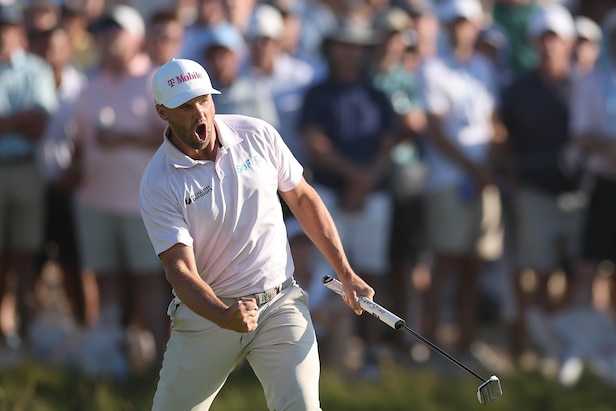
SOUTHAMPTON, N.Y. — For five hours Wyndham Clark tried to win a national championship in front of a crowd that didn’t want to see him do it. They made their feelings known in screams, in jeers, even in silence. And when the outcome was no longer in doubt, when Clark’s 50-foot birdie try at the 18th stopped inches short, his arms rose while the applause barely did, the reaction a strange blend of reluctant respect and studied indifference.
It was the sound that greeted an imperfect man who walked into hell and answered with defiance. And for that, Wyndham Clark is the 2026 U.S. Open champion.
Advertisement
“Man, I mean, the first one was amazing, and this one seems even better,” Clark said after a final-round three-over-par 73 for a four-under total that bested Sam Burns by a shot. “I think especially after such a sour taste last year in this championship, to have some redemption and win this again is, gosh, it’s almost surreal.” To understand why Clark received such a frosty reception, you first have to understand what he did and who he is. This week has belonged to him since Thursday evening, when he exploited calm conditions at the tail end of a fog-delayed opening round to build a four-shot advantage as dusk settled over Shinnecock.
That lead largely held on Friday and expanded on Saturday. With no serious challenger emerging and every marquee name not named Scotttie Scheffler effectively neutralized, Clark occupied the stage alone. And with the spotlight fixed solely on him, it illuminated qualities many would have preferred to ignore.
Golf is a sport largely devoid of polarizing figures. Clark is the exception, and once he commandeered the tournament his reputation came under renewed scrutiny. Over the last three days, some observers, including Clark himself, have attempted to reduce his divisiveness to last year’s locker-room incident at Oakmont. It was unbecoming, certainly, particularly coming on the heels of a similar outburst a month earlier at Quail Hollow. But Clark’s history is too layered, too nuanced, to be distilled into a single episode. In fact, that incident may be the least consequential of the grievances held against him.
Clark has cultivated an uncommon aptitude for materializing at the epicenter of rules disputes. He has never been accused of the c-word from competitors; alas, golf fans’ jurisprudence operates on a different frequency than the rule book. They need only proximity, and Clark has demonstrated a remarkable instinct for wandering into compromised territory.
2282176265
Wyndham Clark celebrates with the winner’s trophy at Shinnecock Hills.
Advertisement
Tracy Wilcox
He pairs this with an equally consistent ability to say precisely the wrong thing at the wrong time with an inflection that often comes off as arrogance. A birth control quip at the Masters Par-3 Contest registered somewhere between provocative and incoherent, depending on the listener. He took aim at playing conditions at the Hero World Challenge, a charitable exhibition where the greens are, by design, the least of anyone’s concerns. He weighed in on Brooks Koepka’s return to the PGA Tour with pointed skepticism, awkward positioning for a man who had once fielded his own LIV overtures.
He is, at minimum, unafraid of friction. He showed up to the RBC Canadian Open’s rink hole in a USA hockey jersey—the athletic equivalent of crashing a funeral in the deceased’s rival team’s colors and asking if there’s an open bar. At the Presidents Cup, he mimicked Si Woo Kim’s signature “Night Night” celebration seconds after Kim had performed it himself. The jersey read as a bit. The imitation, not as much.
But not all sports animus can be traced to a specific grievance. Some athletes possess an instinctive magnetism; others remain strangely distant no matter how impressive the résumé. Clark occupies a third category. Part of the criticism is earned. Part of it seems to exist independent of anything he has done. Sports fandom has never pretended to be rational. We don’t choose what we feel in the stands.
Advertisement
That was the backdrop on Sunday at Shinnecock, and given that Clark was paired with one of the game’s most beloved figures in Scheffler, there was little mystery about where the gallery’s loyalties would lie. What was striking, however, was not whom the crowd supported but how openly it reveled in Clark’s misfortune.
On the opening tee, one spectator shouted, “Crash and burn!” while another pleaded for Clark’s drive to find the bunker. When his errant approach at the fourth finished near a garbage receptacle, a fan barked, “Just like your game, trash!” The gallery erupted when his chip at the fifth rolled back to his feet, and a missed par putt at the seventh drew a roar more befitting a birdie. Equally telling was the response when Clark succeeded. After an all-world scramble at the fourth preserved par, the applause was so sparse it could be counted on one hand.
“Man, they definitely didn’t want me to win. It’s pretty rare in a U.S. Open Championship or a major to have fans kind of boo against your shots or cheer for bad shots,” Clark noted.
No, it was not as venomous as what Rory McIlroy endured down the road at Bethpage during last fall’s Ryder Cup. But that hostility, however ugly, was largely tribal in nature—a byproduct of nationalism and sporting chauvinism. Outside those three days every two years, McIlroy remains one of the most admired figures in the game. What unfolded on Sunday was different, and in some ways more troubling. What happened to Rory was transactional. What happened to Wyndham Clark was personal.
Advertisement
To be clear, as Clark himself acknowledged, some of the backlash was earned. His recent conduct invited scrutiny, and criticism is part of the bargain that accompanies life in the public eye. Yet deserving criticism is not the same as deserving humiliation, especially in that moment and in that manner. There is a line between accountability and cruelty, and too often modern sports crowds seem incapable of distinguishing between the two. As American golf fans, we should once again be embarrassed, not merely by what we tolerate but by what our culture increasingly encourages and rewards.
Which is why this should not be mistaken for a redemption story. Too often, the game’s cognoscenti mistake “overcoming adversity” for little more than a few well-timed shots papering over deeper moral ambiguities. This is not that. Yet acknowledging those complexities does not preclude an appreciation for what Wyndham Clark confronted on Sunday, or the resilience with which he answered.
Because after a bogey at the seventh, the six-shot cushion Clark had begun the day with had all but evaporated. Sam Burns had turned in 32, applying the kind of pressure Scheffler ultimately could not. The momentum had shifted, and with it came the familiar temptation to tighten up, to retreat inward, to let the occasion become too large. It would have been understandable—human, even—for Clark to shrink beneath the weight of the moment.
Instead, he responded with defiance.
Advertisement
Even as his ball-striking had abandoned him over the previous two days, Clark produced one of the great scrambling exhibitions seen on a major stage this century. Nearly every hole became an exercise in survival. Nearly every hole demanded another nervy par save from 10 feet or beyond. Time and again, he staggered into danger only to emerge unscathed. “I was kind of making jokes about it with [my caddie] where if we heard someone cheer for me, I’d go, oh, there’s one person that likes me,” Clark said. “So we would kind of make jokes and make it maybe a little light-hearted.
“But it’s tough, man. I’ve played now a Presidents Cup and Ryder Cup on foreign soil, and it kind of had that atmosphere a little bit. I also got good prep last week in Canada. They were pretty harsh on me the last day, so I think that all of that combined kind of led to this moment where, all right, I’ve been in this position.”
That resilience was perhaps best embodied at the par-5 16th. Clark’s tee shot sailed left, settling in thick fescue with a lie that promised little but trouble. Somehow, he hacked it free and advanced the ball nearly two football fields down the fairway. His third shot raced long, leaving an improbable 24-foot birdie attempt. His fourth stroke found the center of the cup, a stunning conversion that gave him a two-shot cushion with two holes to play.
Burns, meanwhile, had been steady coming home, but golf has a cruel way of exposing the smallest cracks. A three-putt at the 15th squandered precious momentum. A makeable birdie chance slipped away at the 17th. And at the 18th, his bid to force a tie died inches shy of the hole. It was the runway Clark needed after his own three-putt disaster at the 17th. All that remained was to bring the plane home, which he did with the lag putt at the last.
Advertisement
We often speak of pressure and adversity as abstract concepts. What unfolded Sunday was something far more tangible. It was a man confronting both while absorbing every punch they delivered.
“It sucks being the underdog or getting rooted against,” Clark said, “but I can pull through, and there’s nothing like winning kind of an away game.”
Because Clark’s reputation has become a matter of constant debate and revision, it is worth remembering that few things in life are neatly rendered in black and white. When Wyndham was a boy, his mother, Lise, was diagnosed with breast cancer. She fought the disease while doing what mothers so often do: placing the needs of their children above her own. It was Lise who introduced him to golf, who ferried him from tournament to tournament, who celebrated the victories and steadied him through the disappointments, all while living with the knowledge that death was never far from the doorstep. She battled with extraordinary courage, but cancer is an opponent that does not play fair. In 2013, Lise lost that fight. Wyndham was just 19 years old.
2282677067
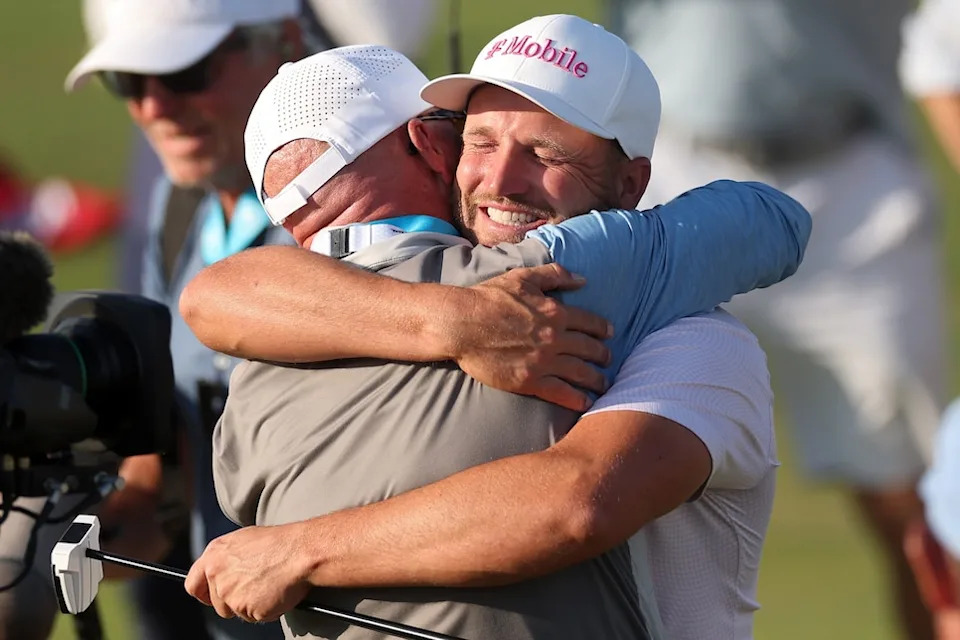
Wyndham Clark hugs his father, Randall Clark, after winning the U.S. Open.
Advertisement
Christian Petersen
Her death left him untethered. The years that followed were marked by grief, anger and confusion. After a promising freshman season at Oklahoma State, his game unraveled. Seeking a fresh start, he transferred to Oregon, hoping distance might dull the pain. It did not. The hurt followed him west, and the rage that accompanied it became so consuming that his teammates staged something of an intervention, urging him to confront the anguish before it consumed him entirely.
There were moments when Clark considered walking away from the game. Yet he kept going, not because he knew things would improve, but because he feared surrender would make the darkness worse. Slowly, he began to open up to friends. He immersed himself in motivational books. He sought professional help. Piece by piece, he rebuilt himself. When he won the U.S. Open at Los Angeles Country Club three years ago, it seemed as though he had reached the summit, proof that he had conquered the mountain.
But grief, depression and self-doubt are not mountains that can be permanently scaled. They are recurring adversaries. Victories over them are real. They are simply never permanent. In the years since Los Angeles Country Club to here, Clark has lost his share of those rounds, including the spiral that followed his locker-room outburst last summer. “It took a while. You know, I think, one, I have an amazing team around me, and … we made a little cocoon, and they were there to help me through that time,” Clark said. “Then, there was a lot of things. … I’ve kind of pushed that time out of my memory, but I do remember it being tough. It didn’t end because I was really trying to make the Ryder Cup. Obviously didn’t, and that was also another just kind of jab to the stomach that I didn’t make that.
Advertisement
“So, yeah, it was a tough June to August last year, but I’m just happy I’m here on the other side of things.”
These things do not excuse the others. But they do what context, honestly considered, always does, which is complicate the verdict. Athletes who inspire strong feelings are rarely simple, and the ones most worth watching almost never are. Modern golf is rich in protagonists and poor in counterweights. The imbalance has dulled some of the game’s dramatic edge. Sports animosity, properly channeled, is not something to eliminate but something to understand. The worthy adversary gives definition to the hero, sharpens investment and injects tension into an enterprise that can otherwise feel sterile. Few athletes can sustain that role without slipping into self-parody. Fewer still can do it authentically.
Clark insists he has no interest in being a villain. But if that’s the role he’s been handed, he seems increasingly comfortable carrying it.
You can sympathize with the hardships he has endured and still feel exactly as you do about Wyndham Clark. Those ideas are not mutually exclusive. Nor should acknowledging his flaws preclude the belief that the treatment he received crossed a line the game should aspire to rise above. And you can dislike Clark while still admiring the way he absorbed five hours of hostility with composure and grace.
It’s complicated. Sunday’s result is not. The crowd wanted Wyndham Clark to fall. He leaves Shinnecock as the last man standing.
Read the full article here