





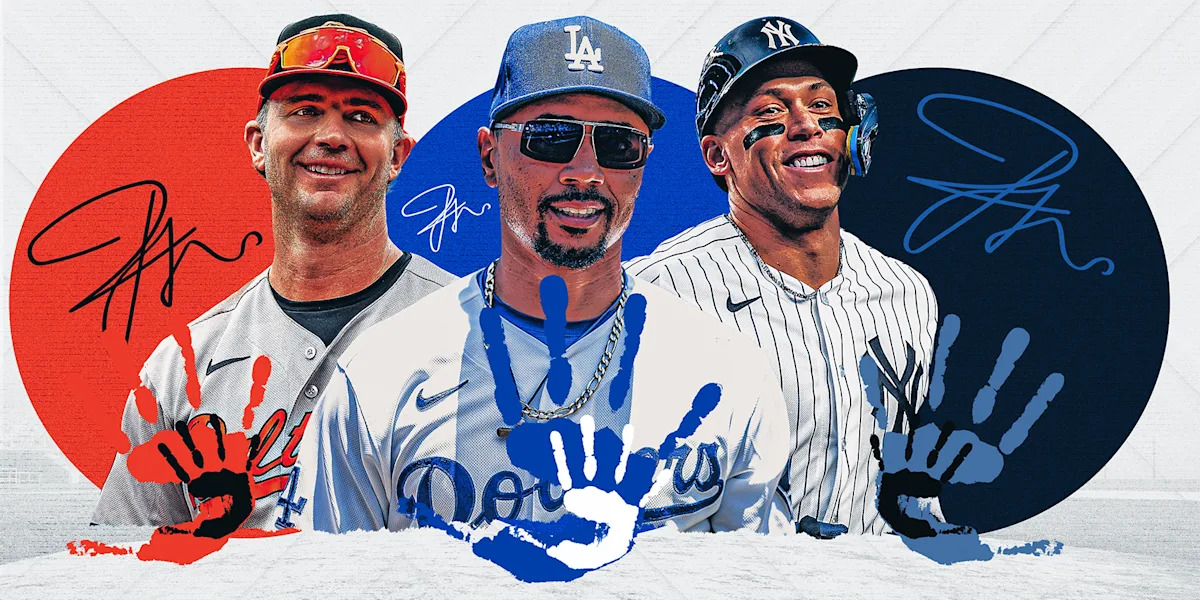
How becoming a father changes a ballplayer’s perspective
Baseball — or, at least, being good at it — is often a selfish endeavor.
The sport’s best players, the top of the top, are some of the most laser-focused, tunnel-visioned, myopic people on Earth. Baseball’s near-daily schedule intensifies that dynamic, reinforcing the head-down mentality. For as long as most big leaguers can remember, their lives have revolved around four bases and little else. These are elite athletes who, since adolescence, have been hellbent on squeezing the most out of their god-given gifts. Within that, success breeds greediness and feeds narcissism. There’s no “I” in “team,” but there is a “me.”
Advertisement
“I think, growing up, all of us out here, our responsibility was to play baseball and be good at it,” Dodgers star Mookie Betts recently told Yahoo Sports.
But for Betts, fatherhood transformed everything.
“You’re suddenly in charge of another human. Your roles and thought processes immediately change,” said Betts, who has three kids with his wife, Brianna. “It’s not really about you as much anymore. Of course, we come here and take care of our jobs and do what we need to do to be successful, but at the end of the day, this doesn’t compare to being a parent.”
This is not a phenomenon particular to ballplayers. It’s how most parents delineate their lives: the before and the after. But given the relentless MLB calendar, being a big-league dad is a unique experience, one that many players say has helped them grow on and off the field.
Advertisement
“The biggest thing is it kind of puts it all in perspective — it’s a game,” Yankees captain Aaron Judge, whose daughter, Nora, was born in January 2025, explained. “I’m out here giving my all to the New York Yankees, but 4-for-4 or 0-for-4, I come home, [and] I got a little girl smiling at me. She’s not looking at swings. She’s not looking at box scores.”
So much of being a successful athlete is not letting today’s failures carry into tomorrow. Try as they might, it’s difficult for ballplayers to not allow on-field struggles to impact off-field temperament. A tough loss or a bad game lingers longer in an empty house.
But when parenting takes precedence, it can push players into checking their attitudes and their strikeouts at the door. Compartmentalizing is easier when you have to change a diaper or you get to see a smile that looks like yours.
“It can make it easier, that perspective, having that distraction at home,” 38-year-old Yankees slugger Paul Goldschmidt said. “But also it makes it tougher in the fact that you want to spend time with your family but need to go to work.”
“That role, that responsibility takes on way more weight than any game you could ever play,” Dodgers shortstop Mookie Betts said of being a dad.
(Hassan Ahmad/Yahoo Sports)
Performing at the highest level necessitates a number of sacrifices, chief of which might be forgoing an ordinary human existence. To be clear, there are millions of reasons to not feel sorry for these large men and their large houses, yet there is an inarguable cost to chasing athletic greatness. The time at the field, the time on the road, the time away. Missing first steps, first words, first days of school. That’s what gets left behind.
Advertisement
“I hate to say, [but] it’s also kind of part of this gig, you know?” Betts admitted. “Other people’s jobs provide more opportunity to [be] with their families, but they may not provide the same opportunities of life that baseball can.”
Those opportunities also allow for a level of support that most American parents cannot afford. But even though many MLB families pay for nannies or night nurses or babysitters, baseball wives still carry an unbalanced burden and perform a disproportionate amount of the parenting labor. That’s on display at the stadium after most games, with moms often wrangling multiple kids or rocking babies to sleep as they wait for their partners to emerge.
There’s also the element of a professional life in the spotlight. For the sport’s bigger characters, their conduct and temperament exist under a microscope. Judge’s every word carries weight. When Betts speaks, people listen.
For Orioles first baseman Pete Alonso, who spent the first seven years of his career in the New York pressure-cooker, becoming a dad made him more self-aware about how he carries himself in public.
Advertisement
“When he grows up, how is he gonna see it?” Alonso said of his son, Finn, who was born last offseason. “Is Dad doing things the right way? How’s Dad acting? Because if I’m acting like an ass hat … you know, I don’t want my son to act like an ass hat, so why should I?”
Sometimes it’s simpler, more straightforward, to be a role model to the masses once you have a little one to be a role model to at home. Kids are also humbling little buggers, while fame can be an intoxicating thing. Children are often too young to understand the scale of it all; they don’t care who Dad is. That has the power to put things back into perspective.
“I don’t think [my daughter understands who I am]. I think I kind of like it,” Betts admitted. “But my daughter now starts to ask, ‘Daddy, why does everybody want to take pictures with you?’ Or, ‘Why do they want you to sign stuff?’”
Betts is as recognizable a figure as there is in today’s game. His success has fostered stardom and riches and notoriety and more opportunities than most people could dream of. With that comes a responsibility to perform on the diamond, to deliver for the fans indirectly paying for his contract. All of that is important to Betts, but it comes second to being a dad.
“That role, that responsibility takes on way more weight than any game you could ever play.”
Read the full article here