





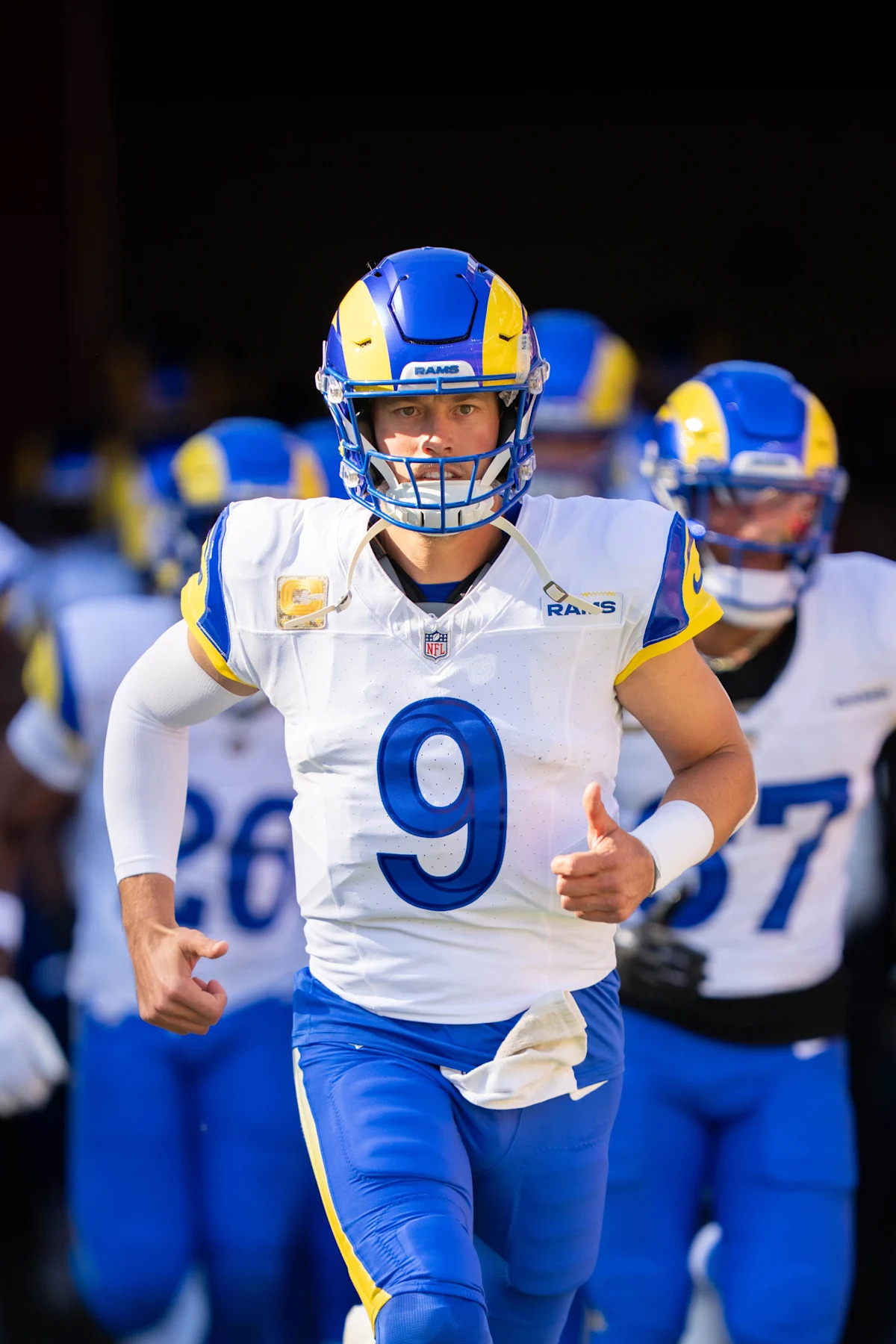
This offseason, there was less speculation about Matthew Stafford’s future and retirement timeline than in previous years, and that could become more of a trend than an outlier despite him being the second-oldest expected starter in the NFL at age 38. Rams fans could be looking forward to at least four more years of Stafford being the oldest starting quarterback in the league.
The reasons for him playing until he’s 40 and beyond are growing faster than the grey hairs in his beard.
Advertisement
Retirement is a personal decision and could have nothing to do with an ability to play football or make money. Aaron Donald recently emphasized that he always planned to retire after eight seasons and was only enticed to return for two more years because of the Super Bowl.
Stafford may want to retire if he wins a second Super Bowl. Or he might want to retire if L.A. does not win the Super Bowl this year. Only he knows the answer. But if he wants to play five more years, it’s hard to believe he lacks the ability to do it..
He’s better than the average quarterback in his 20s
NFL teams drafted Bryce Young and Cam Ward with the first overall pick in 2023 and 2025 respectively, under the assumption that those quarterbacks would soon become the faces of the NFL. Well, Young and Ward combined to throw 38 touchdown passes in 2025, which is nine fewer than Stafford’s 46 touchdowns en route to winning MVP and also leading the league in passing yards.
Ward was only a rookie last year and was not surrounded by much talent. Young is a limited passer who has not proven he can lead a high volume offense, but did take the Panthers to the playoffs at age 24.
Advertisement
However, these aren’t outliers. These are examples of a frightening trend of incoming first round quarterbacks proving to be worse than expectations:
*benched or in a QB competition in 2026
-
2023 draft: Bryce Young, C.J. Stroud, Anthony Richardson*
Even in that group of 23 quarterbacks, of the 14 expected starters in Week 1, at least half have a lot to prove before they’re expected to be starters in 2027 and 2028.
We saw the lack of belief the league has in young starters late last season when the Indianapolis Colts favored 44-year-old Philip Rivers over any other options that could have been available. His historically-bad athletic limitations were outweighed by the Colts belief in his football IQ and experience.
Matthew Stafford is six years younger than Rivers was last season. It’s not that a team would want a 44-year-old quarterback with a weak arm, but this could imply that a 41 or 42-year-old Stafford is far better than the average 25-year-old quarterback.
Advertisement
Four of the top-five quarterbacks in passing yards last season were 28 and older:
Maye was the only outlier and he was a hair from winning MVP. But he was not within a hair of Stafford’s actual value.
No offense to Maye and he could be on a trajectory to be unbelievably good next season or 2027, but he was abysmally bad in the playoffs in spite of the Patriots reaching the Super Bowl. Maye was overrated last season and similar to Stroud in 2023, his season-long stats were considerably uplifted by having two or three dominant performances against the worst teams in the league. Maye had 5 touchdowns against the Jets, two more scores than he had in any other game.
The NFL’s hope for quarterbacks like Caleb Williams and Maye “proving” that they are about to take over the league because of the seasons and playoff runs they had in 2025 will have to go a lot better than Jayden Daniels’ second season or Stroud’s second season, or they risk becoming the next J.J. McCarthy instead.
Advertisement
Rules protect him more than ever
Tom Brady shocked the world year after year by returning to play football until he was 45 and even then never truly “falling off”, especially not as bad as the end of Peyton Manning’s career at 39…but still won a Super Bowl that year for the same reasons that Rivers was at times still “good enough” last year.
Even now at age 48, Brady claims that he could still start in the NFL and that he inquired with the league to see if they’d allow it despite him being part-owner of the Raiders (they are not happy with the idea, per Brady). And the craziest part is that most fans and onlookers don’t think Brady’s claim is out of pocket.
I mean, his skills as a quarterback at 45 all seem plausibly adequate at 48 and highlights of him play flag football in March do more than imply he’s still got enough in the tank.
Brady is not five, but ten years older than Stafford. Ten.
Advertisement
Stafford’s traits as a quarterback have nothing to do with his legs or athleticism, so that’s another check in his favor for playing longer and was on display during his MVP season even though he did keep L.A.‘s final drive alive in the NFC Championship with a little shimmy on fourth down:
His best trait isn’t even a deep ball, although there’s little reason to think he couldn’t throw it deep enough for another 5 years.
His best traits are knowing what a defense will do before they know it and those nifty passes (both look and no-look) within 10-20 yards. It is totally believable that Stafford’s profile fits the type of quarterback who could play into his early-to-mid 40s.
Advertisement
It’s only a matter if he fits the profile of a quarterback who wants to.
Stafford has opportunity to make another $100 million+
On Monday, the Pittsburgh Steelers officially signed Aaron Rodgers for his age-43 season and will pay him up to $25 million for it. Although Rodgers has shown signs of decline in recent years, he made just enough plays last season (24 TD, 7 INT, 10-6 record) to make the Steelers believe that he’s still a better quarterback than any of the options under 30 or 40.
And that last part shouldn’t be glossed over because it’s important:
So many young quarterbacks who fans still think must have the potential to be good were passed over for the Steelers starting job for a 43-year-old who averaged 3.7 air yards per attempt last season (33rd out of 33 qualified QBs). Young quarterbacks like Justin Fields (who the Steelers already tested and gave up on once) and Anthony Richardson (who is on the trade block with no suitors) and McCarthy are non-starters in more ways than one.
Advertisement
The Steelers also didn’t push for Tua Tagovailoa or Trey Lance or Spencer Rattler or Mac Jones (that we know of) in trade pitches or free agency. They also didn’t go for any slightly-younger quarterbacks such as Jimmy Garoppolo, Geno Smith, Russell Wilson, or Kirk Cousins.
Although in cases like Smith and Cousins, we’ve seen that the Jets and Raiders preferred them as bridge starters over any of the recent first and second round picks in the last 5-6 years. Those quarterbacks seem to have quickly worn out their welcome in the league.
This means that by comparison to the younger generation — a class that Stafford himself was having a hard time connecting to a couple years ago — Matthew Stafford could continue to be a top-10 quarterback for not one more season. Not two more seasons. Not three more seasons.
If he wants to, Stafford could be a top-10 option for at least five more seasons.
For a quarterback who has made $408 million in his career, per OvertheCap, why couldn’t Stafford earn another $200 million (50% of his career earnings in the next 3-4 years if he really wants to push it) and build the stacks necessary to become a part-owner of a team too, like Brady, one day?
Advertisement
He could and the NFL has clearly been changing the league intentionally to make sure that players like Stafford could have value for a longer period of time.
The NFL is an “old man QB’s league
As Evan Craig wrote for Turf Show Times on Monday morning, quarterbacks have shown decline after winning MVP in their late-30s. However, those examples could have simply been the groundwork by quarterbacks, teams, and the entire league as a whole to counter-act those reasons for decline in the future. Stafford could be that future.
In recent years, the NFL has emphasized rule changes that benefit quarterbacks more than any other position:
Advertisement
-
Helmet-to-helmet rules, decreasing likelihood of a concussion
-
Body-weight landing restrictions, decreasing likelihood of a broken collarbone, etc.
-
Defenseless sliding rule, keeping defenders away from QBs appearing to give themselves up
Roughing-the-passer penalties get stricter by the year, making many of the past devastating QB injuries a thing of the past. The Joe Theismann, Steve Young, Troy Aikman, Alex Smith type quarterbacks retiring with gross leg injuries or concussions are less common now and will continue to become rarer.
Furthermore, the way that quarterbacks play the sport is different and that also helps increase their longevity, so long as the way they play as a “dual-threat”, which has definitely sapped some quarterbacks of their value lately such as Russell Wilson.
Things like playing out of shotgun, quick passes, using pre-snap motion, 12 and 13 personnel (2 or 3 tight ends on the field), and even just going to your first read more often have helped quarterbacks like Stafford get the ball out too fast to be hit. Or at least, not hit without drawing a penalty.
Plus, with the ever-increasing talent gap between receivers and cornerbacks, players like Davante Adams and Puka Nacua have made it all too easy for Stafford to trust that if he throws the ball now, his receivers will win the play. Cornerbacks also have more restrictions on them than ever, making for historically-high completion percentages and yards per attempt.
With fewer seven-step drops, fewer blindside hits, more useage of tight ends as blockers who could turn into receivers, quarterbacks like Stafford stand to be able to play at a high level for longer than ever before.
Advertisement
It’s one of these cases in the NFL where the past is a bad indicator of the future.
Those quarterbacks of the best, even the ones who were elite at 35, 36, and 37, did not have the same protections and schemes that allow players like Stafford to take advantage of a league that is desperate for longevity at the position.
Just ask 64-year-old Steve Young:
“I absolutely feel confident that I could take the snap, run the screen game, throw the ball in the flat, maybe throw a slant,” Young told the Chronicle. “… It’s not like, ‘Put on the pads and go play.’ Still, if it was ‘Hunger Games’? If they said, you had to do this or die? Yeah, you could pull off something.”
Young’s confidence that he could still run simple screen passes and passes to the flat and have enough success in the NFL today is not without merit.
In fact, many of the league’s “bust” quarterbacks are doing little more than that age age 23. Sure, Justin Fields has a strong arm and has the physical ability to throw the ball deep, something we saw at times from rookie Shedeur Sanders last year, but most of the NFL’s young quarterbacks get the majority of their production from screens and checkdowns and yards after the catch because they’re struggling with reading defenses, making good decisions, and deep ball accuracy.
Advertisement
All things that Stafford is excelling at when he’s 15 years their senior.
And Ty Simpson? His presence on the roster now is of little consequence to Stafford’s future. He has to overcome all the same doubts and reasons for criticism that his peers have gotten in the past few years, the shortcomings that have allowed Stafford to become MVP while they bounce in and out of a starting lineup.
As long as Stafford plays at the level he did at age 37, he will be the starter for the L.A. Rams if he chooses to avoid retirement. Given how the NFL has changed in the last 20 years, that’s an option he’s likely to have for much longer than most people assume.
Read the full article here