





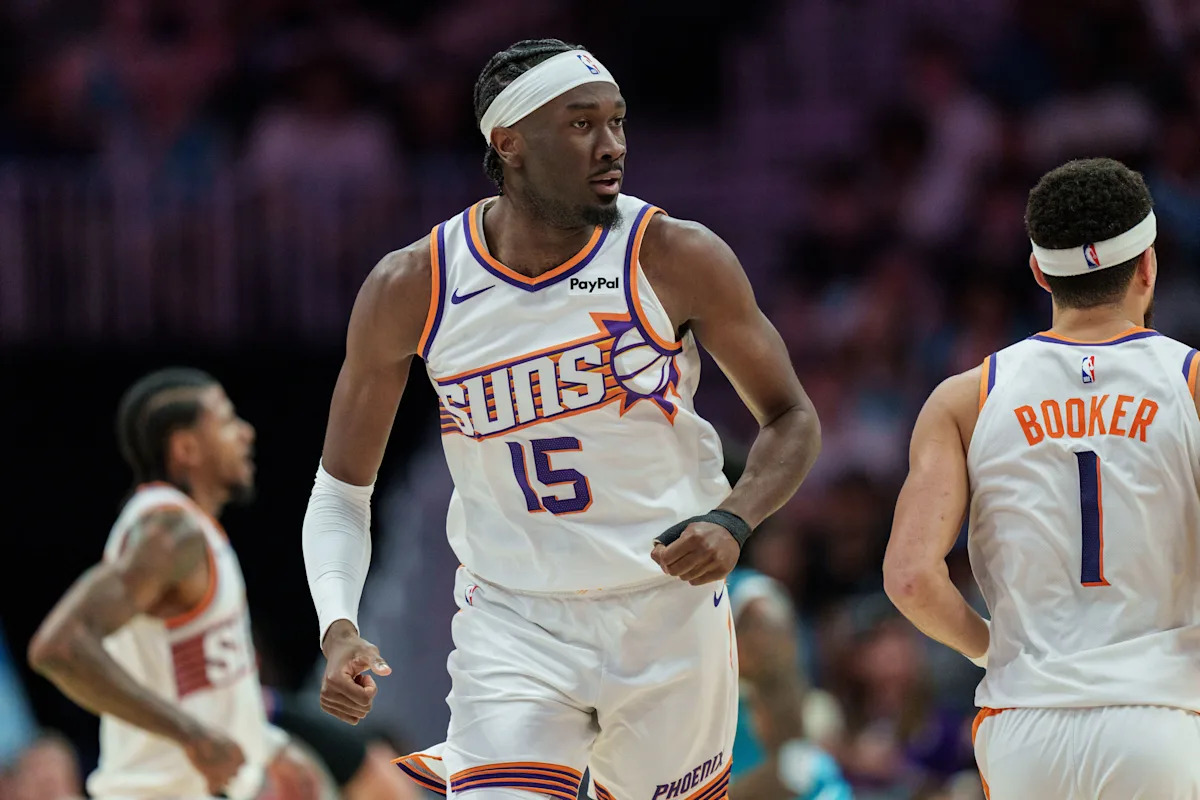
Welcome to our Phoenix Suns Season in Review series, where we revisit every player who suited up during the 2025–26 campaign through the lens of expectation, reality, and what it ultimately meant.
Player Snapshot
-
2026-27 Contract Status: RFA ($9.6 million qualifying offer)
Advertisement
*SunsRank is based on Bright Side writers’ ranking.
Season in One Sentence
While Mark Williams provides the rim deterrence and verticality this roster craves, his inability to stay on the floor makes him a luxury that a shifting contender has to think twice about overpaying for.
By the Numbers
|
GP |
MIN |
PPG |
RPG |
APG |
BLK |
FG% |
3PT% |
FT% |
OFFRTG |
DEFRTG |
+/- (TOTAL) |
|
60 |
23.6 |
11.7 |
8.0 |
1.0 |
0.9 |
64.4% |
1.000% |
77.1% |
111.3 |
113.3 |
-42 |
The Expectation
Many folks knew what to expect in Mark Williams. A lob threat who could rebound and alter shots defensively. He has an insane wingspan and standing reach, and provides size that this Suns team hadn’t had a ton of in recent years.
The hope was straightforward: Mark Williams would serve as the definitive interior anchor for the future. A physical, high-motor bridge center who could lock down the paint while rookie Khaman Maluach learned the ropes. Phoenix needed a consistent, 60-70 game defensive presence capable of solving the team’s interior rebounding woes and anchoring the backline.
Advertisement
Phoenix handpicked Williams as a trade target moments before drafting Khaman Maluach. The vision was clear. Add more youth, size, and athleticism, and figure the rest out later.
The Reality
When he was active, the physical impact was obvious. Williams is an elite lob threat with a massive wingspan and a legitimate motor. He gave the Suns true verticality, averaging 11.7 points and 8.5 rebounds while shooting an incredibly efficient 64.4% from the field.
The problem is, we spent the second half of the year holding our breath every time he contested a shot. The same foot and back issues that disrupted his early career caught up with him during the stretch run. Playing in 60 games was technically a personal career high, but the injuries piled up exactly when the stakes were raised. He missed the entire postseason, including the Play-In games. Watching the Suns get physically overwhelmed inside by longer, twitchier teams made his absence in street clothes feel like a recurring structural flaw.
Advertisement
Do we really want to do that to ourselves again?
What It Means
This comes down to resource allocation in a tightening financial landscape. Williams enters restricted free agency with a $9.6 million qualifying offer, giving Phoenix matching rights. If an outside suitor offers a deal in the $16 million to $20 million annual range, matching that sheet means anchoring significant cap space to a big man with major medical red flags. A sign-and-trade makes sense for anything above $18 million per season.
If the Suns move on from Williams, it likely means the following factors were considered:
-
Khaman Maluach may need to be ahead of schedule. At just 20 years old next season, Maluach flashed immense defensive upside in his limited minutes, proving he possesses the raw length and perimeter-switching fluidity that this frontcourt needs. He’s still very raw and may need another year of seasoning, but if thrown into the fire, I think he could survive.
-
Oso Ighodaro’s reliability. Ighodaro played all 82 games, offering an athletic, playmaking counterweight that keeps the offensive flow from stagnating.
-
The cost of replacement-level talent. Functional backup bigs are consistently the easiest assets to secure via low-cost free agency or the draft. Tying up premium money in a non-shooting center who carries availability risks is how a roster stays inflexible and lacking in lateral quickness.
If he returns next season, it’s pretty clear that the Suns need to hold him off from playing in ALL back-to-backs. Not just occasionally. All of them. It’s easy to get lost in the emotion of a season where things seem to be going well.
Advertisement
Defining Moment
January 27th vs. Brooklyn: Williams absolutely dominated the interior, bruising his way to an ultra-efficient 27 points, 6 rebounds, and 1 block on 13 of 16 shooting from the field in a gritty, physical 106-102 win. The 81% clip for a season-high 27 points was a glimpse at just how dominant he could be when involved in the flow of the offense.
It was a showcase of exactly how imposing he can be when his body cooperates.
Grade: B
It’s difficult to go any higher or lower than a solid B. He did his job and made strides with his durability by appearing in 60 games. That should not be glossed over, even if the timing of his injuries could not be worse. By all accounts, he had himself a strong season.
Advertisement
If Phoenix can land him on a team-friendly deal or one that is heavily incentivized with games played or team options in the back-end of the deal, then I’m all for bringing him back. If he prices himself out by commanding a good chunk of the salary cap, then that’s another story.
If a team like Brooklyn or Toronto wants to step up and offer a massive multi-year bag, the Suns should look to leverage their matching rights into a sign-and-trade rather than locking themselves in long-term. With Maluach and Ighodaro on cheap rookie deals, executing a pivot now maximizes Williams’ trade value before his health history complicates the books.
Read the full article here