





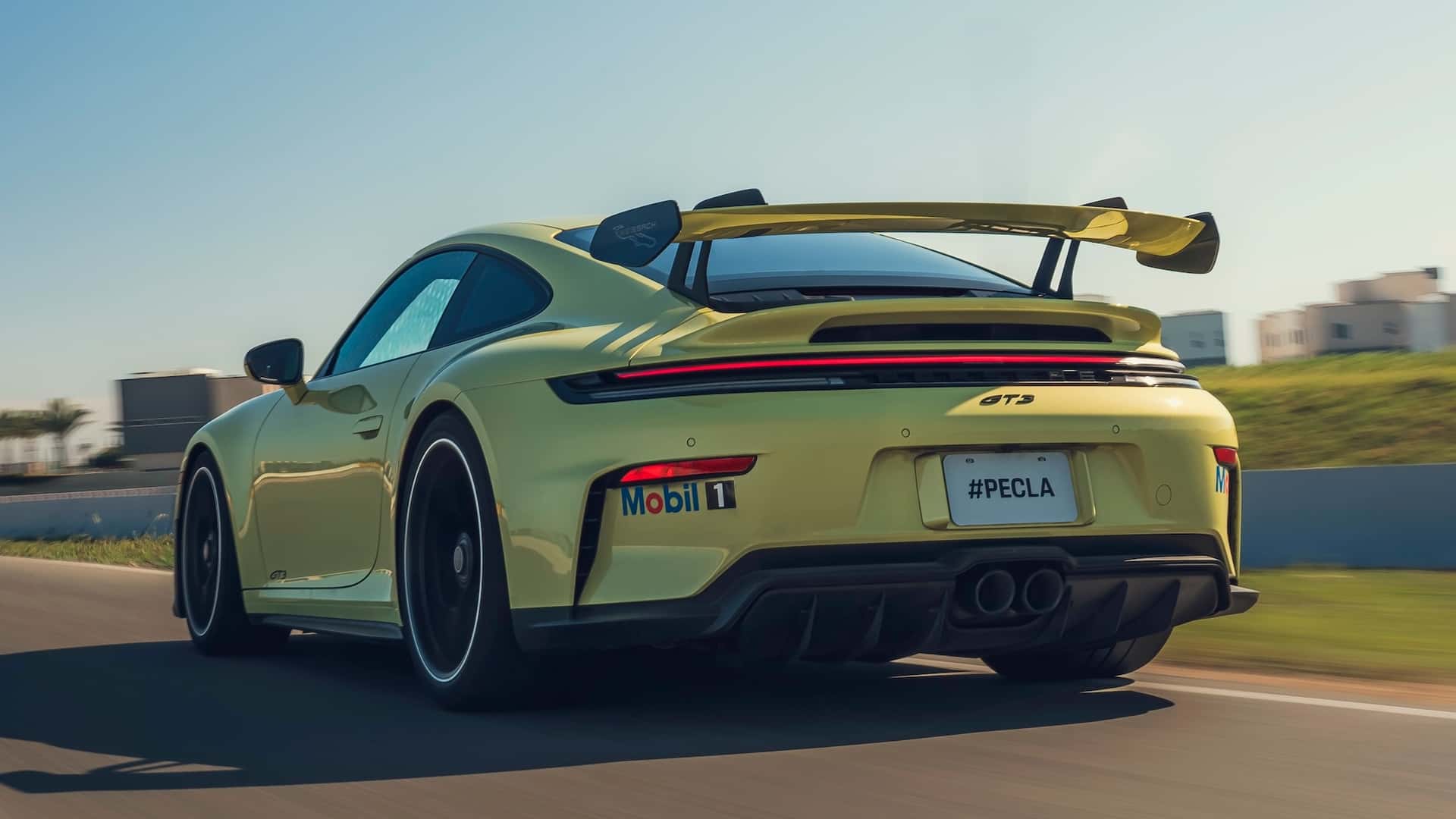
- Porsche GT boss Andreas Preuninger doesn’t rule out forced induction for the GT3.
- The naturally aspirated flat-six is living on borrowed time in Europe.
- America’s more relaxed emissions regulations will extend the 4.0-liter engine’s life.
Naturally aspirated engines are a dying breed in Europe, and it’s not necessarily because that’s what automakers wanted. The EU’s ongoing push for vehicles that consume less fuel and emit fewer CO2 emissions has directly affected the availability of production models powered by NA engines. Only a handful of cars still skip forced induction, and with stricter legislation looming, the list could get even shorter.
We’re not just talking about the impending arrival of the Euro 7 standard. Automakers active in Europe will have to slash their fleet emissions by 90 percent by 2035 compared with 2021 levels. An intermediate target will take effect in 2030, when car companies must cut fleet emissions by 55 percent versus 2021 levels. Should the target be exceeded, companies will be allowed to offset it in another year if the requirement is met over the 2030-2032 interval.
These tighter rules are giving Porsche a hard time, since it’s one of the few remaining automakers still offering naturally aspirated engines. Car and Driver spoke with the man in charge of GT models about what the future may hold for the track-focused cars. When asked whether the 911 GT3 could go turbo, Andreas Preuninger didn’t rule it out: “It might be.”
Photo by: Porsche
He explained the flat-six 4.0-liter mill is living on borrowed time in Europe, where it can continue for “probably only a few years without any substantial changes.” It’s a different story in the United States, where more lenient regulations will allow Porsche to keep the naturally aspirated engine “for quite some time.”
While the 992.2 911 GT3 could remain on sale longer in America than in Europe, the situation beyond the current generation is murky. Realistically, it doesn’t seem feasible for Porsche to develop separate GT3s for different regions, since that would require a far greater investment.
Zuffenhausen already has a lot on its plate, considering the six-cylinder 718 models are coming back, even though the original plan was to replace the Boxster and Cayman with EVs. Porsche is also spending money on another model it hadn’t originally planned: developing a direct successor to the first-generation Macan with a combustion engine. Add the three-row flagship SUV to the mix, and it’s clear the budget is already stretched thin.

30
Source: Porsche
Motor1’s Take: Whatever happens to the GT3, Porsche has made it clear that the 911 will go down in history as the company’s last model with a combustion engine. While hybrid versions have appeared in the lineup, a fully electric 911 isn’t happening this decade. Even more mainstream models like the Panamera and Cayenne will retain ICE power “far into the next decade.”
Considering the new compact crossover and flagship SUV will launch in the coming years, both are likely to remain in the lineup for much of the 2030s. The 911 will outlive them all, though not without changes to comply with the EU’s ever-stricter legislation.
Read the full article here