





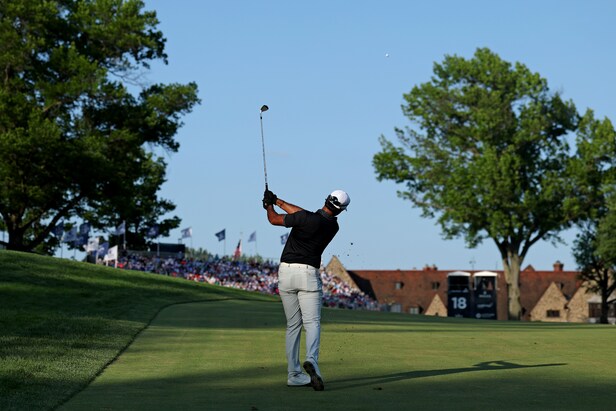
NEWTOWN SQUARE, Pa. — As an amateur golfer, I aspire to play boring golf.
I want to keep my ball in the short grass unceremoniously.
I want easy, uneventful two putts.
I want to hit the middle of lots of greens, and avoid disaster when I don’t.
Advertisement
I want to make my short putts whenever they come.
It’s what made Aaron Rai the perfect winner of the 2026 PGA Championship.
He’s the king of boring golf—and I mean that as the highest compliment. He’s average-ish distance-wise but very accurate. He keeps the ball in front of him. His superpower this week was finishing first in Birdie Conversion percentage. That’s his game. He put himself in position often enough, and when the putts happen to fall, he finishes well.
2276779022
Carl Recine
And that was the formula on Aronimink’s tricky greens, which were so complex that not even the best players in the world could figure out how to attack them in any risk-free way. Combine this with the lack of penalty hazards off the tee, and it had the effect of making no real difference in positive separators (things I can do more of, like hitting more long drives) and negative separators (things I can do less of, hitting fewer drives into hazards).
Advertisement
This week, it was only the negative separators.
-
Avoiding the rough: Approach proximity from the fairway was about a foot better than tour average, but approach proximity from the rough was about 4 feet worse than tour average
-
Avoiding three-putts: Players three-putted almost double as much this week as during average weeks (4.8 percent vs 2.6 percent). Of the six players tied for first in that stat, five finished inside the top 10.
-
Avoiding ‘double chips’: There were multiple incidents of players missing the green from greenside bunkers and chips because they cut it too close with the slopes. It’s one reason why scrambling percentage was a whopping 15 percent lower this week than on average weeks.
And I thought that was cool, because it proved a true, deep examination into the fundamentals of the game that often get overlooked. It wasn’t about doing the extraordinary this week. It was, as former PGA of America Teacher of the year Jason Baile likes to say, about doing the ordinary, extraordinarily well.
Few players do that better than Aaron Rai.
1. Learn how to see straight
Earlier this week I walked past the practice putting green and saw lots of players hitting lots of putts—and one player not hitting any.
Justin Rose gets up to all sorts of interesting things. He’s a professional golfer in the truest sense of the word. He looks for edges everywhere, and when he does, he does so intentionally. He knows what he’s going to practice, why and how before each session. The rest of us may not be as good as Justin Rose, but we can adopt that approach.
Advertisement
On this occasion, he was working on seeing straight—yes, really. His coach Phil Kenyon had aligned a series of tees in a straight line towards the hole. Rose would set up to the golf ball, track his eyes up and down the line, then reset.
“His tendency is to skip up towards the hole instead of tracking his eyes down the line,” Kenyon explains. “He does this for a few minutes most days to make sure his perception of straight matches reality.”
If your perception of straight isn’t actually straight, you’ll aim in the wrong direction and make compensations because of it. If you force yourself to line up straight, but it doesn’t feel comfortable, you’re not going to make a committed stroke. It’s a tedious way to practice, but Rose’s method solves for both. You can do it on the range, too, by placing an alignment aid down the target line.
“If more amateurs did that on the range, I guarantee their golf swing would instantly improve,” top 50 coach Justin Parsons says.
Advertisement
2. Swedish swing syndrome
It’s kind of a miracle that a country like Sweden, where it’s so cold that players literally can’t play golf half the year, keeps churning out so many elite golfers. It seems like such an inherent disadvantage—but the more I think about it, the more I wonder if there’s something strangely beneficial about it.
I asked Ludvig Aberg early in the week what his offseason-onseason practice splits used to look like.
During the winter, he said his practice would revolve around key tenets:
-
Start lines: Making sure your putts and full swing shots are starting on line.
-
Golf swing technique: Lots of video analysis of your golf swing (don’t worry about much else when you do this)
-
Proximity tests: Steady diet of Trackman combines to test your dispersion patterns
These three things represent the best part of practicing in a lab environment, but also creates a problem.
Advertisement
“I call it Swedish syndrome,” Ludvig says. “You have an amazing golf swing, but you struggle to score.”
The fact is that certain things can’t be done in a simulator—aiming, for instance, is essentially all done for you.
That’s why to combat the syndrome, you need to adopt three new tenets in the summer, and leave the others behind:
-
Play your way through problems—stop the driving range from becoming a crutch
-
Get comfortable making lots of little changes to your swing—daily tweaks, the time for overhauls is not now.
-
Practice the boring stuff, specifically routine and aiming.
It won’t come easy, but learning how to flip that switch gives you the best of both.
Anyway, it was boom times for quick-hit items this week, so let’s get to those…
3. Manage, don’t ‘fix’
I was at TPI two weeks ago, when I found out I early extend on both the backswing and the downswing, and I was pretty bummed about it. But at the PGA Championship Justin Parsons helped me feel better. Lots of pros, it turns out. Brian Harman and Rory McIlroy—two major champs—both shift their hips towards the ball on the downswing.
Advertisement
The point of this, as Justin Parsons explained to me, is that there’s nothing inherently wrong with it, and that the idea of eliminating it altogether probably isn’t ideal.
“There’s probably a reason why your body is doing something,” he explains. “Your goal should be to manage your movement patterns. Keep it in a position where you have played your best golf. Measure it and avoid extremes.”
4. Shoes matter more than you think
Rory switched to a softer style shoe at the PGA Championship after developing a nasty blister on his pinky toe. I asked PGA of America professional Joe Plecker how different types of shoes can affect his, and our, golf swings.
Advertisement
The answer: yes!
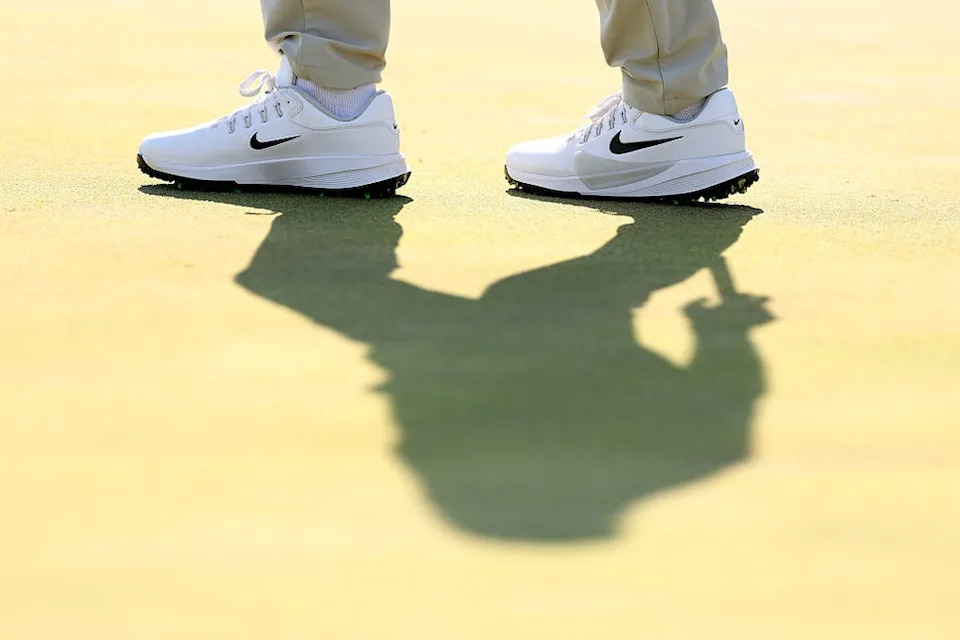
“With shoes I like to see the maximum amount of surface area of the foot on the ground,” Plecker says. “The really good players gravitate towards that because it helps them use the ground more. The more padding a shoe has under the heel, the more it could restrict your hip turn and shift you onto your toes.”
2276770913
Richard Heathcote
5. These guys are good strong
This week I found out that Brooks Koepka can bench 365 lbs, and that Jon Rahm can trap bar deadlift more than 500 lbs—he goes heavy in the offseason, and more explosive in-season.
“We alter the weight, but he still trap bar deadlifts almost every day,” says his trainer Dr. Harry Sese.
Advertisement
It’s not true that golfers hit the ball longer now simply because they are more athletic now than golfers in the past, but make no mistake: These guys are a whole new level of elite athlete.
6. Rai’s unique ball position
Something cool about Aaron Rai’s quirky golf swing is that he plays the ball almost in the middle of his stance with a driver. He started doing this as a way to force himself to rotate more, but it had the added benefit of making him one of the most accurate drivers in golf.
It’s probably not worth trying for anyone other than low handicaps, but for Rai, it gives him one of the lowest launch angles and highest spin rates on tour—two things that help golfers hit it straight.
Advertisement
7. Keep your hands close
This was an old Jack Nicklaus tip: You can’t keep your hands close enough to you during your swing.
It’s a good one for amateurs: When your arms get too far away from your body on the downswing, you’re equally as likely to come over-the-top (higher handicaps tend to do this) or get the club stuck behind you (lower handicaps tend to do this).
And I was thinking about it as I saw it pop up everywhere this week.
Rahm works on it in the backswing by keeping a towel under his right arm. His hands tend to lift out on the takeaway; a few swings like this keep them “moving with his body,” his coach Dave Philips says.
Advertisement
Your browser does not support the video tag.
Hideki Matsuyama was working on a similar feel on the downswing. Hands in closer to his body, with the club out.
Your browser does not support the video tag.
Like anything in golf, you can overdo it. But generally speaking, it’s a good thought to remember.
8. Body checkpoints
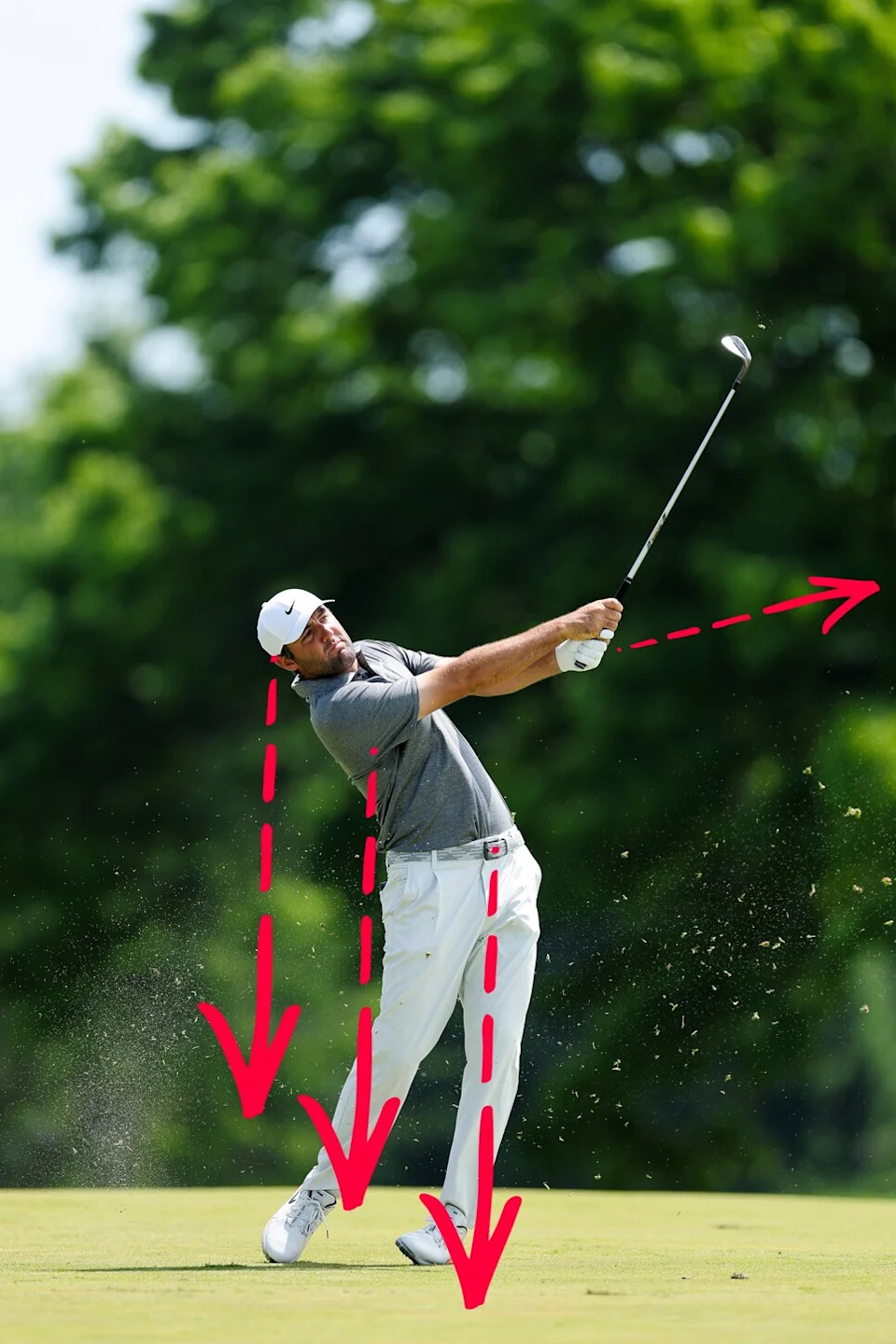
Andreas Kali, who coaches rising Danish star Rasmus Neergaard-Petersen, has been helping me with my golf swing, and shared an interesting tidbit that you can spot in literally every pros’ swing.
“When your arms are pointing to the target [on the release], I look for the hips to be ahead of your chest and your chest to be ahead of your head.”
2276728377
Michael Reaves
Advertisement
9. Par-3 strategy *kinda* exists
Hunting for unique game improvement tips means being OK with striking out. And this week, I struck out on one of my ideas: Par-3 strategies.
Turns out, par-3 strategy and approach shot strategy is exactly the same. Dead end on building out that idea, but Scottie Scheffler’s caddie Ted Scott did supply some helpful breadcrumbs….
“The process for the shot is the same, but par-3s themselves have certain designs, so the strategy is about knowing what to do on each of those designs.”
Alright, I can work with that! Stay tuned.
Read the full article here