




Like the rest of their peers, college football’s highest achievers are afforded no guarantees in the NFL draft.
The league’s annual exercise in sorting out top young talent can be somewhat divorced from the established results on the field. And while the prospects selected with the earliest picks tend to have an extensive track record of production, a good number of the most prolific players at the college level end up relegated to the third day of the draft – if they’re chosen at all.
Advertisement
With the 2026 NFL Draft starting Thursday in Pittsburgh, here are seven college football standouts who could be in for a long wait:
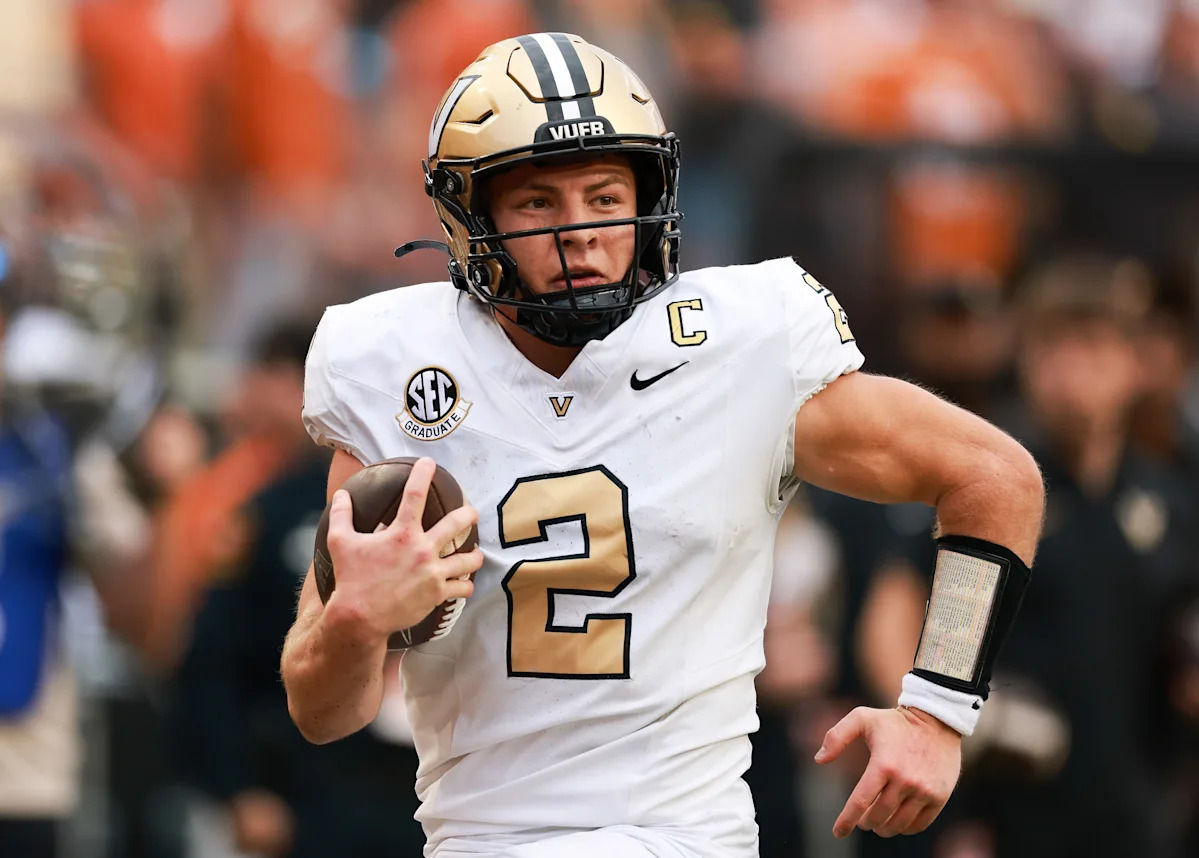
In his rise to become one of college football’s most prolific and visible stars, Pavia repeatedly won with style all his own. The former junior college standout and New Mexico State transfer made his mark on the Southeastern Conference by putting defenses on their heels, whether that meant taking off as a runner or distributing in the short-to-intermediate areas as a passer. No matter the scenario, Pavia had a way of dictating terms for the flow of the game.
Those days are decidedly gone. Pavia’s pro acclimation will hinge on his ability to adapt to an existing offensive structure rather than have it molded to his proclivities. That could be troublesome, as the Heisman Trophy runner-up is saddled with some significant restraints as a passer. At 5-10 and 207 pounds, he falls well below some teams’ size thresholds. At Vanderbilt, he circumvented concerns about his height with frequent rollouts, but a similar approach seems untenable in the NFL. Deep routes also could be inaccessible to him, with his arm strength, accuracy and timing for that portion of the field all falling well below pro standards. A backup role will be hard to come by, unless a team feels it can fully trust him to run its existing scheme. That might mean that some agency of an unwanted variety, as Pavia could be left to pick among some options as an undrafted free agent.
Advertisement
Quarterbacks who fall outside of the first two rounds tend to be in for a bumpy ride in the draft. With teams not needing their services immediately, signal-callers who last that long typically fall into one of two buckets: developmental projects or potential backup options. Klubnik seems to be trending toward the latter, and it could be reflected in his landing spot.
After his three years as a starter for the Tigers, there’s not much mystery as to who the former five-star recruit is. Klubnik can muster enough to deliver some downfield strikes, but he’s merely adequate in most phases. That’s a problem for a player who can break down in the pocket in the face of pressure. Perhaps he can stick around as a second-stringer taken in the final two rounds, but improvements to his composure can’t be counted on.
Carrying the nickname “Fatman” typically doesn’t bode well for a running back’s draft stock. The moniker was given to Allen when he was a baby, yet it followed the 5-11, 233-pound ball carrier throughout a collegiate career during which his bruising style came to complement his more explosive counterpart in Nick Singleton. And though Singleton earned top billing in the early going for the backfield timeshare, Allen ended his career as Penn State’s all-time leading rusher (4,180 yards) after a senior year in which he was one of the few bright spots.
Advertisement
For better or worse, everything about Allen’s running style is methodical. He’s patient and discerning, which allowed him to average 6.2 yards as a senior while also racking up 15 rushing touchdowns. But he can’t be counted on to shake anyone in the open field or turn the corner, which means many of his runs die quickly once they reach the second level. With little to offer as a pass catcher out of the backfield, Allen might be pigeonholed as a backup option who does the bulk of his damage in third-down scenarios. Even in a thin running back class, he might only garner mid-to-late-round consideration.
Jones probably won’t stir the same level of excitement as other figures on this list, but he belongs nonetheless. The Rimington Trophy winner was the tone-setter for a line that once again was college football’s standard-bearer up front, with the unit winning the Joe Moore Award for the nation’s most outstanding offensive line. A unanimous All-American and four-year starter, he set himself apart from his peers as a savvy blocker who’s at his best on the move.
His pro projection, however, is considerably more muddled than his college standing. Jones is part of a pack of centers – including Kansas State’s Sam Hecht, Auburn’s Connor Lew and Florida’s Jake Slaughter – who figure to come off the board at some point on Day 3. Each is widely considered a potential early starter and has been ranked closely to the others, with all four coming in from No. 88 to 98 on USA TODAY Sports’ big board. But Jones has had to combat questions about his short arms (30 3/4 inches) and ability to anchor, so he could end up being pushed down in the positional pecking order.
Advertisement
The Red Raiders’ defense wasn’t solely the David Bailey show last season, even if the expected top-five pick was the main attraction. Height found his footing at his fourth stop in a circuitous college career, recording 10 sacks and putting himself on the map as a legitimate NFL draft prospect rather than just a promising pass rusher.
While creating pressure can be a calling card, Height might have several factors working against him. Set to arrive in a league that’s tilting toward higher run rates and heavier tight end usage, the 6-3, 235-pounder is enough of a potential liability in the ground game to limit him to a designated pass rusher role in the early going. His subpar core strength could also leave him overly reliant on bending around the edge to reach the quarterback. He also turned 25 earlier this month and too easily falls off his target when attempting to finish plays. Height at least should find resolution a bit earlier than the other entries here, as he provides enough of a jolt off the edge to land somewhere in the third or fourth round.
A transfer from James Madison, Fisher was integral to Indiana’s once unfathomable ascent to the championship summit. He racked up 215 tackles in the last two seasons, with his advanced instincts and diagnostic skills allowing him to beat blockers to spots and make plays against the run.
Advertisement
Yet in the NFL, the 6-1, 232-pound linebacker might rapidly find himself butting up against the ceiling imposed by his athletic limitations. Fisher looks liable to being swallowed up by bigger linemen when operating between the tackles, and he might lack the range to finish plays to the outside. Those same traits might leave him ill-equipped to hold up in coverage as well. At some point on Day 3, though, a team needing depth at linebacker should come calling for Fisher, who also can immediately add value on special teams.
As a former walk-on, Taaffe was a clear outlier on a Texas defense dotted with former four- and five-star recruits. Nevertheless, his rapid recognition skills allowed him to become a key cog for the Longhorns and one of college football’s more accomplished safeties over the span of his three years as a starter.
Yet as he enters the draft, Taaffe might be in something of a no-man’s land as a safety prospect. At just under 6-0 and 190 pounds, he’s not built to be a force in the run game or hang with tight ends in coverage. Between those shortcomings and a skill set not suited for the slot or operating in space, it’s not exactly clear where he finds his fit at the next level. Perhaps a zone-heavy team will look to him in the middle to late portion of Day 3, hoping he can figure out some way to contribute beyond special teams.
This article originally appeared on USA TODAY: 2026 NFL Draft: 7 college football stars who could have long wait
Read the full article here


