




Twenty-one years ago, the White Sox swept the Astros in the World Series to end an 88-year championship drought, bringing baseball jubilation to the south side of Chicago. Occasional regular-season interleague series followed until 2013, when Houston made the move from the NL Central to the AL West, inviting the possibility that the two franchises could meet far more frequently in October. But that has occurred just once in the years since, with the Astros eliminating the White Sox in the 2021 ALDS en route to the pennant and sending the White Sox spiraling into a dark period for the franchise while Houston was in the middle of its golden era.
Five years later, the White Sox have emerged from their deep rebuild, and the Astros are desperately trying to keep their competitive window open. And in an ultra-weak American League (particularly outside the AL East), an unlikely race has surfaced between the White Sox and Astros, the current Central and West leaders, to claim the No. 2 seed and the valuable first-round bye that comes with it. As such, this week’s four-game series at Daikin Park carried a ton of weight with October fast approaching. The Astros took advantage of the opportunity, taking three of four to close the gap with the White Sox to just 1.5 games.
Advertisement
Here are five takeaways from this week’s series in H-Town.
Join or create a Yahoo Fantasy Football league for the 2026 NFL season
Checking in on the Kyle Tucker trade return
When a team moves on from a general manager, it’s natural to reflect on their tenure and contemplate how the moves they did and didn’t make impacted the trajectory of the organization. Without question, the most significant transaction recently fired GM Dana Brown executed during his three-plus years leading the Astros’ front office was trading outfielder Kyle Tucker to the Cubs in exchange for three players: infielder Isaac Paredes, then-top prospect and recent first-round pick Cam Smith and right-hander Hayden Wesneski. While Brown experienced several other successes and missteps during his time as Houston’s baseball ops leader, that trade — and how much these three players end up contributing to the Astros — will define his tenure.
Advertisement
Last season was a mixed bag in that regard. Smith starred in spring training and looked excellent in the early going but faded badly as his rookie season progressed. Paredes was terrific for three months and earned an All-Star nod, but a severe right hamstring strain limited his availability and impact down the stretch. Wesneski made six decent starts before needing Tommy John surgery in June.
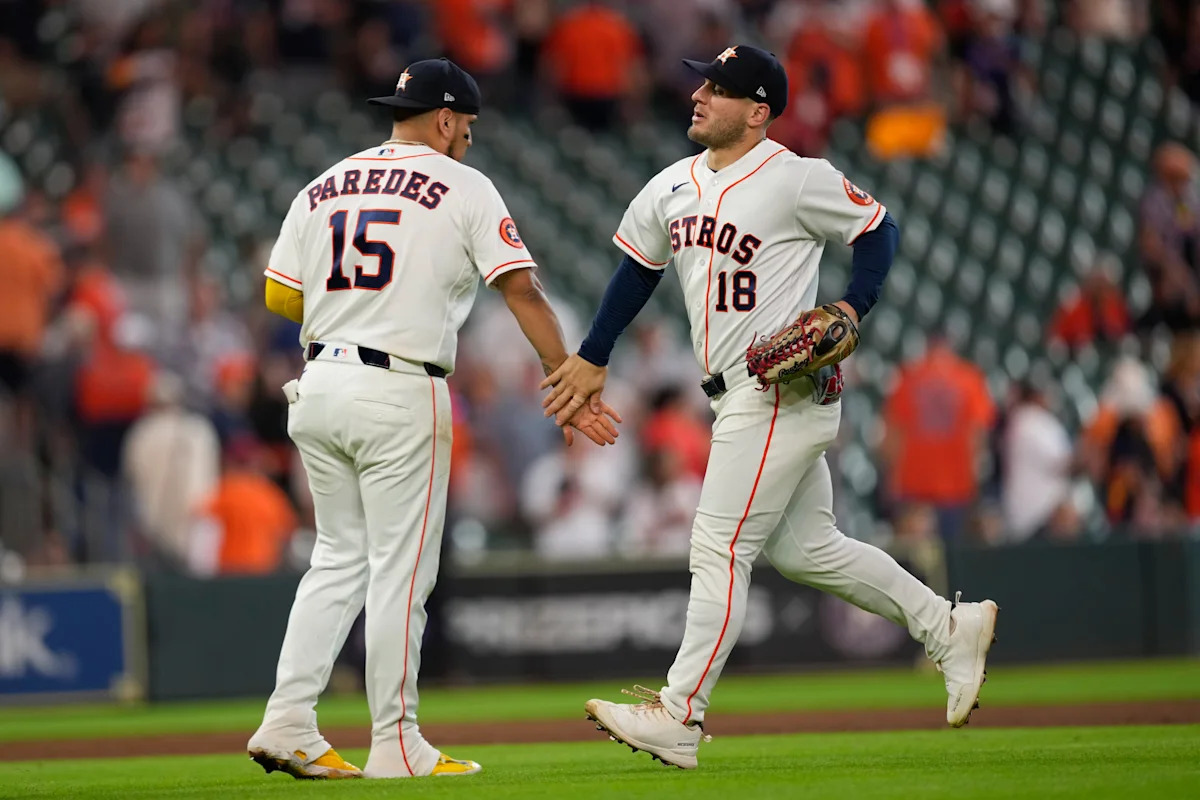
This year has provided a mix of validation for Brown’s acquisitions and some lingering concerns. Injuries to Carlos Correa and Jeremy Peña thinned Houston’s crowded infield depth chart, clearing a path for Paredes to take over as the every-day third baseman. He has acquitted himself respectably on defense and has produced as consistently with the bat as any Astro not named Yordan Alvarez. Paredes hit his 18th home run of the season on Tuesday and smashed a go-ahead RBI double in Thursday’s series finale. What Houston decides to do with Paredes’ $13.35 million club option for 2027, considering the infield logjam that will exist once Correa is healthy, is one of the most fascinating early questions of the upcoming offseason.
Smith continues to flash tremendous physical tools, with elite sprint speed (93rd percentile) and bat speed (99th percentile), but his offensive statline (.212/.278/.386) has shown minimal progress relative to his rookie output (.236/.312/.358). While he deserves ample credit for his transition from his native third base to right field — he has become a legitimately great outfield defender and robbed a homer on Tuesday — it’s imperative for him to start figuring it out at the plate, as the Astros were clearly counting on him becoming a game-changing hitter, not just a role player with a stellar glove. Among 142 qualified hitters, Smith’s .664 OPS ranks 126th.
Advertisement
Wesneski has returned from his elbow injury to provide stability in Houston’s famously rickety rotation and could pitch his way to a postseason start if the Astros are able to qualify and advance in October. Wednesday delivered the 28-year-old right-hander’s best showing yet, as Wesneski spun seven scoreless innings of one-hit ball in Houston’s 2-0 victory. The Astros are 6-1 in Wesneski’s starts since he rejoined the rotation in late July.
Overall, this week’s series was a solid showcase of the Tucker return in Brown’s favor. But there’s a long way to go — this season and beyond — before we can really judge this trade.
Get to know Sean Burke
Much of the attention paid to Chicago’s incredible turnaround this season has centered on the offense, and rightfully so: Miguel Vargas, Munetaka Murakami and Colson Montgomery are a fearsome trio of sluggers, not to mention unlikely All-Star Tristan Peters and role players such as second baseman Chase Meidroth and left fielder Sam Antonacci.
Advertisement
But if the White Sox are going to finish strong and reach October — let alone have any chance of advancing — a lot will depend on what they can do on the mound. That brings us to Burke, perhaps the most anonymous pitcher in MLB who has a chance of starting Game 1 of a postseason series. The 26-year-old has quietly been a dependable anchor atop Chicago’s rotation for the entire season. That dynamic was on display Tuesday, as Burke led the way in Chicago’s lone win in the series, tossing 5 ⅔ scoreless innings with one hit allowed and lowering his ERA to 3.20, seventh-best among qualified AL starters.
A third-round pick out of the University of Maryland in 2021, Burke climbed the minor-league ladder and was a perfectly adequate rotation member as a rookie in 2025. He has taken a big step forward as a sophomore, leading the Sox in innings and raising his strikeout rate from 22.3% to 26.3% while dropping his walk rate from 10.6% to 8.5%. Although he wields only average velocity, Burke keeps hitters guessing by attacking with a balanced repertoire, throwing five pitches (four-seam fastball, curveball, slider, sinker, cutter) at least 10% of the time. This week’s showing in a high-stakes series was an encouraging sign for Burke as October approaches, but how he fares in his upcoming postseason debut will be remembered a lot more by White Sox fans.
Subscribe to Yahoo! Sports MLB on YouTube for videos, podcasts and more
Advertisement
Josh Hader’s still got it
After finishing last season on the injured list due to a shoulder strain, Hader showed up to spring training in February and told reporters that he was dealing with biceps tendinitis, setting an ominous tone for an Astros pitching staff that was ravaged by injuries over the season’s first few months. Hader began the year on the injured list and was nowhere to be found as the Astros sputtered to a 20-31 start with a 5.68 bullpen ERA, the worst mark in MLB.
But since he was activated on June 2, Hader has looked every bit like the All-Star closer the Astros expected when they signed him to a gargantuan free-agent contract. He has stabilized the beleaguered bullpen by allowing the rest of the relievers to handle less-stressful leverage before he shuts things down in the ninth. On Wednesday, Hader tossed a perfect final frame in Houston’s 2-0 victory — his 19th consecutive scoreless appearance — to lower his ERA to 0.72 across 37 ⅓ innings.
Hader represents only a fraction of the workload the bullpen has shouldered since his return, but it’s clear that his presence has impacted the entire unit for the better; Houston’s 3.31 bullpen ERA since his return ranks fifth in MLB. So while the Astros have a fair bit to sort through in their starting staff before October, they can take comfort in the knowledge that if they have a late lead, they’ve got a guy in Hader who is ready to slam the door.
Advertisement
Hit-by-pitch history in the making
In the top of the fifth inning Tuesday, Astros right-hander Kai-Wei Teng overcooked an 0-2 sweeper that sailed inside and hit White Sox left fielder Sam Antonacci in the foot. It was the second time this season that Teng hit Antonacci with a sweeper, having also done so in Chicago on July 24. And this accidental plunking had historical significance beyond this strange case of baseball deja vu: It was Antonacci’s 25th hit-by-pitch of the season, tying the modern record (since 1901) for plunkings endured by a rookie, set in 2019 by Victor Robles with the Washington Nationals. With Antonacci’s next painful free pass, he’ll stand alone.
Based on his track record, Antonacci’s unpleasant push into the record books comes as no surprise. As a junior at Coastal Carolina, he was hit by 27 pitches across 61 games, tied for sixth-most in Division I. In his first professional season last year, he racked up 35 more across 116 games (second-most in the minors), plus four more in 19 Arizona Fall League games. He even managed to get hit three times in six games playing for Team Italy in the World Baseball Classic in March. Some guys just know how to get plunked — Anthony Rizzo, Ty France and Mark Canha stand out as recent examples — and Antonacci looks to be the next great ball magnet, for better or worse.
Advertisement
Remarkably, Antonacci is not the only White Sox player on the cusp of history in this category: Left-hander Anthony Kay has hit 22 batters across 136 ⅔ innings this season. That’s the most in MLB this year by a mile (Nolan McLean is second at 15), and it’s the second-most by a pitcher in a season in the past 100 years, behind only Padres reliever Austin Adams, who somehow plunked 24 across just 52 ⅔ innings in 2021.
What’s bizarre is that unlike Antonacci, whose history hinted that his HBP chase could be possible, little about Kay’s track record suggested this was coming. His previous season high was 10 HBPs across 147 ⅔ innings in 2019, and across his last two seasons pitching in Japan for the Yokohama DeNA BayStars, he hit 10 batters in 291 ⅔ innings. Kay did not hit any Astros in his start Monday in Houston, but with at least a handful of starts left in September, this is another record chase worth monitoring in September.
The road ahead
Having taken two out of three from the White Sox during their trip to Rate Field in July, Houston needed two wins this week to clinch the tiebreaker over Chicago, which they did, plus another victory Thursday to close the gap in the standings further. This tiebreaker could prove pivotal in the race for the No. 2 seed in the AL postseason.
Advertisement
But even after this week, the Sox have the superior record with 22 games left (the Astros have 21 remaining) and Chicago’s final stretch of games is notably less difficult than what Houston is slated to face. In fact, the White Sox have the third-easiest strength of schedule remaining, behind only Toronto and Seattle, with their toughest opponents still on the docket being Cleveland and St. Louis, while the rest of the slate features clubs with losing records, including Colorado and Kansas City. Houston, meanwhile, still has a trip to top seed Tampa Bay, plus a trio of interleague series against Arizona, Philadelphia and Atlanta.
That’s quite the discrepancy on paper, but it’s also worth noting that the Astros have played their best ball this year against top competition, going 28-18 against teams above .500 — the second-best mark in MLB behind only the Brewers — whereas the White Sox have gone 26-37 in such games. Perhaps the raised stakes and tougher assignments will elevate Houston’s play over the final few weeks en route to the Astros securing a first-round bye.
That would be an astonishing outcome, considering how dire things were earlier this season. But such is life in the American League in 2026.
Read the full article here


