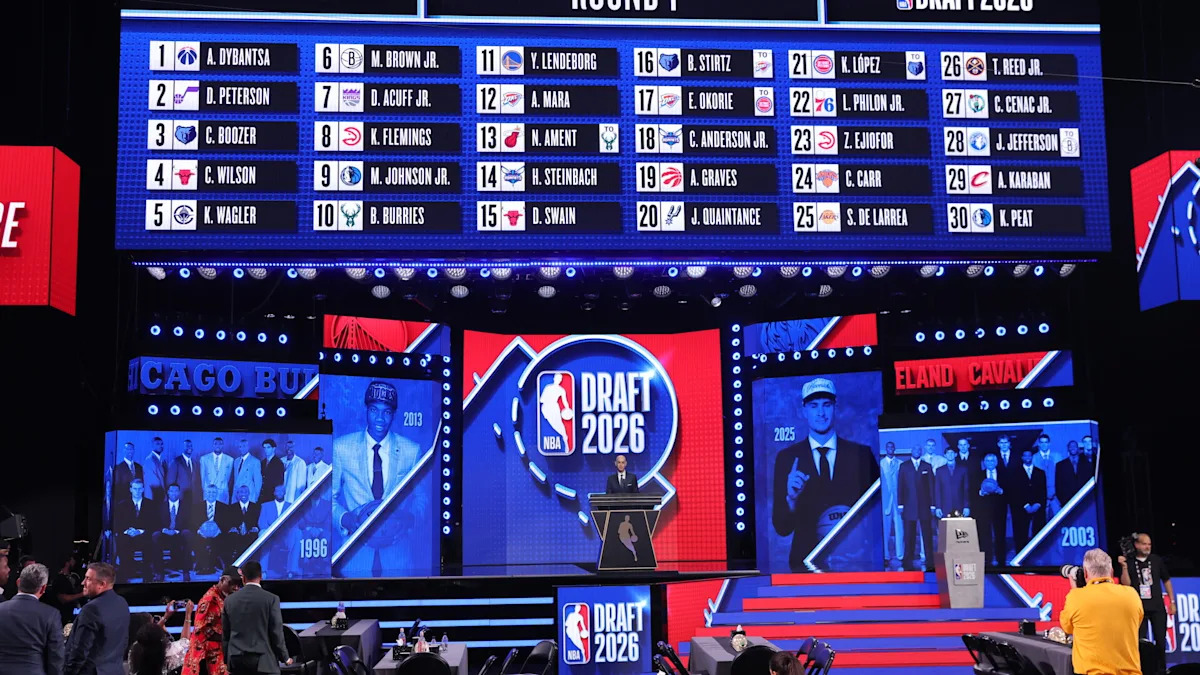
The fireworks for the 2026 NBA Draft seemed to go off a day early. The Giannis Antetokounmpo trade to Miami stole the headlines in the morning, and when the NBA Draft itself got underway… it largely followed the chalk and stayed to form. There were no shocking trades, no wildly unexpected picks, just a lot of smart choices.
That’s reflected in the grades for the first round. Let’s break it down by team.
Advertisement
AJ Dybantsa (1)
This was not a no-brainer — there were three players legitimately worthy of being the No. 1 at the top of the draft. Washington, however, made the best choice for them. Dybantsa is a 6’9″ wing who can score from all three levels and lit up college basketball last season. When I saw him play in person, what stood out was that he is a tough shotmaker, a skill needed by elite players in the league. Dybantsa seems a natural fit between Trae Young at the point and Anthony Davis and Alex Sarr on the front line. Washington nailed this.
Darryn Peterson (2)
Advertisement
Utah got the best fit for its roster out of the top four picks in this draft — and there are plenty of people around the league who would argue they may have drafted the best player. Going into last season, Darryn Peterson was the guy on top of everyone’s draft board — he was seen as the most explosive athlete in the class and the player with the highest upside. His one season at Kansas did not play out like he or the Jayhawks envisioned, but multiple NBA teams talked to him, looked at his league medical evaluation, and came away largely unconcerned about his future. Pairing Peterson with Keyonte George in the backcourt — and Lauri Markkanen, Jaren Jackson Jr. and Walker Kessler along the front line — makes a very good starting five.
Cameron Boozer (3), Karim Lopez (21, via OKC and Detroit)
Memphis has a vision for how it’s retooling this roster, and Boozer is a perfect fit and crown jewel for it. The Memphis front line is now Cedric Coward, Boozer and Zach Edey, with Lopez coming off the bench — that is a foundation you can build around. Boozer just does everything well: Can score inside and out, has elite footwork, is a good screener, can get you rebounds, defends the paint, and most importantly, just processes the game fast and at a high level. Nice bit of work by Memphis to pick up five second-round picks to move back from 16 to 21, with a series of trades with Oklahoma City and Detroit and still get a big with potential in Lopez.
Advertisement
Caleb Wilson (4), Dailyn Swain (15)
The last time Chicago drafted a North Carolina star near the top of the NBA Draft, things worked out pretty well for them.
The Bulls hired Tiago Splitter as coach in part because he showed real player-development skills in Portland (Deni Avdija, Scoot Henderson), and now that gets put to the test. Wilson was the only pick to make at four and he has the upside potential of the three players above him, but he’s also a bit more raw and there needs to be work. Swain is even more of a project, a fantastic athlete and slasher who needs to develop his jump shot, improve his decision making and more. All that development of really athletic forwards is something Chicago has historically struggled with, but Splitter deserves a chance to change the narrative.
Advertisement
Keaton Wagler (5)
Wagler was not really on NBA teams’ radar until the past year or so, when he shot up to No. 5 after an impressive season at Illinois, where he led the nation’s best offense. This is a smart pick by the Clippers because they needed some size and someone who can play off the ball next to Darius Garland in the backcourt, and Wagler is that. He can shoot, is a good passer and has handles. I’m always a little cautious with guys who fly up draft boards, but with his shot, it’s not like he’s going to flame out. He’s going to be good, and maybe someday an All-Star, he has that potential.
Mikel Brown Jr. (6), Joshua Jefferson (28, via Minnesota)
Advertisement
I’ll admit my bias here, I am higher on Brown than most, I think his combination of pace, shooting and vision is built for the more open game in the NBA. He’s got to get stronger and make better decisions at points, but Brooklyn is a great fit. Having Brown running pick-and-rolls with just-acquired Julius Randle, that is going to be a tough play to stop. Jefferson is also a nice late-round pick. There is a lot to like about Jefferson’s feel for the game and the way he can do a little bit of everything — he can defend, he can pass, he can do whatever is called for.
Darius Acuff Jr. (7), Alex Karaban (29, via Cleveland trade)
Sacramento got the guy they wanted and needed. Sacramento didn’t just need someone to become the focal point of their offense, they needed someone entertaining for a starved fan base to rally around. Acuff is that guy. His high-end player comp is Damian Lillard (although he’s built a little more like Jalen Brunson). The only knock (and why they get a minus on this grade) is that Acuff is an undersized guard who can’t defend, which tends to be an issue in the NBA. Karaban can develop into a solid role player. He’s a movement shooter who can defend a little and has good size.
Advertisement
Kingston Flemmings (8), Zuby Ejiofor (23)
There is a distinct plan for the retooling in Atlanta and Flemmings fits right in — he is a high-level defensive point guard. If Quin Snyder puts him on the floor with Dyson Daniels and Nickeil Alexander-Walker, that’s some shut down perimeter defense. I’m not as high on Flemmings as some others, he’s going to have to learn how to be an NBA point guard (like NFL quarterback, it’s an adjustment) but I like how Flemmings fits the overall plan. Ejiofor is another quality defender, plus he is a high-motor player who could bring real energy off the bench.
Morez Johnson Jr. (9), Sergio De Larrea (25, via Lakers and Knicks)
Advertisement
First, Dallas poaches Michigan’s coach, Dusty May, then they draft one of his star players — that duo just won a national championship. Dallas needs defense along the front line and Johnson, 6’9″, is the best defensive forward in this draft, plus he can play some small-ball five. I thought this was a little high to take Johnson in a deep draft, but he was a flat-out winner in college, and May clearly believes he can bring that to the next level. De Larrea is considered the best young player in the Spanish ABC league, he’s got a high basketball IQ and he has great skills. It’s a big jump to the NBA, but the Mavericks might have a steal here.
Brayden Burries (10), Nate Ament (13, via Miami)
Burries was absolutely the guy to draft here, the best player on the board at the moment. He’s a strong all-around player who can defend, score at all three levels, is physically strong and just does a lot of things well. My concern with Burries in Milwaukee is he’s not a No. 1 option on a team searching for one after trading Giannis Antetokounmpo, and he could be thrust into that role. Ament was the perfect pick for a rebuilding team, a player with good athleticism and a lot of upside who has not lived up to that yet, but with some development could be a steal.
Advertisement
Yaxel Lendenborg (11)
Golden State needed some size and defense at the forward slot (outside of Draymond Green) and they got it with a plug-and-play guy in Lendenborg. He is older (almost 24) but comes in the door NBA-ready, both as a quality defender and someone who can score a little in the flow of an offense. Lendenborg can help the Warriors win now and be part of their future.
Aday Mara (12), Bennett Stirtz (16, via Memphis)
Two very smart picks by Oklahoma City, good young players who need a little development, headed to maybe the best player development team in the league. It’s not an accident the Thunder took Mara on a team that already has Isaiah Hartenstein and Chet Holmgren — they have seen Victor Wembanyama up close and know they need all the bigs they can find to beat him. Stirtz is the kind of guy who may not play much as a rookie for OKC, then suddenly explode on the scene in his second season. He can shoot and he’s an unflappable floor general. Both Mara and Stirtz are going to thrive with the Thunder.
Advertisement
Hannes Steinbach (14), Christian Anderson (18)
Charlotte came into this offseason looking for more size up front and more shooting. Check and Check. While I’m not as high on Steinbach as some, he’s an elite rebounder who has good hands, and the Hornets could use that. Anderson should fit in well with Charlotte, as he may be the best shooter in this class, and the Hornets need shooting. Kon Knueppel, the best shooter from last year’s draft, now paired with Anderson, the best shooter in this draft, is good team building — you can never have enough shooting. Anderson’s lack of defense could hold him back.
Ebuka Okorie (17, via Memphis/OKC trade)
Advertisement
Oklahoma City needs to add playmaking next to and behind Cade Cunningham, and Okorie is a perfect fit that way. He is arguably the best driving guard in this class, getting downhill and touching the paint almost at will. He’s got to improve his decision-making when he gets to the paint and his 3-point shot, but the fit here with Detroit makes sense.
Allen Graves (19)
Graves was a favorite of the analytics community going into this draft, but in reality, he’s a bit of a project for Toronto. There’s a lot to like, he’s a high-IQ player who helps a team win the possession game. But it’s one thing to do that at Santa Clara and another in the NBA. This may take a minute.
Advertisement
Jayden Quaintance (21), Tarris Reed Jr. (26, via Denver trade)
San Antonio clearly went into this draft with a plan to find some big man depth to play behind (and take some load off) Victor Wembanyama. Drafting Quaintance is a bet on his health and the Spurs’ medical staff. The question isn’t whether he has the skills to be a high-level NBA rim protector and rolling big man who can finish — he has shown that when healthy — it’s his knee issues that kept him out most of the season. There were teams that saw his medical report and slowly backed away, but his upside as a finisher and rim protector is undeniable if healthy. Reed was a solid big man last season who stood out during the NCAA Tournament, when he averaged 19 points and 13.5 rebounds a game in UConn’s run to the NCAA title game. He’s a physical bruiser.
LaBaron Philon Jr. (22)
Advertisement
In the modern NBA, you can’t have enough shot creations, and while the 76ers have some dynamic guards in-house already (Tyrese Maxey, VJ Edgecombe), Philon could be a high-level reserve. He is a high-IQ, very skilled player who can run a team and get buckets. There are questions about his ceiling, but at pick 22 it’s worth the risk.
Cameron Carr (24, via trade with New York)
The Lakers have very defined needs this summer and shooting is one of them. Carr is a knockdown 3-point shooter (37.4% last season for the Bears) and an athletic slasher who can put the ball on the floor and attack closeouts. In an ideal world, he develops into a Derrick Jones Jr.-type player who would thrive alongside Luka Doncic.
Advertisement
Chris Cenac Jr. (27)
In the playoffs, Joel Embiid showed the Celtics they need more depth and size inside, and Cenac brings that… or has the potential to. Cenac is a development project, a player who has all the tools Boston would want in a big man — size, athleticism, some shooting — but it has never all come together for him. Maybe Boston can develop him.
Koa Peat (via reported trade with New York)
For my money, Peat is a good player to take a flyer on at the end of the first round. He was a top-10 high school recruit with plenty of tools, but it has never come together for him. He was more highly recruited but took a back seat to Brayden Burries and Jaden Bradley at Arizona. Peat’s a Phoenix native, maybe going home — and with not much pressure on him to play right away — he can develop and start to show us why he was so highly recruited. If not, well, this is where the Suns did okay because this is where you should take big swings in the draft.
Read the full article here