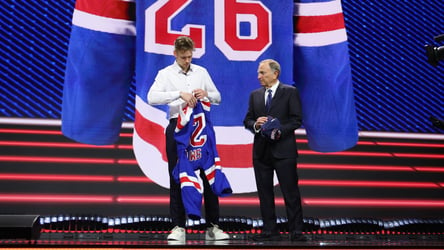



The Anaheim Ducks made nine selections in the 2026 NHL Draft over the two-day event in Buffalo, NY on June 26 and 27.
They made two significant trades on Day 1 of the draft, parting with young center Mason McTavish (3rd overall in 2021) and young, budding defenseman Olen Zellweger (33rd in ’21). On the eve of the draft night, the Ducks didn’t have any first-round picks for the first time since 2017, but by trading McTavish, they acquired two: the 15th and 29th overall picks.
Advertisement
Ducks GM Pat Verbeek on McTavish/Zellweger Trades, 2026 Draft & More
Anaheim Ducks Select Marcus Nordmark with 28th Overall Pick
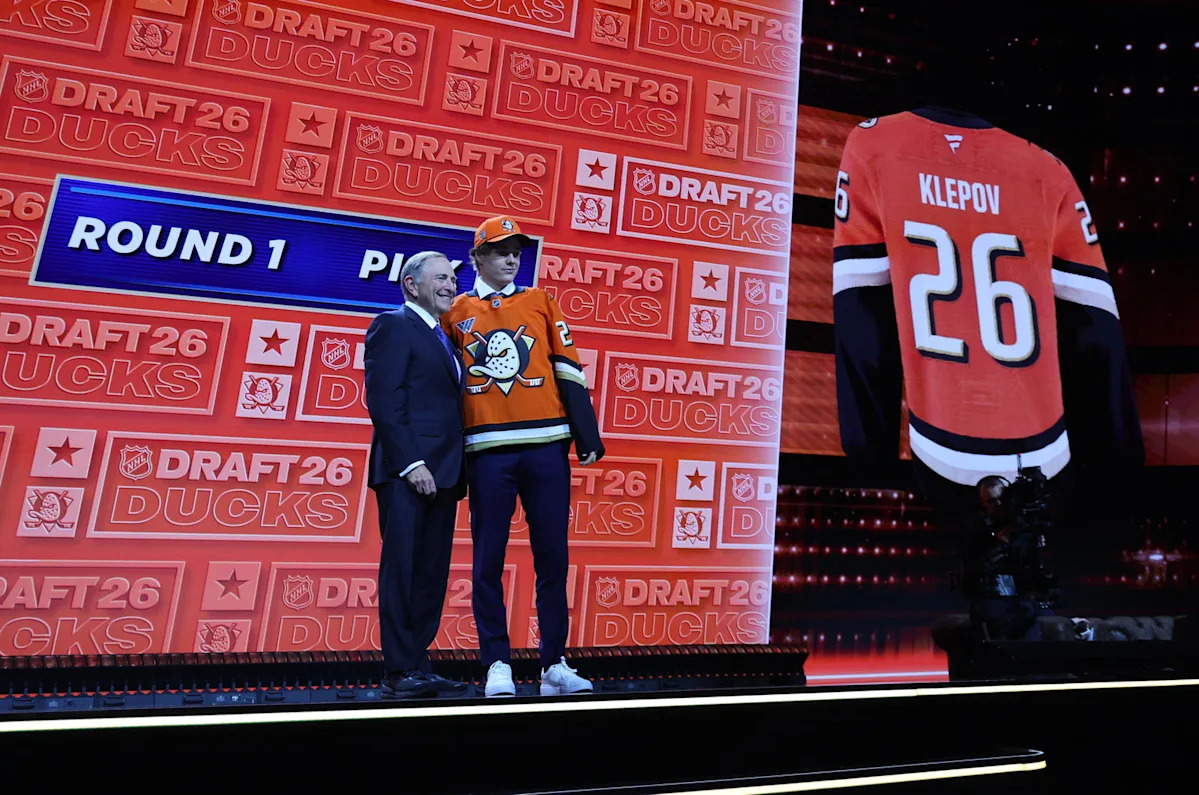
Anaheim Ducks Select Nikita Klepov with 15th Overall Pick
Due to the uncertain nature of evaluating draft picks, as they’re incredibly young and likely will take several years to reach the NHL, if at all, it’s difficult to dislike any selection made by any team at any point in the draft. With that said, for this exercise, instead of typical letter grades, I have graded the Ducks’ selections in terms of “Cold Stone Creamery” ice cream sizes, which reflect varying degrees of enjoyment: “Like It,” Love It,” and “Gotta Have It.”
Advertisement
6-Foot | 187 Pounds
Grade: Gotta Have It
Heading into the draft, Klepov was ranked around this position, with a range of 15 to 25. He led the OHL in scoring with 97 points (37-60=97) in 67 regular season games, and dictates every aspect of play with the puck on his stick. He’s calculating, deceptive, tenacious, and has some of the top pure skill in this entire draft class.
The reason this pick receives such a high grade from me is, in large part, the cost it took to make this selection. The Ducks had Klepov targeted, and general manager Pat Verbeek stated that if he weren’t available at 15, the Ducks wouldn’t have made the deal. Klepov will forever be tied to Mason McTavish for the duration of their careers, and the Ducks put their neck out by trading a former third-overall pick in a trade where he’s the centerpiece coming back.
Advertisement
Other players that Verbeek and Martin Madden, as a duo, have staked their reputation on whether it’s selecting them higher than they were projected or have traded up for in the first round include Leo Carlsson (2nd in ’23), Beckett Sennecke (3rd in ’24), and Stian Solberg (23rd in ’24).
“I think our scouts were super excited, but I was (also) super excited to get to him just because I think he provides what I call a 50-50 player in a sense,” Verbeek told media after the first round. “He’s equal part goalscorer, equal part playmaker. He does have creativity, has really good hockey sense, and with an 18-year-old, they need to get stronger.
“And I believe over the next year or so, if we get him stronger, he’s going to be in a place that’s going to be really good to play in the NHL. We just like his compete level. We like the drive that he has to score goals. And right now, it’s just a matter of getting him stronger because there’s a lot of really top-notch athletic ability with this player as well.”
Beyond the top ten, for the most part, the Ducks have been relatively safe with the type of player they select in the late-first round and into the second round. They’ve preferred more projectable, potentially lower-ceiling players. However, with this pick and their second first-round pick, they gambled big on upside.
Advertisement
6-foot-2 | 187 Pounds
Grade: Like It
This pick was a significant bet on talent for the Ducks, looking to add dynamism to their forward pipeline. Nordmark has every imaginable physical tool aside from skating. His processing speed with the puck on his stick is high-level, his release is quick and heavy, and he’s a plus facilitator.
The question marks surrounding Nordmark’s game appear to be mostly between the ears. He lacks consistency, and with that, his compete level can appear lacking. He has good defensive instincts, but could stand to improve his forechecking and stride-to-stride involvement.
Advertisement
The Ducks clearly believe in their development staff to get the most out of the mental aspects of Nordmark’s game. This is a bet on upside that most followers crave their teams make at this position in the draft.
In an unusual tactic, the Ducks traded up one single spot from 29 to 28 to take Nordmark.
“That’s the deal. When you start looking at your board, and you start looking at your list, you don’t want to take a chance,” Verbeek said when asked about trading up so minimally. “I didn’t feel like we had the chance to do it (at 29th overall versus 28th overall), and I don’t like taking chances to hope that that player is going to be there. We like the player a lot, and we want to be aggressive to make sure that we got that player.”
6-foot-3 | 194 Pounds
Grade: Like It
As has become tradition to an extent, the Ducks went a bit off the board with an early Day 2 pick when they selected Jayden Kurtz from the Minnesota high school hockey circuit. Kurtz is a long, responsible defender who could be classified as a “long-term project” for Anaheim.
Advertisement
Kurtz scored 38 points (13-25=38) in 26 high school games in 2025-26 and added three points (1-2=3) in 16 USHL games in a stint with the Chicago Steel to end the campaign. This selection is reminiscent of when they selected Jackson LaCombe with the 39th overall pick in the 2019 draft.
Kurtz will play his 2026-27 season at the University of Wisconsin in the NCAA.
5-foot-11 | 176 Pounds
Grade: Gotta Have It
This is yet another bet on upside, as Preston is one of the more electric players in the 2026 Draft. He’s the shiftiest, fastest skater in the class with lightning hands and a lightning release. He’s more of a transition expert than a cycle play driver, but his instant offense is a tool that any team could use.
Advertisement
His length is roughly NHL average, but he’ll need to add to his 176-pound frame in the next couple of seasons to round out his toolkit. Preston’s lack of a “B Game” is what likely caused his drop into the second round, but the Ducks can afford to take a gamble on tremendous offensive upside, which is why this is my favorite pick of the draft.
Mathis finished his WHL season with 44 points (18-26=44) in 46 games, split between the Spokane Chiefs and Vancouver Giants, and ended his season playing for Canada at the U18 World Championships, where he scored six points (2-4=6) in five games.
“I think I’m a dynamic skater. I love to attack off the rush, play in-zone,” Preston said after he was drafted. “I think I make my teammates around me better, and I learn people’s games so that I can help them. I know their strengths and where they’re comfortable. I think that helps the team, overall.”
6-foot-1 | 191 Pounds
Grade: Like It
After four high-upside potential projects, the Ducks went back to the well of selecting a translatable, responsible, north/south forward in the third round with their selection of Rian Chudzinski.
Advertisement
Chudzinski plays a pacey “meat and potatoes” game, where he makes an impact on the forecheck, provides a physical presence, and gets to the hard areas of the ice. The production will likely never come around, and he projects to top out with a fourth-line toolkit.
He scored 38 points (21-17=38) in 54 games and added 17 (6-11=17) in 21 playoff games during Moncton’s run to the QMJHL final. It’s unclear where he’ll play his hockey in 2026-27.
6-foot-6 | 206 Pounds
Grade: Love It
Frossard’s size, defensive fundamentals, and projectability render it somewhat of a surprise that he was available this late into the draft for the Ducks. His skills aren’t dazzling, but are good enough to retrieve a puck, make a first pass, and feed shots through from the point.
Advertisement
His expertise is defense, specifically eliminating angles and protecting the net front. He likely has bottom pair upside, and it will take him several years of development before he may even sniff NHL action, but certainly a worthwhile gamble in the fifth round.
He scored 14 points (5-9=14) in 51 games for Guelph in 2025-26. He’ll look to round out and develop more of a robust offensive game in 2026-27, again playing for Guelph, but he’ll make the jump to the NCAA in 2027-28 to play for the University of Notre Dame.
“I’m a big defenseman who skates really well, plays a really strong defensive game, use my stick, closes fast, but also has some offensive ability and more of a two-way style,” Frossard said after his selection. “I use my skating to join the rush and try to help the team score as well.”
6-foot-3 | 212 Pounds
Grade: Love It
The Ducks rarely exit a draft without selecting a goaltender. This year, it was Peshkov in the sixth round. The Ducks will add him to their goalie pipeline that includes Tomas Suchanek, Damian Clara, Vyacheslav Buteyets, and Elijah Neuenschwander.
Advertisement
Peshkov is reported to be an athletic, but very raw goaltender who managed a .930 SV% in 47 MHL games in 2025-26. Positioning and puck tracking seem to be areas in need of improvement for Peshkov before he potentially makes the transition to North America.
6-foot | 160 Pounds
Grade: Like It
The Ducks acquired the 192nd pick in the 2026 NHL draft along with ECHL defenseman Kyle Masters (23) from the Carolina Hurricanes in exchange for the signing rights for veteran defenseman John Carlson. With the pick, the Ducks selected Kosick, a playmaking center from the WHL who has good vision, hockey sense, and puck skills, but needs to round out every other aspect of his game.
Advertisement
He scored 54 points (16-38=54) in 69 games in 2025-26, split between the Swift Current Broncos and Seattle Thunderbirds. He is reportedly heading to the University of Michigan in the NCAA for the 2026-27 season.
6-foot-2 | 176 Pounds
Grade: Like It
With their final selection in the draft, the Ducks took a swing on Rieber, who scored 11 points (2-9=11) in 60 regular season USHL games. He’s committed to Miami University (Ohio) in the NCAA for the 2027-28 season and will presumably play another year in the USHL next season.
Ducks Sign Ian Moore to Two-Year Contract Extension
Ducks Trade Mason McTavish to St. Louis Blues
Ducks Trade Olen Zellweger to the Buffalo Sabres
Read the full article here