





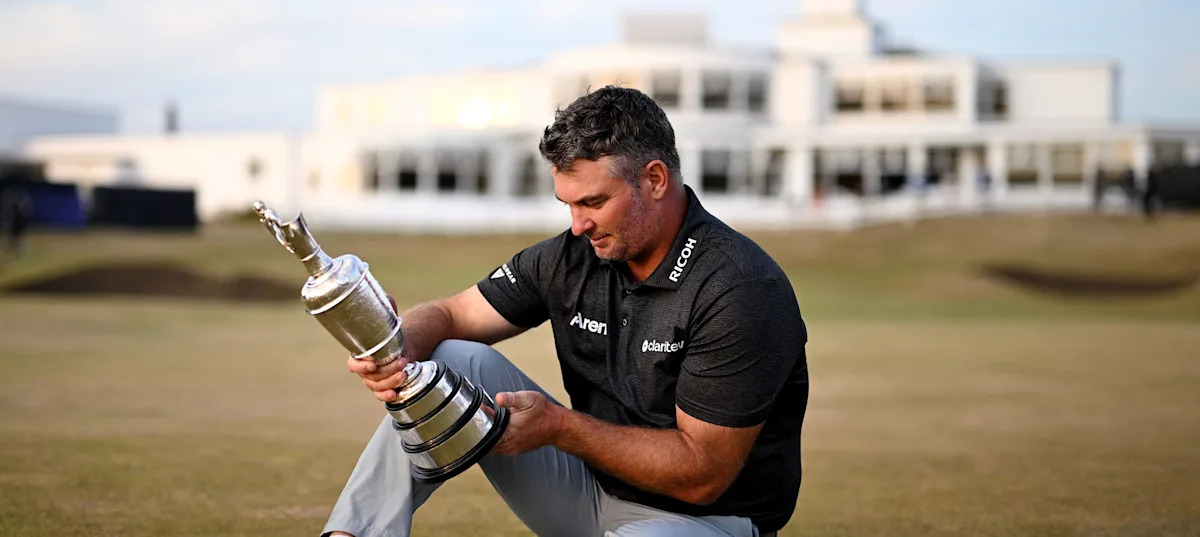
Major season is over, but not without an epic Sunday performance and plenty of controversy. Dan Rapaport breaks it all down.
A Win for the Late Bloomers
Ryan Fox started a law degree at Auckland University. Around that same time he gave up cricket and, more notably given his family history, rugby. He’d gotten down to a 2-handicap before ever taking a lesson and figured he’d give this whole competitive golf thing a try.
Advertisement
“Loved it,” Fox told me last year. “Immediately, I was like, this is it.”
He wouldn’t turn pro for another half-decade, until after his 25th birthday, and it’d be another ten years before he broke into the game’s highest level. That move to America, to the PGA Tour, provided priceless evidence that despite his late entry into this sport he can play it as well as anyone.
Finally, at age 39, Fox is a major champion. In an age of hyper-specialization in youth sports, of can’t-miss phenom, it is truly remarkable that a man who turned pro when he was older than Tom Kim is right now is the Champion Golfer of the Year.
“Surreal, to be honest,” Fox said of his journey in the game. “It’s something you dream of. I used to get up in the middle of the night to watch this tournament back home. It was always something that was there just to be able to play in it, first up, and now to be an Open champion, to be the Champion Golfer of the Year, it’s unbelievable, surreal, crazy. I don’t have the words in my vocabulary to explain it, to be honest.”
Advertisement
It’s a reminder that golf is the ultimate meritocracy; you don’t need to go to a certain school or hit a certain benchmark by a certain age to play at this level. There is no draft, no general manager you need to give you a shot. If you are good enough, you will find your way to the world stage.
Bounce Backs and Birdies on the Final 9
Fox played the boldest and the best of the contenders by a wide margin. It was an interesting scoring week; this was the first major championship that featured three 62s but not a single player reached 12-under for the week at any point, and come Sunday afternoon bogeys were far more common than birdies. As is so often the case, once the finish line came into view (and the wind freshened) so many drove inverse.
Which underscores just how impressive Fox’s finishing flourish was. He made four birdies in his last six holes, including birdie on the toughest hole at Royal Birkdale with three perfect shots. But he was just as impressive on the two holes he didn’t birdie.
Advertisement
Coming off back-to-back birds Fox stepped to the tee on 15, the rebuilt par-3 playing 240-plus yards, and tugged a long iron by the slightest of margins—only to get one of those harrowing Links Golf bounces, his ball careening of the right face of the bunker and nestling up against then left lip. His only option from there was to play backwards, and the ensuing up-and-down for bogey harkened back to Jordan Spieth’s miraculous bogey at this same course nine years ago.
Fox bounced back with a birdie on 16 then took to the very reachable par-5 17th. He pulled a driving iron and hit a low screamer that would take advantage of cart-path fast fairways. When he made the first move toward an early tee pickup you thought he’d pulled it off, only his ball kept drifting with the wind and it tumbled and hopped and finally dove into another bunker, once again finishing far-too-close to the left lip. He then, upon all that rugby strength, deep-squatted as low as he could while standing outside the bunker and somehow managed to advance it more than 100 yards. That set up a comfortable par and the platform for his heroics on 18.
What struck me was how quickly he played. The crowd wasn’t finished giving their respect to Sam Burns when Fox stepped up to hit the biggest putt of his life. The spectators hastily shushed themselves to clear the stage for the moment. Twenty-ish seconds after Burns tapped in for his par, Fox had won The Open.
It’s how he always plays, and there’s no sense in deviating from your tempo at the most important moment of all.
Advertisement
“I was always that way as a kid,” Fox said. “I see things fast…for me—I need to make sure this comes across right—it’s not that difficult to pick a shot and pick a club. I get in there and it all happens quick. It’s always going to be between one or two clubs into a green, and I just see the shot quickly, pick a shot quickly, and the less time I have to think about it, the less bad stuff can creep in there.”
I’m Standing Firm That Bryson Should Not Have Been Penalized
I’ve watched the video more than 20 times and I still can’t believe the R&A penalized Bryson DeChambeau. The video evidence was far from conclusive and the camera angle wasn’t even zoomed in—this wasn’t a case of, say, Patrick Reed in the Bahamas, where we had that pixelated close-up showing him clearly moving the sand behind his ball. Bryson’s ball isn’t even visible. The question isn’t whether Bryson stepped on fescue; the question is whether that materially improved the condition of his stroke, and without clear-cut evidence surely the player’s word takes precedence? That’s one of the key tenets of golf—players police themselves.
There’s also zero chance Bryson was trying to pull a fast one. No professional is more keenly aware of camera angles than the Golfluencer Extraordinaire. He’s playing in a major championship besides the world No. 1. It’d take some kind of sociopath to cheat live in 4K.
Advertisement
This, of course, is merely one man’s opinion. A quick peruse of social media found public opinion divided. Rory McIlroy thought it was a clear-cut penalty but Xander Schauffele didn’t.
“It’s a tough one,” Schauffele said. “Who knows. I have no idea, to be honest. I’m assuming you talk to Bryson—I haven’t spoken to him or heard what he said, but he’s just stepping in how you’d normally step in to hit a golf shot. I think the R&A said something along the lines of whether it’s intentional or not, it’s a penalty. It’s a tough spot to be, obviously, when yo’ure in high brush, kind of having to dance around to get your golf ball is a tricky thing. It’s not something we’re used to doing that often. You imagine you give him the benefit of the doubt. He said he didn’t do it intentionally, and it’s unfortunate that he got penalized because he was playing incredibly well.”
That it wasn’t by any means clear-cut tells you all you need to know. In golf, ties should go to the player. It’s always been that way.
His Reaction Is a Different Story
Advertisement
That said, how a person reacts in a moment of crisis like that one, when your cortisol spikes and all the blood rushes to your head, reveals a lot about character. That Bryson’s first inclination was to throw a fit, threaten not to play the final round then play this strange cat-and-mouse game with the assembled media…it turned the whole ordeal into a circus. You almost got the sense he was enjoying the performance aspect of it all. Rory McIlroy didn’t hold back.
“I won’t pretend to be up here and defend Bryson. I’m not particularly fond of him. I think a lot of it’s performative. I think a lot of it’s for attention.
“To hold the tournament hostage like that, and to have all of us, players, volunteers, everyone waiting on him to depart—I didn’t feel like it was a great look.”
Advertisement
It brought to mind another unjust penalty from a few weeks ago: the red card handed to Folarin Balogun in the U.S. men’s national team’s round-of-16 game against Bosnia and Herzegovina. Balogun didn’t throw his hands up in the air or post memes. He accepted something he didn’t agree with, conducted himself like a professional and moved on.
An Unnecessary Circus
One more on the Bryson saga. I’m not a big fan of how the R&A handled things, and their slow action allowed the situation to have an outsized effect on the tournament. Why wasn’t there any discussion of a potential penalty until after the round? When the USGA kept Dustin Johnson in limbo at Oakmont the anti-establishment pitchforks came out. And the whole delayed-tee times thing on Saturday afternoon, which multiple players took issue with—that was a direct result of the delayed handing out of the penalty, compounded by them waiting on one player to either follow through on a childish threat or not? Surely the better course of action would be to release tee times as normal, and in the small chance Bryson actually did withdraw, simply deal with it as they deal with the mid-tournament WDs that happen every tournament? It’d suck for the guy who has to play solo in contention on Sunday, but Bryson was never actually not going to play.
Xander Keeps the Streak Going
Advertisement
That was an all-time quiet major week for Xander Schauffele—but he did manage to squeak out a T18 finish, which means he has now finished T18 or better in 18 of the last 19 major championships. The outlier, for those concerned: a T28 at the 2025 PGA Championship.
A T18 won’t get the juices flowing for a two-time major winner but Xander to top 20 in a major remains the best bet in our sport. He came into this week off a T51 out of 72 players at the Travelers and a missed cut at the Scottish and yet here we are.
Birkdale on Bronzer
I’ve been watching too much Love Island UK, so bear with me, but the color differences between the baked-out fairways/rough at Royal Birkdale and the very-green putting surfaces reminded me of the ladies on the show who lather their faces in so much bronzer that they become a completely different color than the rest of their bodies.
We Need a Ceasefire in Broadcast Chirping
Advertisement
It’s not every day you have the in-the-booth network commentator firing back at social media critics in the middle of a weekend major broadcast. But Kisner’s not your every-day broadcaster. He’s comfortable in the mud. He doesn’t take shit.
The first tweet that set him off came Saturday from No Laying Up, OGs of Golf Twitter and frequent broadcast criticizers. They called Kisner’s bringing up the walking official’s role in the Bryson saga “bizarre,” which prompted Kisner to highlight NLU’s lack of PGA Tour starts. Kisner was in a similar mood Sunday, firing back at Kyler Porter of Normal Sport.
It’s easy to lob grenades at a broadcast (and those talking on it) from the comforts of home, where you have unlimited time to polish off a witty tweet that dunks on a bunch of people doing their best live on-air. It’s complaining for the sake of complaining. It results in a pile-on that doesn’t actually solve anything, which is social media at its worst. It’s tired.
Advertisement
Our DOG of the Week is Billy Foster
Our DOG of the week is a legend of the caddying game. We’ve had Foster on Dan on Golf before—it’s one of my favorite interviews we’ve ever done—and he’s had a front row seat to golfing greatness through his stints caddying for Seve Ballesteros, Thomas Bjorn, Darren Clarke, Lee Westwood, Matthew Southgate, most recently, Matthew Jordan.
Foster, who’s as Leeds as they come, first caddied in The Open Championship in 1984, at the age of 21, for a South African named Hugh Baiocchi. He’s missed THe Open just once, in 2012, when he suffered a torn ACL but still attended the tournament at Royal Lytham because he simply adores this tournament. Foster once said that he’d trade all 45 of the wins he’s been on the bag for to work for the winner of the Claret Jug.
He was in danger of not getting the opportunity to even try this year after he and Matt Fitzpatrick parted ways last year. He’s been working for Lee Westwood on LIV Golf but Westwood was not in the field this week. Enter Southgate, a 30-year-old Liverpudlian who got through Final Qualifying for the sixth time and gave Billy a call. Southgate made the cut cut this week and bounced back from a 76 on Saturday with a very-tidy 66 to close the week out, giving Foster yet another one of those cherished walks up the last at The Open. Here’s to many more.
Advertisement
Sam Burns’ Time Will Come
Sam Burns couldn’t figure out the majors for quite a while. He failed to post a single finish better than T20 in his first 16 tries, a curiously barren run for a Ryder Cup-caliber player. But the cool thing about golfing careers is that they often span decades, and there’s plenty of time to turn the narrative around and Burns has done exactly that. His first true chance at a major ended in a puddle at Oakmont but he has kept knocking on the door, missing a playoff at Shinnecock by a centimeter and contending all week at Royal Birkdale before his game deserted him on Sunday. After birdieing the 2nd hole he failed to make another one the entire round and slowly bled out to a 72. His time will come.
No More ‘British Open’ Please (Do We Have to Say This?)
At this point, calling it the British Open borders on disrespectful. It’s also counterfactual, as the Open literally last year was held outside the island of Great Britain, and with an Open coming soon to Portmarnock in Dublin you can’t even use the excuse that it’s always played in the United Kingdom, which the vast majority of Americans wrongly use interchangeably with Britain.
Advertisement
The Open is the oldest golf tournament in existence. It deserves reverence, and the least we Americans can do is call it by its true name.
An Unfortunate ‘First Time Since…’
That wraps an entire major season without Tiger Woods or Phil Mickelson. It’s the first time since 1989 that neither teed it up in any of the big 4 and it’s not due to anything that happened on the actual golf course. Taking a step back, it’s truly bizarre that both legends have derailed the latter stages of their careers with so many self-inflicted wounds.
Lucas Herbert the Meme
Deep cut here, but who remembers the Australian kid who graciously agreed to apologize for throwing a party while his parents were away but heroically refused to apologize? Every time Lucas Herbert’s face popped up on the screen, that’s where my head went.
Advertisement
In related news: I am generally unwell.
They Just Hit the Shots, Man
Golf’s a torturous game. You’re trying to hit a little white ball into a hole 450 yards away with bunkers and long grass and humps-and-bumps in your way. If you allow yourself to think of everything that might go wrong you’ll be too paralyzed with fear to bring the club back.
…And that’s just the recreational players. Imagine all that mental chatter supercharged with thoughts of chasing legends, or how people will talk about you after you’re gone. It’s no way to play good golf.
Which brings us to all the legacy talk in the pre-tournament press conferences. It’s our job to contextualize performances; it’s the player’s job to perform. Both Scottie and Rory weren’t in a particularly reflective mood early in the week, which makes complete sense.
Advertisement
“I don’t really play for a place in history,” Scheffler said Tuesday. “I’m not playing for anything like that because—this is going to sound a little morbid—at the end of the day, I’m going to live my life, and it’s going to end. When it ends, I’m going somewhere else, and I’m not going to be here anymore.”
Translation: I just hit the shots, man.
And here’s Rory: “No, I don’t really care (about what people will say when I’m gone). I would like to think that the people that love and care about me think a certain way of me, but yeah, I’ll be long gone. I’ll be dead. I don’t think I’ll be seeing what people say about me. I’ll be six feet under. I don’t think I’ll be a ghost.”
Translation: I just hit the shots, man.
Advertisement
And then there’s Sam Burns, who had no idea he had tied the all-time major championship scoring record—which probably helped him tie the all-time major championship scoring record.
“Yeah, I had no idea until they told me up there. I didn’t realize that was the case.”
Translation: I just hit the shots, man.
It’s Darker Than Ever in the Spieth Universe.
He returned to the site of his last major triumph and laid an egg, shooting a putrid 10-over par total to miss the cut by nine. The most sobering part of it all is how unsurprising it all was.
He did his best to portray optimism in his pre-tournament press conference, suggesting his game’s in a much healthier place than his results would suggest. In hindsight it seems a bit quixotic. In the moment it felt a bit quixotic. He does not have a single top 10 this year. He does have two T11s and two T12s, but this is Jordan Spieth we’re talking about, in the early-30s period that historically has found golfers at their best.
Advertisement
“I’m quite frustrated with the result considering I know where my game is at,” he said. “It’s better than it was four or five years ago when I got back to top 10 in the world. It’s without a doubt better than it was then; it’s just not quite showing up in results…knowing me, when the lid pops off the hole, I feel like I can go on a run about as hot as anybody can run. So I’m just waiting for that opportunity.”
Waiting is a passive activity. Given his last nine years he could take a more active role? A new set of eyes on his swing? A new putter? Something?
There’s still so, so much to play for. You don’t win 3 majors before your 24th birthday without generational ability. And, as he pointed out, Mickelson didn’t win his first major until he was 34. I’d just like to see a bit more red-ass in him. There comes a point where patience morphs from a virtue to borderline lethargy. We’ve seen so, so many players make changes that jumpstart them out of a moribund stretch. Matt Fitzpatrick going to Mark Blackburn comes to mind. We all want Spieth to become Spieth again, but how long can you continue doing the same things and expecting a different result?
A Poor Showing from the Ams This Week
Advertisement
None of the 10 amateurs in the field made the cut this week. The highest-ranked amateur in the field was No. 10 Tim Wiedemeyer. Am I crazy for thinking the top-ranked amateur in WAGR should get an exemption into The Open, like they do into the U.S. Open? Jackson Koivun’s presence made the U.S. Open at Shinnecock a better tournament, and I would’ve loved to see No. 1 Preston Stout, the reigning NCAA champion and three-time Big 12 Champion, get a crack this week.
Don’t Make Assumptions About UK Golfers
There’s an assumption that if a guy’s English or Irish or Scottish he must love links golf. It’s in his blood. He grew up playing courses like this. This is the turf he’s most comfortable on.
Like most broad-stroke narratives it has plenty of blind spots. Take Matt Fitzpatrick, for example. Born and bred in the England’s steel city of Sheffield. Surely he loves being back playing links golf?
Advertisement
It’s the opposite.
“Yeah, just look, this week, you’ve just got to look at three or four holes for me. I’ve hit decent shots, gotten no luck and come away with 4-over par. That’s the way links golf is. You need to have that rub of the green sometimes, and I didn’t have it this week…That’s the way links golf is. When it’s this firm, there’s a lot of luck of the bounces and luck of the lies. It is what it is.”
That’s an Englishman who can’t wait to get to the parkland paradise of the PGA Tour.
My 2026 Major Season Grades
That wraps up another major season that flew by way too quickly—I’m missing the days of the PGA Championship in August—and, with their performances fresh in mind, let’s hand out some major-championship grades for some of the biggest names in our sport.
Advertisement
A quick reminder that grades are relative to a player’s expectations. Scottie’s scale isn’t the same as Tommy’s. Life’s not fair. Get used to it.
Scottie Scheffler: B+
He contended in three of the four, finishing a shot out of a playoff at the Masters, four back at the U.S. Open and three back this week. He shot 20-under combined, tied with his buddy Burns for the best mark of the 14 players who made the cut in all four majors. He’s been statistically the best player in the world again this year but when after winning one major in 2024 and two in 2025, it can’t be in the A-range without a victory.
Rory McIlroy: A-
Advertisement
He graded himself perfectly after Sunday’s round.
This season feels very similar to last season. Obviously won the first major of the year, fell off a little bit after that, but still any time you win a major in a year, you have to be pleased with that.
Sam Burns: A
One shot back at the U.S. Open, two at Royal Birkdale, three top 10s, tying Scottie cumulatively… a major step forward in his career.
Tommy Fleetwood: B-
This week was an unabashed success. If you view professional golf as binary, as everything besides a win being a disappointment, you’re never going to be happy. This performance rang very similarly to Rory’s last year at Royal Portrush, and he looks back at the week with nothing but fond memories. Would Tommy have loved to win? Sure. Did he give the fans a ton to cheer about and experience something extremely special? Absolutely. It was, however, his only top 10 in a major of the year and his first since the 2025 Masters.
Matt Fitzpatrick: C
He’s been arguably the best player in non-majors this year but hasn’t quite brought that form into the big ones. He was the better’s darling this week—I didn’t see a single player picked to win more than he was—and missed the cut. He was solid-but-not spectacular in the first three majors of the year also (T18 at the Masters, T14 at the PGA Championship, 22nd at the U.S. Open). The grade may seem harsh at first glance but he’s earned the honor of high expectations.
Bryson DeChambeau: D+
Missed cuts in the first three followed by an extremely eventful T14 at the Open. His career now enters yet another can’t-look-away chapter: where will he play his golf in 2027, and how much of it will he play?
Jordan Spieth: D
Read above. I don’t want to beat a dead horse.
Jon Rahm: C+
A T2 at the PGA Championship marked his best finish since darting for LIV Golf but he missed the cut at Oakmont and tumbled down the board on Sunday at Royal Birkdale with a four-over 74. Like Bryson, his playing future remains something of a mystery, though the chatter is that he’s got less contractual flexibility.
Read the full article here