




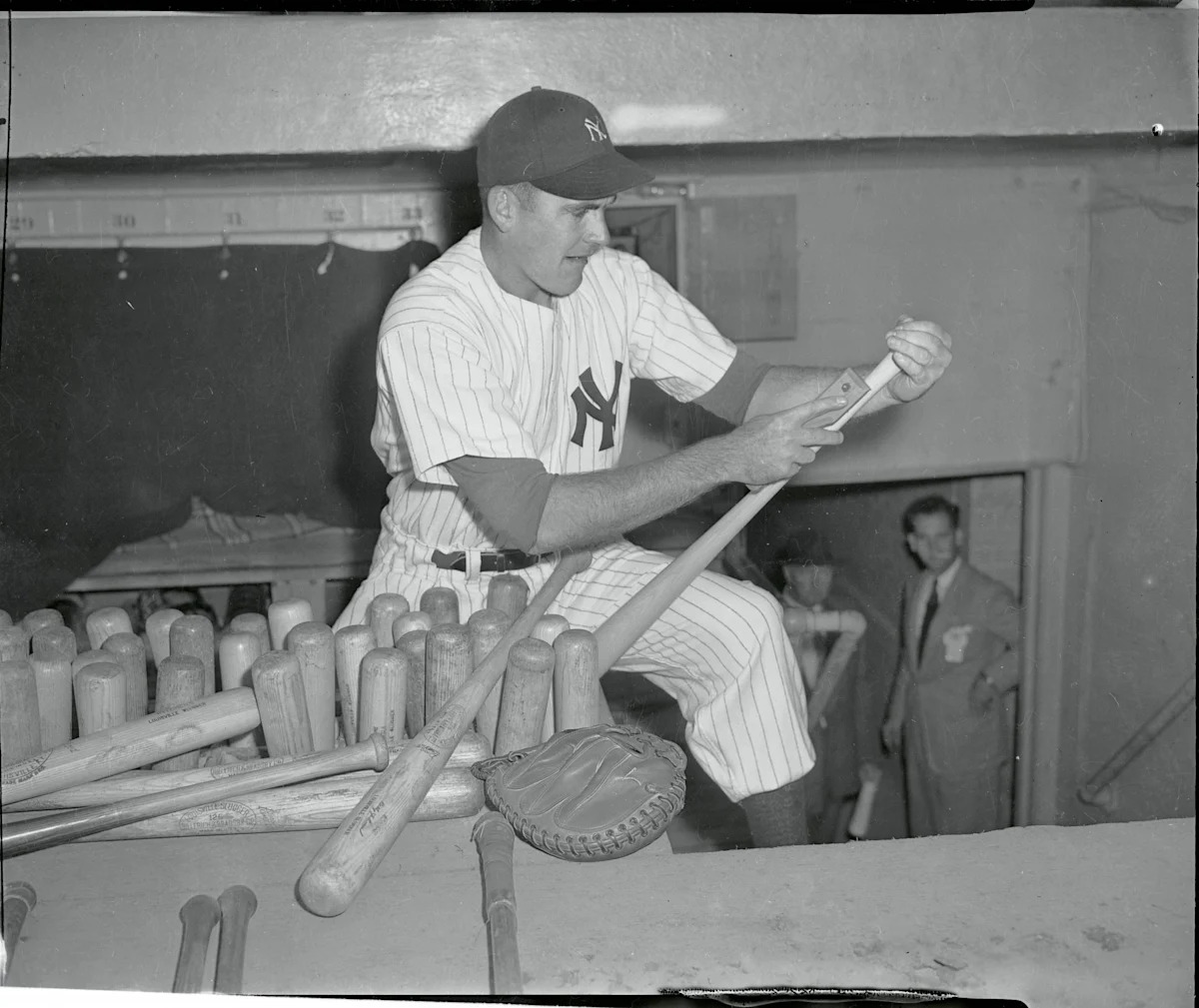
Johnny Lindell was born in Colorado, but was raised in California. From an early age and through high school he showed to be a promising athlete starring for Monrovia High School in football, track, and of course baseball. The 6-foot-4 right-handed pitcher caught the eye of Yankees scouts and was signed as an amateur free agent in 1936 receiving a bonus of $150.
John Harlan Lindell
Advertisement
Born: August 30, 1916 (Greeley, CO)
Died: August 27, 1985 (Newport Beach, CA)
Yankees Tenure: 1941-1950
After signing with the Yankees, Lindell started working his way through the farm system. In his first season in the minors he posted a 17-8 record. Despite his large frame Lindell was known for his breaking balls, depending on his curve and slider to produce outs. In 1940 Lindell went 18-7 with a 2.70 ERA in the American Association with the Yankees’ farm team in Kansas City.
Lindell’s performance in 1940, as well as a strong spring, landed Lindell on the opening day roster as a reliever. However, that promotion turned into a cup of coffee as Lindell was sent back down to the minors after only appearing as a pinch-hitter. Lindell would spend 1941 in Newark with the Yankees’ top farm club. He went 23-4 with a league-leading 2.05 ERA and then picked up three more victories in the playoffs. The Sporting News named Lindell the 1941 Minor League Player of the Year for that performance.
NEW YORK – 1942. Three New York Yankees pose in the Yankee Stadium dugout before a game in 1942. They are (L-R) Tommy Henrich, Johnny Lindell, and Joe DiMaggio. (Photo by Mark Rucker/Transcendental Graphics, Getty Images) | Getty Images
Heading into the 1942 season the Yankees and the rest of the majors were dealing with players leaving to serve in World War II. It was thought the top pitching prospect would win a starting job. However, Lindell seemed to have that Quad-A type stuff and was stuck out in the bullpen. Lindell finished the 1942 season going 2-1 with a 3.76 ERA in 52.2 innings. The Yankees lost the World Series loss to the St. Louis Cardinals that season and Lindell did not make an appearance in the postseason.
Advertisement
Prior to the 1943 season, skipper Joe McCarthy decided that Lindell did not have a fastball worthy of the show, but decided Lindell was a good enough hitter to try him out in the outfield. With starters Joe DiMaggio and Tommy Henrich in the service Lindell not only made the club but was a starting outfielder. Lindell got off to a great start and was selected to the 1943 All-Star team. His final slash line on the season was .245/.329/.365 and he led the league in triples with 12. The Yankees would face the Cardinals in a rematch of the previous Fall Classic and this time the Yankees would prevail in five games.
View Link
The best season of Lindell’s career would come the following season in 1944. Lindell hit .300, set his career high with 18 home runs, had 103 runs batted in, and again led the league in triples this time with 16. The team finished in third place, however, and missed the postseason. Lindell was off to a solid start in 1945, but was drafted into the military that June and would serve until March of 1946.
With all the boys returning in 1946 Lindell found himself in a crowded outfield with no sure spot in the lineup. Lindell appeared in 102 games shuffling around in a utility role as the Yankees went 87-67 on the season, finishing in third and missing the playoffs.


(Original Caption) Yankee outfielders are just as eager as the rest of the team to tangle with the Brooklyn Dodgers in the World Series, beginning October 5th. Here, after an afternoon of practice at Yankee Stadium are (left to right): Gene Woodling, Hank Bauer, Cliff Mapes, Johnny Lindell, Joe DiMaggio, and Charlie Keller.
An injury to Charlie Keller in 1947 put Lindell back into a regular role. Lindell posted solid number over the course of the regular season, but really entered a zone in the World Series. Facing the Brooklyn Dodgers, Lindell went 9-for-18 at the plate and led the team with seven runs batted in. The Yankees would take the series in seven games.
Advertisement
View Link
The Yankees moved Yogi Berra to the outfield before the 1948 season and welcomed back a healthy Keller. This again crowded the grass and pushed Lindell into a utility role. Playing in only 88 games, Lindell slashed .317/.387/.511 with 13 home runs. The team finished third again and missed the playoffs.
Lindell’s playing time continued its downward projection in 1949. Despite the limited role Lindell got to play the hero at the end of the season helping the Yankees take down the Red Sox to claim the pennant. The Yankees would face and defeat the Brooklyn Dodgers this time in five games giving Lindell his third ring as a Yankee.
View Link
Advertisement
Heading into 1950 Lindell was still the Yankees’ fourth outfielder. However, that would change in May as he was sold to the St. Louis Cardinals. Lindell struggled at the plate following the move, and this led to him being sent back down to the minors. In June the Cardinals traded Lindell to the Brooklyn Dodgers for Glen Moulder. While bouncing around in the minors Lindell started pitching again, now throwing a knuckleball. Prior to the 1951 season, Lindell landed in the Pirates’ organization.
In 1953 Lindell was back on a major league roster throwing a knuckleball for the Pirates. Now 36, Lindell went 5-16 with a 4.71 ERA. On the last day of August that season Lindell was purchased by the Philadelphia Phillies. Rounding out the year with the Phillies, Lindell went 1-1 with a 4.24 ERA. Lindell started the 1954 season with the Phillies and appeared in a handful of games as a pinch hitter before being released.
That release ended his playing career. After that, Lindell took a position as the athletic director of the 7-Up Foundation back in California. Lindell passed away from lung cancer in 1985.
It’s no small feat to win multiple World Series titles, especially contributing as a quality hitter after coming up as a promising pitcher. Lindell filled whatever role the team needed him in, and his name will forever be a part of the era that saw the team cement their spot atop the sport’s history books. Happy birthday Johnny!
Read the full article here


