




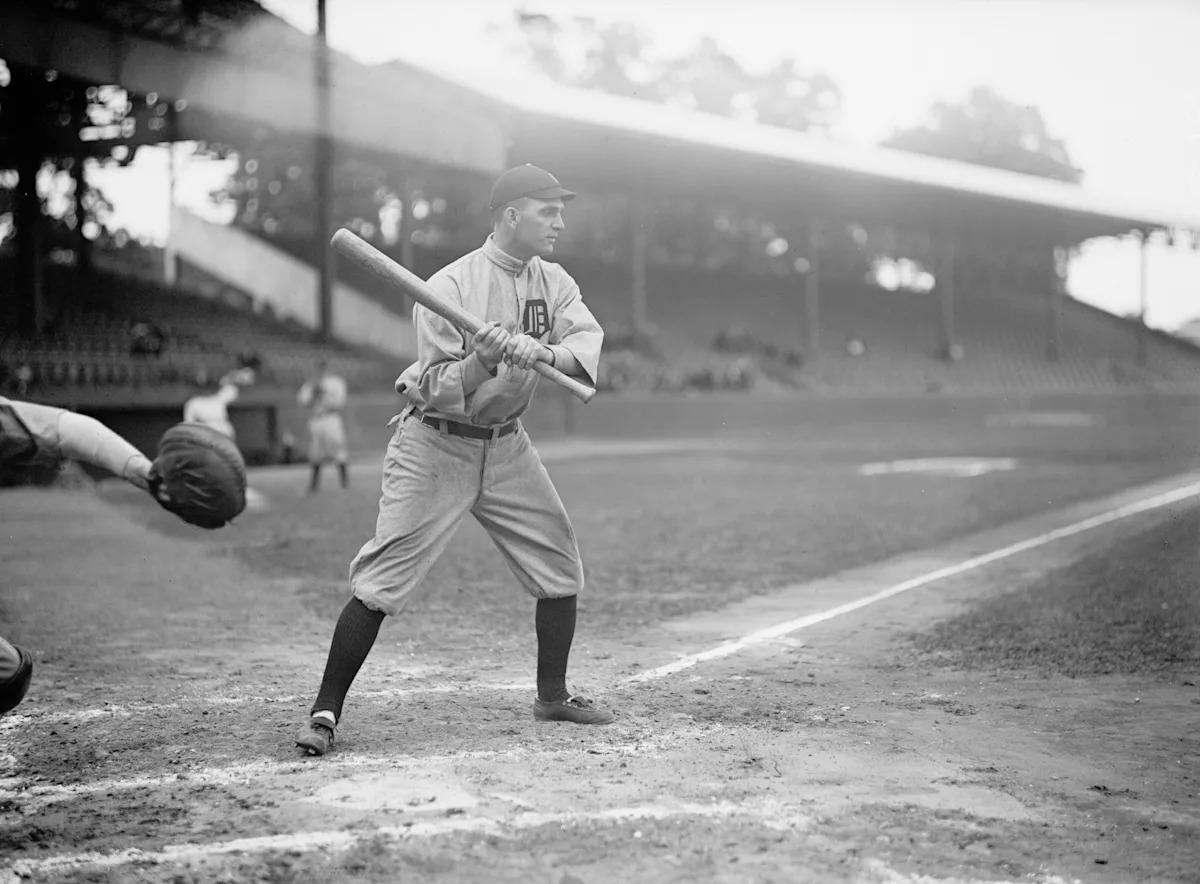
The Yankees, having existed for well over a century, have had more than their fair share of characters don their uniform. Some of them were stars like Yogi Berra, and some of them were role players like Billy Martin. It’s players like them that add some texture to the history of the team and of the game, reminding us that though we come to see the best of the best play, sometimes we stay for the interesting characters on the side. George Moriarty, known for combining an easygoing demeanor off the baseball diamond with a rough-and-tumble personality in the clubhouse, was one of those characters.
George Joseph Moriarty
Born: July 7, 1885 (Chicago, IL)
Died: April 8, 1964 (Miami, FL)
Yankees Tenure: 1906-1908 (player)
Advertisement
George Moriarty was born in Chicago to a former semi-pro catcher, and dropped out of school at an early age to pursue baseball. He played in various semi-pro leagues around the city and even began his professional baseball career in 1901 at 16. He signed with the Davenport River Rats and the Rock Island Islanders in the Illinois-Indiana-Iowa League. He played in 110 games during the first of three seasons he would spend in the Three-I League. Moriarty was then moved to the Bloomington Blues in 1902 and, once again, to the Joliet Standards/Springfield Foot Trackers to play ball there in 1903. He hit .232 in 1902 and .222 in Joliet/Springfield. Moriarty took a job in Chicago toward the end of 1903, and in an exhibition game against the Cubs, Moriarty started a triple play at third base. The Cubs’ manager, Frank Selee, decided to give Moriarty a one-game tryout on the last day of the 1903 season.
On the day of the one-game tryout, those in the press box noted that Moriarty was nervous in his debut and went 0-for-5. Despite his poor performance at the plate, he managed to make another tryout with the Cubs in the spring of 1904.
The first four games for Moriarty in a Cubs uniform were strikingly bad, as he did not register a hit in 14 plate appearances, and his only time on base came on a walk. As a result, he was sent back to the minors, and after the Southern Association’s sale to Little Rock, he was sent to the Toledo Mud Hens of the American Association.
Moriarty played 136 games and not only found his stride at the plate, batting .295 by season’s end, but he also began to earn his scrappy reputation. There were plenty of stories about the third baseman fighting those who gave him attitude with his bare hands while also continuing his excellent play on the field.
Advertisement
Moriarty led the league with 51 steals for Toledo in Class-A ball in 1905, and after that excellent year on the basepaths, he joined the New York Highlanders (now the Yankees) when his contract was sold for the 1906 season. He played all over the field in his first season with New York at the age of 20, including second, third, left, and center field, finishing with a slash line of .234/.298/.340 in 65 games.
In 1907 with the Highlanders, Moriarty became a full-time utility player, registering 474 plate appearances while playing seven different positions. He also upped his play at the plate, moving from a .234 average to a .277 average, a .320 on-base percentage, and a .336 slugging percentage, all of which were better than the league average. His on-base and slugging percentages that year would remain career highs for the rest of his time on a baseball diamond.
Moriarty stayed in the same role in 1908 under managers Clark Griffith and Kid Elberfeld. He continued to get playing time, but his numbers dropped sharply, finishing at .236/.269/.276. Along with the drop in the individual numbers, the Highlanders finished dead last in the American League with a record of 51-103. They were 39.5 games behind the first-place Detroit Tigers, and they finished 17 games behind the second-to-last place Washington Senators.
But for Moriarty, the end of the season resulted in some good news. The Highlanders had sold him to the top of the table: the Detroit Tigers.
Advertisement
Instead of being a utility player, Moriarty was made the team’s consistent third baseman. He helped the Tigers win another pennant in 1909, despite the team losing to the Pittsburgh Pirates in the World Series. And his time with the Tigers was when his reputation as a fighter grew from just a story here or there. He was willing to spar with anyone who stepped up.
Tigers legend Ty Cobb reportedly wanted to fight Moriarty, and, according to the Society for American Baseball Research, Moriarty promptly handed Cobb a baseball bat, saying he’d need it to even have a chance. Cobb did not take the challenge. But he was not the same player on the field as he was off of it, being known for his quiet and peaceful demeanor on the diamond.
Moriarty would play with Detroit for another five years from 1910 to 1915. His best year came in 1914 at the age of 29, when he played in 132 games and finished with a slash line of .254/.318/.323, the best of his time with the Tigers. He also remained a stalwart on defense, as he was throughout his career.
In the 1915 season, Moriarty played only 31 games, ultimately gave up his job at third base to 25-year-old Ossie Vitt, and spent the year assisting manager Hughie Jennings as a player-coach. The Tigers gave Moriarty his unconditional release that November.
Advertisement
The third baseman joined the Chicago White Sox in 1916 and, after going 1-for-5 as a pinch-hitter, Moriarty was released and was named manager of the Memphis Chickasaws in Memphis, TN. But after his managerial career in the minor leagues, he found his real calling in 1917 — umpiring.
Moriarty was a major league umpire from 1917 to 1940, with a break in 1927 and 1928 to take over as the Tigers’ manager after Ty Cobb. He finished after two seasons, when his contract expired, with a 150-157 record at the helm of the team. His Tigers finished fourth and sixth in the American League and eventually returned to umpiring, garnering plenty of stories along the way.
One of the most notable stories was when Moriarty came to the defense of future Hall of Famer Hank Greenberg in the 1935 World Series, issuing numerous warnings to the Chicago Cubs bench to stop yelling antisemitic slurs at the Tigers slugger. When they did not listen and continued, he ejected three Cubs players, which ultimately resulted in a $200 fine from the league commissioner. That World Series was one of five he umpired (and was the crew chief for two of them), and he umpired the second-ever MLB All-Star Game in 1934 at the Polo Grounds, when the Giants’ Carl Hubbell famously struck out legends Babe Ruth, Lou Gehrig, Jimmie Foxx, Al Simmons, and Joe Cronin all in a row.
Advertisement
Following his extensive major-league umpiring career, Moriarty worked as a scout, a writer, and in other roles, and spent the rest of his days in Miami, where he passed away on April 8, 1964, at the age of 79 due to kidney cancer. He was buried at Saint Mary Catholic Cemetery in Evergreen Park, Illinois.
See more of the “Yankees Birthday of the Day” series here.
Read the full article here


