





Welcome to Judgment Week.
The final games of the 2025-26 regular season are upon us and award races are heating up. Teams are vying for playoff positioning, others are loading up the tanks for one last hurrah and the league is preparing for a pivotal period. Thanks as always for the question submissions, let’s dive in …
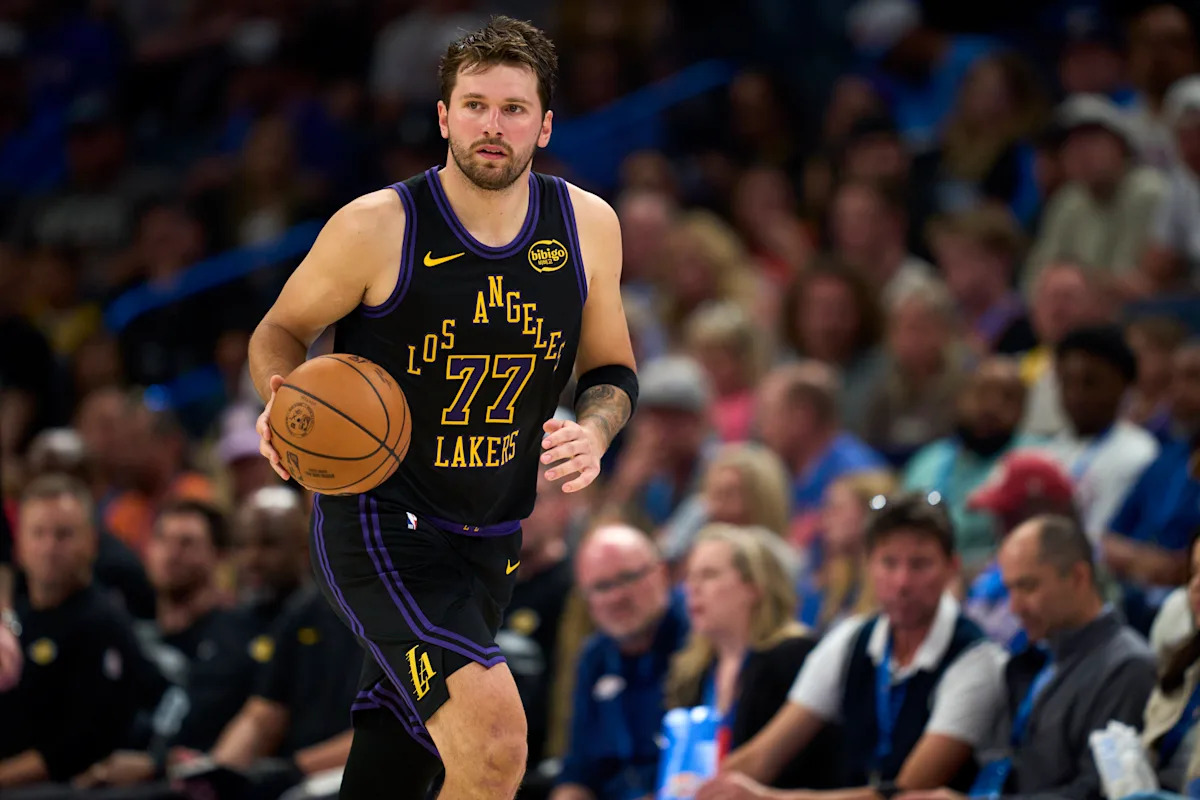
If Luka Dončić had beaten Oklahoma City and played well, would it be enough for him to get the MVP award? I know it should be, but what do you think? — @Grumsi24
Dončić finished with 12 points on 3-for-10 shooting in 26 minutes in a 139-96 loss on Thursday. But the major plot point is that he left the game with a hamstring injury.
Advertisement
I think this is a good place to start. As we approach the final week of the regular season (that zoomed by, to be honest), the nature of online award discourse — particularly MVP — has reached nauseating levels.
Don’t get me wrong; I’m very much in favor of players taking full ownership of presenting their cases, like San Antonio’s Victor Wembanyama grandstanding last month and Oklahoma City’s Shai Gilgeous-Alexander keeping his reasoning short and simple. This has been one of the most exhilarating and engaging races in quite some time and we’re in a golden era of basketball.
Outside of that ecosystem, however, the online back-and-forths between team fan bases, non-biased third parties and even the general public has almost diminished the value of the award, desperately seeking any avenue to downplay a worthy candidate in favor of pumping up another. Needless to say, you won’t see any of that here. This is a question about the MVP and an answer based on basketball, not feelings.
Dončić’s case is straightforward: the NBA’s leading scorer on a 50-win Laker team, a top-3 seed in the ever-arduous Western Conference. He’s an ultra-efficient, heliocentric conductor of a top-5ish offense and the glue that kept Los Angeles together in a season where an aging LeBron James and Austin Reaves succumbed to the injury bug. But now, Dončić’s awards eligibility is in danger, pending the results of an MRI on his hamstring. Through 64 games, Dončić is averaging 33.5 points (on .616 true shooting) and 8.3 assists per game, all while maintaining complete control — a staggering 38.1 usage rate and 40.5 assist rate all while maintaining a 12.6 turnover rate. It’s not enough that Dončić ranks in the top three in gravity whether the ball is in his hands or not. It’s that in the history of folks dribbling an orange, leather basketball, there have been five instances where those aforementioned benchmarks have been cleared — and three of those belong to Luka. And it still might not be enough! The other players — Dwyane Wade in 2009, Giannis Antetokounmpo in 2025 — did not end up winning MVP. (The Heat won 43 games, the Bucks won 48.)
Advertisement
In terms of what matters to voters, the narrative of MVP seems to shift from year to year. For folks like myself, I tend to stay within similar guidelines; a combination of eye test, advanced analytics, on/off impact, season highs/lows, team success and, of course, Oscar moments. Joel Embiid dropping 47 points and 18 rebounds in a hotly contested 2022 duel with Nikola Jokić that was a crowning moment. Those otherworldly performances stick with people, they matter.
It wasn’t a great night for Luka Doncic on Thursday in OKC. (Photo by Cooper Neill/Getty Images)
(Cooper Neill via Getty Images)
To Dončić’s viability, the unfortunate timing of a matchup with SGA is that by now, the biggest league storyline has become the Thunder’s quest to repeat and the Spurs’ bold quest to challenge and usurp the throne. By nature, both Gilgeous-Alexander and Wemby are having generational seasons of their own — combined with the fact that both franchises will finish with at least 10 more wins than the Lakers. There’s also the notion of impact, where Dončić, while still incredibly vital to the Lakers’ success, just doesn’t quite stack up compared to the likes of SGA, Wemby and the Joker. Had this game been two months earlier, this might have been a different conversation. So, clear-cut All-NBA selection (health permitting), not so clear MVP.
(This goes back to my All-Coaching first-team argument and why I don’t really love these individual awards where there’s an abundance of greatness — but I digress.)
Good or bad, which NBA team surprised you the most this season? And why? —@MrEd315
Advertisement
Fantastic question, because it really forced me to think. By the end of the exercise, I couldn’t break the tie between Charlotte and San Antonio.
As part of my process, I probably tend to pay closer attention to head coaches than other media members. Certainly not in a bravado sense, but more along the lines of their delivery. Not what they’re saying, but how they’re getting a message across.
I remember sitting in a back room at American Airlines Center for a preseason Hornets-Mavericks matchup, coming away from a six-minute chat with Charles Lee completely blown away with how effortlessly he broke down concepts, schemes and his vision for a Hornets team very few people expected anything from. I also remember sitting in the Spurs practice facility for the official passing-of-the-torch to Mitch Johnson, with the legendary Gregg Popovich beaming from ear to ear — a rarity if you’ve ever been around Pop. There was a palpable respect in the room that day bestowed upon a young mind hell-bent on inspiring others.
On both occasions, the messaging spoke to a clear, concise plan of attack. Both desired to enhance their teams’ current spacing, share the ball and play to a collective. Obviously, there’s a clear difference between coaching Wembanyama and LaMelo Ball and Kon Kneuppel, but both require a vision. Both require sacrifice. Both require a buy-in. It’s no surprise that these are two of the most enjoyable League Pass watches on any given night, the NBA’s Nos. 3 and 5 offenses that are second and seventh, respectively, in efficiency differential.
Advertisement
Expectations have gone from already throwing Charlotte into the Tankathon simulations to potential first-round opponents. San Antonio was meant to be a nice storyline, bright play-in team, but it could very well go all the way. None of this is possible without the full respect of a leader. Welcome, surprises.
Collin Gillespie has gone from a marginal NBA player who played 10 games in the G league last season to a quality rotation player and a glue guy on a surprising Phoenix Suns team ravaged by injuries. Why isn’t he considered a major MIP award candidate? He should typify the award. — @arhooptalk
I recently stumbled upon a well written Gillespie-centric article in Forbes, written by NBA writer Mat Issa, stating the guard’s case for Most Improved.
Advertisement
(I’ll shout it from the mountaintops: Abolish Most Improved! Create All-Improved First Team!)
In a vacuum, yes, Gillespie’s improvement — based on how he initially entered the NBA — should give him real legs in any Most Improved race. His brand of low-usage, decent-efficiency output with a wholesome usage-to-playmaking ratio is valuable, and that’s before you dive into his elite floor spacing and his underrated/underdiscussed defensive ability as a point-of-attack option, smart shot contestster and an energy magnet. Gillespie is on the level in win shares per 48 with Scottie Barnes and Stephon Castle, and advanced analytics — like LEBRON — paint him as just outside the top 50 in overall impact. That’s good!
A few things are working against him, though. His production has slipped some since the break, going from a 43% 3-point shooter to a 37% one, which also aligns with his drop in overall scoring efficiency. Gillespie is scoring just 109.6 points per 100 shot attempts since the deadline, which is essentially in the bottom third of the league. He’s also averaging a shade over 12 points per game; good, but doesn’t exactly scream award winner.
Compared to names like Nickeil Alexander-Walker and Jalen Duren, who are currently the top two favorites for the award per BetMGM, Gillespie’s numbers don’t give him a strong argument over these two.
Advertisement
NAW detractors will point to his draft position, taken 17th in 2019, and say, “He’s a former first-rounder. He’s supposed to be this good!” Which is fair to some degree, but I’ll read you the list of names drafted right before and after Walker. Stop me when you find a 20-point scorer. Romeo Langford. Sekou Doumbouya. Chuma Okeke. Goga Bitadze. Luka Šamanić. Matisse Thybulle. Should I keep going?
I think I will. Brandon Clarke. Grant Williams. Darius Bazley. Ty Jerome. Nasir Little. Dylan Windler. Real deep draft.
NAW has essentially doubled his 3-point output from last season in Minnesota and somehow is shooting better, a sliver under 40%. He’s shown a proclivity for driving more, doubling his frequency from last season, and uses his length for good, with creative finishes around the rim. The Hawks are a plus-7.3 points per 100 possessions better offensively when he’s on the floor, a 95th-percentile impact. Advanced analytics — DARKO, LEBRON AND Real Adjusted Plus-Minus — all portray Alexander-Walker as a top-60 player, which tracks. The Hawks are a +211 in nearly 2,500 Alexander-Walker minutes and plus-24 in net rating. In other words, he’s a more impactful player on a slightly better team that had a larger year-over-year leap. Same with Duren, who became an All-Star on a 60-ish win-pace Pistons team while becoming a bonafide go-to option, better ballhandler and finisher.
Read the full article here