





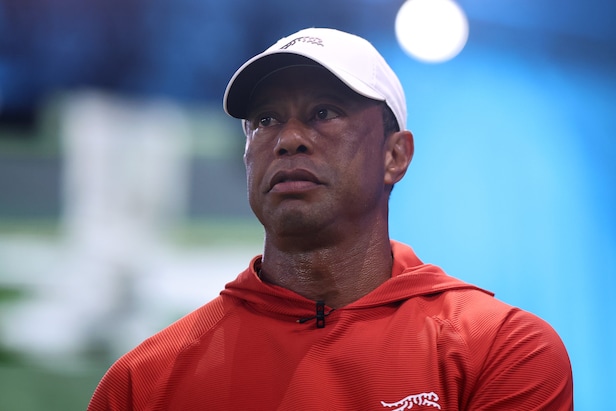
Society, including the PGA Tour, is of two minds when it comes to addiction and its frequent consequence, impaired driving. A drunk or high person at the wheel of a car can be a dangerous, even deadly, criminal. He can also be a helpless victim of a disease. The fate of Tiger Woods—as a criminal defendant, a professional golfer and a public figure—may depend on which of these views prevails.
Woods’ brushes with automotive calamity are already well known. The 2009 collision with a fire hydrant which took place amid news of his marital infidelities; the arrest in 2017 after he was found asleep in his car with multiple prescription drugs in his system, including Vicodin, Dilaudid, Xanax, Ambien and THC (the active ingredient in marijuana); the 2021 high-speed crash near Los Angeles, which nearly cost him his leg.
Advertisement
Now, there’s his flipped Land Rover SUV last Friday as he tried to pass a truck near his home in Jupiter, Fla., and his failure of several field-sobriety tests. A breathalyzer test revealed no sign of alcohol (which was also true in 2017), but he refused to submit to a urinalysis. Woods was charged with a pair of misdemeanors—DUI with property damage and refusal to submit to a lawful test.
In light of his fame and accomplishments, the questions surrounding these incidents have tended to focus on Woods himself—his many injuries and surgeries, his rehabs, his medications, his future as a golfer. Increasingly, though, the legal system looks at car crashes not for what they mean for the driver, but rather for their effects on the pedestrians and other drivers on the road. For that reason, while Woods avoided physical injury in this latest crash, he’s never been in greater legal jeopardy.
Woods’ arrest comes in a still-evolving legal environment. It’s hard to imagine today, but drunk driving used to be grist for stand-up comedians. Thanks in significant part to the efforts of Mothers Against Drunk Driving, which was founded in 1980 by the mother of a 13-year-old girl who was killed by a repeat offender drunk driver, attitudes quickly changed, as did the laws. States lowered permissible blood alcohol levels, established sobriety checkpoints and raised penalties for driving under the influence. By wielding the cudgel of federal highway funds, Congress essentially forced every state to raise the drinking age to 21 in 1984.
The reason for this hard line was aptly summed by Martin County Sheriff John Budensiek at his news conference following Woods’ arrest. “This could have been a lot worse,” he said, “Had there been somebody moving in the opposite direction, we would not be having a conversation saying there was no injuries.” It’s basically dumb luck which determines whether an impaired driver creates an inconvenience—or a tragedy.
Advertisement
At the same time, the law—and the judges who determine the consequences of violations —have come to recognize that driving while impaired is often different from other crimes, like, say, bank robbery. Alcoholism and drug addiction are, or can be, forms of disease, not fully under the control of those who suffer from them. Treatments, not just punishment, areoften seen as the appropriate remedy.
It’s tempting to see Woods in this light. For all the blessings in his life, he has also been burdened with an almost unimaginable series of orthopedic horrors, all of which have caused him great pain. He didn’t choose to live that way, and like anyone whose body has suffered so many insults, he’s turned to medication to get through his days.
The PGA Tour straddles these two approaches in its drug policy, which is laid out in the 52 densely packed pages of its anti-doping manual. Much of the manual deals with performance enhancing drugs, like steroids, but it also covers recreational drugs and painkillers. The Tour, which has done random drug testing of players since 2008, bans marijuana, cocaine and opioids (such as Percocet and Oxycontin). To use any of the banned substances, players can apply to the Tour in writing for what’s called Therapeutic Use Exemptions (TUE). These applications must be supported by a physician. (It’s not known what exemptions, if any, Woods has sought.)
The Tour’s straddle is revealed in the range of sanctions it may impose. Violations of the drug policy can include “disqualification, forfeiture of prize money/ points and other awards, ineligibility, and fines.” But the Tour’s response to violations “may include rehabilitation or medical treatment in lieu of or in addition to other sanctions.” In other words, the Tour has it both ways, which is similar to how the legal system treats offenders.
Advertisement
As for Woods, who just turned 50, his status as a player was already in doubt. Because of his range of injuries, he hasn’t competed in an official PGA Tour event since 2024. He played in a TGL event in March and hinted about possibly playing in the Masters in April, but that now seems unlikely, to say the least. A debut on the Champions Tour, for which Woods is now eligible, also seems like a long shot.
The priority for Woods must be the criminal case against him, which already looks different from his first offense in 2017. At that time, he was allowed to enter a DUI diversion program and avoid criminal penalties. It’s less likely that he’ll get another free pass—or that he’ll deserve one.
Notwithstanding Woods’ admirable struggle to recover from his injuries, prosecutors and ultimately a judge are going to be concerned above all with the threat he poses on the roads. If Woods were only endangering himself, that would be bad enough, but he now appears to be a repeat offender in putting others at risk. On the Tour and in the law, those in charge have a lot of discretion. The rich and powerful, like Woods, often get a more sympathetic reception than those who are neither. But even privilege has a limit, and this time Woods may be looking at a resolution that leans away from treatment and toward punishment.
RELATED: Tiger Woods coverage has centered around one persistent question for years: Can he play? It becomes incomplete without an honest answer to a prior question—Is he OK?
Read the full article here