





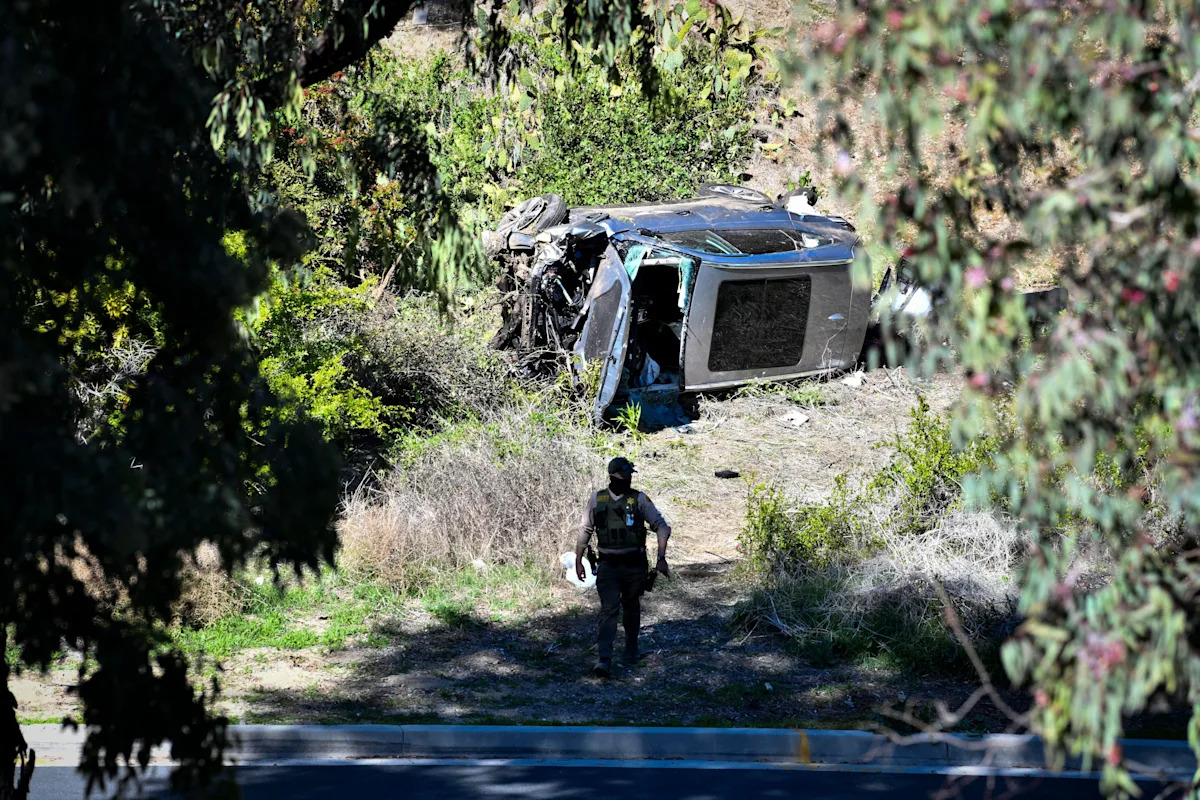
The last time Tiger Woods drove this recklessly and endangered other drivers, law enforcement authorities made a conclusion that didn’t seem to square with the evidence.
They said there was “no evidence of any impairment whatsoever.” They didn’t even issue Woods a ticket, let alone charge him with reckless driving or driving while impaired.
Advertisement
Woods, the golf legend, got off the hook in 2021, even though his car crash in Los Angeles County was more dangerous and might have had more signs of impairment than his latest wreck in Florida March 27, according to the evidence and experts contacted by USA TODAY Sports.
The recent arrest in Florida also raises the question whether Woods and the public would have been made safer if the Los Angeles County Sheriff’s Department had handled Woods differently in 2021.
“It’s pretty obvious to me it was overlooked in 2021,” said Jonathan Cherney, a former police detective in Southern California who now works as a car crash reconstruction and police practices expert. “It’s easy to conclude that the L.A. Sheriff’s Department was either starstruck and/or there was an attitude of, ‘Well he didn’t really hurt anybody else except himself, so why bother doing anything?’ The problem with that attitude is that nobody gave him any incentive to not do it again.”
The crash in Los Angeles remains the only time out of four high-profile incidents since 2009 Woods wasn’t at least issued a ticket for his driving problems. Paradoxically, it also happened to be his most dangerous wreck.
Advertisement
Key investigative difference in Tiger Woods case now vs. 2021.
In his latest crash March 27, Woods was charged with driving while impaired after his Land Rover clipped a trailer from behind in a residential neighborhood and rolled onto its side. Woods has pleaded not guilty and said he is stepping away to “seek treatment and focus on my health.” He was not injured, unlike in 2021, when he suffered broken bones in his right leg after his Genesis SUV barreled through a sign in the median, launched into opposing traffic lanes, went off road, hit a tree and rolled over.
The Los Angeles County Sheriff’s Department didn’t bring in a drug-recognition expert (DRE) to evaluate Woods for impairment in that case, unlike in Florida March 27, when a DRE evaluated Woods and determined he was impaired. Nor did the L.A. sheriff’s department attempt to get a warrant to draw Woods’ blood to evaluate it for the presence of drugs.
“Florida law enforcement handled it much better,” Cherney told USA TODAY Sports. “They probably saw what happened with the sheriff’s department in L.A. and thought, ‘We need to get this right, gang.'”
Advertisement
The conclusions of the L.A. sheriff’s department then under then-Sheriff Alex Villanueva drew scrutiny from car-crash experts, including Cherney, who visited the scene of the wreck in Los Angeles and told USA TODAY Sports it looked like a “classic case of falling asleep behind the wheel, because the road curves and his vehicle goes straight.”
The evidence from Tiger Woods’ 2021 crash
Even without evaluating his cognitive function, these signs were at the scene in 2021:
∎ Instead of sticking with the curve in his lane to the right, Woods’ Genesis SUV went on a collision course in a generally straight line for about 400 feet. He struck the curb of the median, hit a large wooden sign in the median, sped into opposing traffic lanes and then hit another curb before leaving the road, uprooting a tree and rolling over.
Advertisement
∎ Yet Woods didn’t hit the brakes during the recorded collision sequence, didn’t steer out of the emergency and didn’t remember driving, according to the evidence in the case. Does a conscious person diverge from his lane in a straight line through a median and opposing traffic lanes without evidence of braking or trying to steer out of it?
∎ Woods didn’t know where he was shortly after the crash in 2021 and said he thought he was in the state of Florida, not California. It was sort of a reversal from 2017, when he was found asleep behind the wheel in a car that was stopped on the road but with its engine running in Jupiter, Florida. He told police then he also didn’t know where he was and thought he was coming from “L.A. California.” He was charged with DUI then, with five drugs found in his blood, including the sleep drug Ambien and painkiller Vicodin.
∎ A pharmaceutical bottle was found in a backpack at the scene of the crash in L.A. with no label.
Why Tiger Woods’ 2021 crash matters now
Despite this evidence, the L.A. County Sheriff’s Department didn’t suspect impairment and instead said the cause of the accident was “driving at a speed unsafe for the road conditions and the inability to negotiate the curve of the roadway.”
Advertisement
If the sheriff’s department had handled it differently and evaluated Woods for impairment, the evidence from that could have led to Woods being charged with a crime, or not, depending on the findings. If convicted, his sentence could have led to a change in his driving decisions, especially after his DUI case in 2017.
“If back in 2021 they had found that Tiger Woods was under the influence of drugs at the time of that incident, and he was charged and convicted, it may have had an effect on him psychologically, and made him realize that he should not be driving if he’s going to continue to require pain medications for his chronic conditions,” said Doug Burnetti, a transportation injury lawyer in Florida.
Cherney noted a DUI conviction in California would have led to a mandatory 90-day DUI program, a suspension of Woods’ driver’s license and probation. That’s the point of traffic-law enforcement: protecting the public and the driver.
L.A. sheriff says ‘We will not engage in conjecture’ about 2021
USA TODAY Sports contacted the L.A. County Sheriff’s Department recently to ask if officials there had any second thoughts about their conclusions from 2021 in the wake of Woods’ latest arrest in Florida.
Advertisement
“We will not engage in conjecture about an incident that occurred five years ago, regardless of the individual involved,” the department said in a statement to USA TODAY Sports April 2.
The department instead referred USA TODAY Sports to the department’s news conference about it then, when Sheriff Alex Villanueva said Woods was traveling at an estimated speed of 84 to 87 mph at the first area of impact in the collision sequence. Instead of braking, Woods was actually accelerating prior to impact, according to data received from the black box recorder of Woods’ loaner Genesis SUV.
Asked then if Woods made a conscious effort to avoid the accident, Captain Jim Powers stated then, “We don’t know that.”
Villanueva was defeated in his bid for reelection in 2022 but is running for sheriff again this November. A message seeking comment from his campaign wasn’t returned.
Advertisement
The signal and pattern of Tiger Woods’ driving problems
Woods previously has acknowledged having a sleep disorder, in addition to pain issues. He has been involved in four reckless driving incidents since 2009, including in 2026, 2021 and the 2017 DUI case.
In 2009, Woods was behind the wheel when his Cadillac Escalade collided with a row of hedges and hit a fire hydrant and tree outside his mansion in Florida. A neighbor reported seeing Woods snoring at the scene. Even then Woods was issued a ticket for careless driving, which carries a $164 fine and four points on his driving record.
Out of all of them, the most dangerous one was the crash in Los Angeles, the only one for which Woods didn’t even get a ticket. He was lucky then he didn’t collide with traffic in the opposing lane, just like he was lucky he didn’t do the same in Florida March 27.
Advertisement
The difference this time is law enforcement is holding him accountable.
“Tiger didn’t just lose his swing after 2009, he lost control of something in his life,” said Richard Taite, founder of Carrara Treatment, a luxury rehab business in Los Angeles. “Whether that’s pain management, prescription medication, or something else, I’m not going to speculate beyond the facts. But when the same types of incidents keep happening, that’s not bad luck. That’s a signal.”
Follow reporter Brent Schrotenboer @Schrotenboer. Email: [email protected]
This article originally appeared on USA TODAY: Tiger Woods DUI raises issues about how sheriff handled crash in 2021
Read the full article here