




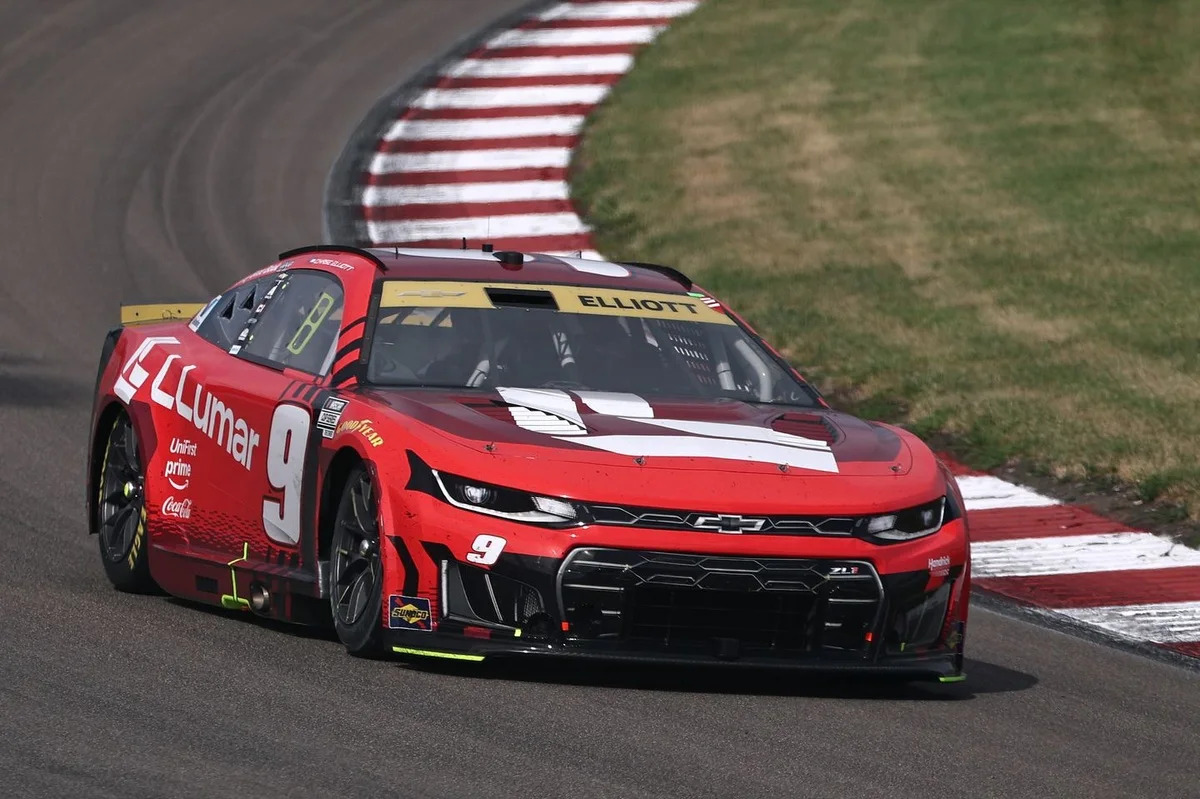
The Enjoy Illinois 300 was always going to play out like this.
There were no shortage of brake issues on Sunday at World Wide Technology Raceway but there always is at tracks with long straights and heavy braking corners. That has been the case at Loudon, Nashville and Phoenix too since the Cup Series implemented the current generation car in 2022.
Advertisement
The fact that this happened during the first race at Gateway with the new higher horsepower and lower downforce short track rules package made it even more expected. There was more speed down the straights and less to spoiler to catch the cars at the end of it.
Brakes failures affected several of the teams racing within the Chase for the Championship.
Zane Smith suffered a hard impact at the end of Stage 2 due to a rotor failure. Ryan Blaney drilled the frontstretch wall on Lap 155 while running in the sixth position. Chase Elliott suffered a brake failure and collected Chase Briscoe on Lap 214.
Advertisement
The final three in that driver grouping were all championship contenders.
Chris Buescher, a lower seeded Chase for the Championship competitor also crashed with a brake failure and brought out the final caution with three laps to go. Throughout the race, several drivers had complained about having a ‘long pedal’ and fading brake pressure.
Zane Smith, Front Row Motorsports
Zane Smith, Front Row Motorsports
Blaney’s crew chief, Jonathan Hassler, said that his team ultimately did not cool their brakes enough with their setup.
Advertisement
“Gateway has always been a place that’s tough on brakes,” Hassler told NASCAR.com after the race. “We’ve been on the good side of it before, but we knew there was a little more demand with this package. We certainly were trying to be conservative, but still didn’t give it enough cooling, I don’t think.”
Championship leader Denny Hamlin said he was close to a failure by the end of the race as well.
“I would say I was on the verge,” Hamlin said. “I had long pedal those last two restarts, so that’s the indication you’re usually about to blow one.”
Advertisement
Read Also:


Brake failure deals major blow to Ryan Blaney’s NASCAR title bid

Chase Elliott apologizes to Chase Briscoe after Gateway crash: ‘I had nowhere to go’
Clearly, some teams did provide enough cooling, as Bubba Wallace reported no changes whatsoever once the race ended while challenging for a top 5 late in the evening.
“Yeah, my car was fine,” Wallace said. “We’ve really worked on our brake package a lot over the last six years. And we feel like the 23 group has got into a really good spot for brakes. So, mine felt brand new to the finish.”
Advertisement
William Byron finished fourth but needed crew chief Rudy Fugle to nurse him to the end.
“Unfortunately, we’ve had some issues with this car since the start of it, at tracks like Gateway and Phoenix is on the edge of it, and Nashville; places with long straightaways,” Fugle said Monday on SiriusXM NASCAR Radio. “We have a lot of brake issues and it’s caused some issues with a lot of the field; different manufacturers and different companies. It stinks because we don’t have a lot to do with it. We get to pick brake pads and that’s about it. It’s tough.
“It’s always a worry; and we’re making decisions about trying to survive the race instead of focusing on performance when it comes to these couple of tracks. We were monitoring it. We had a long pedal at times, which can be a death sentence, because you want to pump the brakes, which creates heat, which leads to losing a rotor. We have to encourage him to use less pump and wait for a caution to come out. That’s how we got through it.”
Advertisement
NASCAR allows teams to choose which brand and type of brake pads they can run from any vendor.
Some of the talk in the garage has been that teams that have gotten into trouble at Nashville and New Hampshire were using Ferodo brake pads as well. James Small, crew chief for Chase Briscoe, also told NASCAR.com that his team’s challenges at Iowa were similar to an issue taking place in the REPCO Supercars Series.
Potentially increasing the likelihood of brake failures are the additional laps now run under the expanded practice sessions each week.
Advertisement
This was best articulated by race winning crew chief for Kyle Larson, Cliff Daniels.
“Yeah, just from the perspective of lap count, which is that much more brake pad wear and overall cycles,” Daniels said. “When you have the extended practice with two sets of tires, which we all wanted, we all love, and are grateful to have … but when you come in to put on your second set of sticker tires, you’re going to be sitting for a minute.
“That’s another rapid cooling cycle from where you go from (the brakes) being really hot on track. You come in, sit (and) make your changes, putting on sticker tires to go back out. This is a bit different than what a pit stop scenario would be during a race.
Advertisement
“You have the thermal cycle aspect because you have the pad wear aspect. Both of those things, in my mind, play a factor in just the overall threshold that you have going into a day like today.”
With that said, Daniels has a brake package for these races that very rarely cause troubles, which gives him a lot of confidence at these tracks.
“I would say typically for us, we have learned a brake package that has a good balance of grip and feel,” Daniels said. “It is a very common package. There’s nothing special. There’s nothing tricky. We run that at every one of these track types from Loudon to Phoenix to Gateway.”
Advertisement
He called it a ‘standard’ package.
NASCAR rules do not allow teams to change brake pads after practice sessions and before the race the next day. Teams can change their pads after the green flag comes out but that would require losing several laps behind the wall.
Daniels believes some issues could be alleviated by simply allowing a pad change before the race. And even then, he says NASCAR should mandate that it should be the same pad combinations they first go through technical inspection with.
Advertisement
“I wonder as we get towards more practice, having two sets of tires, which in my view is really good for the sport (and) good for the fans, (but) it’s also a lot more duty cycles on the brakes,” Daniels said.
“Part of the conversation might be to consider in the future after we have these longer practice sessions at the Nashvilles, Loudons, Gateways, Phoenix, tracks that are notorious heavy brake-demand tracks — do we allow the teams to put like-for-like changes, brake rotors and pads, on the cars going into the race?
“I’m sure that would be a topic that could be kicked around.”
Advertisement
Ultimately, his direct supervisor, Jeff Gordon, says teams are in too tight of a box and this sort of dynamic is only present because of a very restrictive rule book.
“I better be careful how I answer that, because I don’t want to overstep,” Gordon said. “I feel like the reason we’re in this position is because we’re so limited. We need more options and more ability. If we want to cool more, cool more. If we want a different pad …
“I mean, I was glad to see them at least look at rotors and things. But this track is really extreme on brakes. I would just like to see NASCAR and the teams work a little bit more together with the brake manufacturers to try to find a solution for here.
Advertisement
“I mean, our cars are notorious hard on brakes in general, then hard on them here. I feel like with the right amount of effort, they can come up with a solution. We shouldn’t be coming here with teams feeling like the margins are that close. I think every team came in here nervous. When they dropped the green, they were nervous.”
Read Also:


Kyle Larson’s winless drought was a bigger deal to you than him

The NASCAR Cup Series Chase comes into focus after chaotic Gateway

Jesse Love honors his word and the NASCAR O’Reily Chase gets tighter
To read more Motorsport.com articles visit our website.
Read the full article here


