




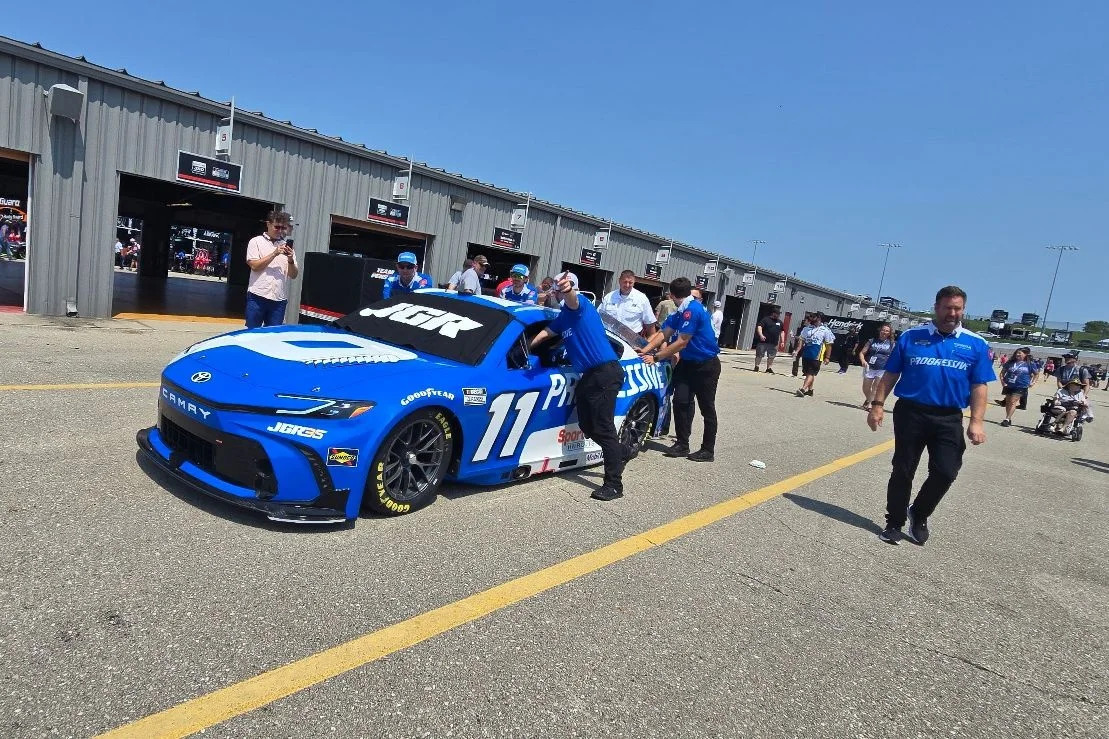
Within moments of hitting the track on Saturday at Iowa Speedway, Denny Hamlin realized he had a problem and it was one that crew chief Chris Gayle recognized as one that could potentially end their race before it began.
They didn’t have adequate or consistent brake pressure.
Advertisement
Their Joe Gibbs Racing teammate, Chase Briscoe, also started suffering from similar problems and crew chief James Small reached the same conclusion. Ditto their alliance stablemate at 23XI, Riley Herbst and crew chief Davin Restivo.
Those three cars alongside the 23XI no. 23 of Bubba Wallace spent well into the morning garage hours making various adjustments in the hopes of giving their drivers a shot to contend.
These teams were allowed to drain their brake lines, referred to as ‘bleeding,’ without penalty and can change their rotors if they are cracked. This is a safety matter and both the No. 11 and 35 teams made that change as well.
Advertisement
However, teams are not allowed to change from a heavier short track and road course rotor to a lighter superspeedway rotor (and vice versa) once that decision is made before technical inspection.
Additionally, Gayle’s No. 11 team also changed their brake coolant ducts, which resulted in a ‘to the rear penalty,’ which was a moot point since Hamlin only qualified 32nd anyway. Small was not able to change his rotors despite saying that morning that they were ‘destroyed’ and did not feel confident about their chances.
For his part, Gayle said it was 50/50 whether or not these changes would be enough to get Hamlin to end of the race. As for the 23XI Racing camp, their internal expectations were that Tyler Reddick did not expect any issues and Bubba Wallace would largely be okay as well.
Advertisement
Herbst was expected to have a rough go of it and he did.
Meanwhile, the other Tier 1 Toyota team of Legacy Motor Club did not have any issues, for reasons best explained by No. 43 car chief Austin Pollak before the race.
“JGR and 23XI run a different package than we do.”
Read Also:
JGR and 23XI scramble as Toyota battles brake issues at Iowa
Hamlin later said his brake pedal went straight to the floor by Lap 3, and Briscoe experienced the same issue by the start of the second stage. It was the worst-case scenario for both Gayle and Small. Even so, their drivers battled to a fifth and sixth-place results, despite the physical toll it took on them.
Advertisement
Hamlin gladly accepted the result given how dire things seemed on Saturday night.
“No question,” Hamlin said. “If I would have known it was going to be like this the whole race, I would have said (just give me a) top 25. Honestly, I would have been happy with it. But they kept working on the car and made adjustments around not having any brakes.
“They just did a great job of giving me something that I could somewhat get around the corners for 350 laps.”
Advertisement
His exhaustion made him look frail and he knew even before the race it was likely going to be a challenge.
“This was the worst mindset I’ve ever had going into a race,” Hamlin said. “I never felt beat before a race started and I thought I was done today. I knew there was a chance it could be fixed but I knew it was still the same components that couldn’t be fixed so I just felt down. I switched my goals to needing some cars to wreck and maybe I get a top 25.
Advertisement
“That honestly was the goal but the team just kept working on the car … That allowed me to manipulate the car a little bit differently.”
Briscoe said he had never had this much anxiety going into a race prior to Sunday.
“Honestly, the first stage I had zero issues and I was amazed that I didn’t because I was expecting it,” Briscoe said. “And then, in the middle of the second stage, I went into the corner and all of a sudden (my pedal) went to the floor just like yesterday. It was weird.
Advertisement
“I would have a restart and it would be good for five or six laps, then right back to the floor. And I mean, I was just pumping nonstop all the way around the racetrack. And sometimes you’d have a pedal and the next time, it would just got to the floor.”
Read Also:


Inside the strategy that turned Ty Gibbs into a legit NASCAR title threat

Ty Gibbs holds off Christopher Bell to win NASCAR Cup race at Iowa
What happened?
NASCAR rules do not allow brake pad changes during the course of a race weekend until after the green flag. That would mean losing several laps.
Advertisement
And while neither Gayle nor Small would get into exactly which pads they were using, it’s commonplace for teams to engage in brake splitting — the practice of running several different combinations together.
Teams are allowed to use whichever brand of brake pads they want.
“I would say it was just a brake choice that we made that we could not undo this weekend,” Gayle told Motorsport.com after the race. “It kind of surprised a few of the teams. A few of the Toyota teams that were running it have run them safely at other places with no problems and it just kind of caught us off guard here.”
Advertisement
Small echoed those sentiments.
“We came here, like I told you this morning, trying to do the right things, be conservative, cure (brake) shake and it kind of bit us,” Small said. “It’s not like it was a new package for us. We’ve run it successfully at a bunch of other short tracks and Nashville. And yeah, I was just thankful to hang on and we took a sixth and moved up into fifth in the standings so it was an overall decent day.”
It may have even been a preview of sorts for the second race of the Chase for the Championship at Gateway. Or if nothing else, these were lessons learned for what not to do in that race, which is why they tried it on Sunday in Newton.
Advertisement
Tyler Allen, crew chief for race winning driver Ty Gibbs, had no issues with their combination.
“We rely on our teammates, all the information is shared, but we’re finally building on our notebook from last year and our recent races this year and we made decisions that we think will best suit Ty,” Allen said. “I think we finally got a feel for that. It takes time to get there, and to get Ty’s feedback, get the engineers in tune with what Ty needs, and I think we’re really hitting that week in and week out now.”
They beat their other teammates, Christopher Bell and crew chief Adam Stevens, and the latter said it’s a complicated decision-making process.
Advertisement
“There’s lots of potential problems with the brake system and it’s not very straightforward,” Stevens told Motorsport.com. “So part of it depends on your driver’s driving style and your car setup — which prevents everyone from gravitating to the same answer.
“And some people have historically had more problems with a certain combination than others, even inside our camp, so we each kind of go with what’s working for us. This track has a lot of chatter, and Richmond next week does as well, so everyone has to be willing to try something different.
“There were groups within our camp that tried the same things and some that didn’t and that’s the nature of the beast. There are a lot of known complications with these brakes and they can be finicky.”
Advertisement
Read Also:

NASCAR drivers endorse new stage rules with one key caveat

Ryan Blaney will give Kyle Busch tribute helmet to Brexton Busch after Iowa race
Safety matter?
Sunday was not the first time this has come up, but there has been a growing sentiment in the garage that NASCAR should allow brake pad changes before a race, even if that means implementing a drive through penalty at the start.
Right now, pad changes are not permitted before a race at all, unless the manufacturer notifies the sanctioning body of a production defect.
Advertisement
By having a blanket policy of ‘no pad changes over the weekend’ until after the start of a race, this encourages crew chiefs to risk failures, which could then also result in brake components flying into the grandstands.
Gayle and Small both credited NASCAR for fairly enforcing these rules each year but wishes series officials would take a second look at allowing pad changes in the name of safety.
“Yeah, they have been consistent; I’ll give them that,” Small told Motorsport.com. “They haven’t allowed people to change brake types before. They said you’d have to do it once the race started, which is fair and you got to admire their consistency. …
Advertisement
“But with us going to 50-minute practice sessions, I think this opens up an avenue for discussion in the future, since we’re tuning a lot more laps. It’s always been a challenge in practice at short tracks with the brake shake and all those things, and I think we’re going to have a lot more now that we’re coming off pit road and then to the race.
“It’s a real problem in the category, I think. We probably need to have an open discussion on how we need to look ahead and fix it in the future for everyone.”
Small said a compromise would even be staying on the same brake splitting combination but allowing a worn-down pad to be replaced but with the same manufacturer.
Advertisement
Gayle agreed.
“I mean, I think the problem is when it’s a safety concern, and I understand there needs to be some definition of what you think is a ‘safety concern,’ because that’s been the question when teams asked for this and were denied.
“But when there’s a safety concern and drivers are involved, there should be an out. Maybe it’s more of a penalty than just starting in the back. Maybe it’s a pass through. Maybe it’s something that would deter teams from doing things unless it truly is a safety thing that they need to do, you know what I mean.
Advertisement
“Otherwise, they wouldn’t start deciding to do this on the regular. But there’s got to be some way to tie your hands other than saying ‘no, you cannot fix the problem until the race starts,’ which is ultimately too severe for something that is a safety issue in my opinion.”
Stevens said he understands why NASCAR has been reluctant to cave on these overtures but agreed with his teammates, and some of his rivals, that this needs to be adjusted in the name of safety.
“Brakes are not something we would actively be looking to change during the weekend unless we were having a problem,” Stevens said. “It’s not like a shock or a spring or a sway bar or a suspension setting so I understand the argument but I do land more towards erring on the side of safety, for sure.”
To read more Motorsport.com articles visit our website.
Read the full article here


