



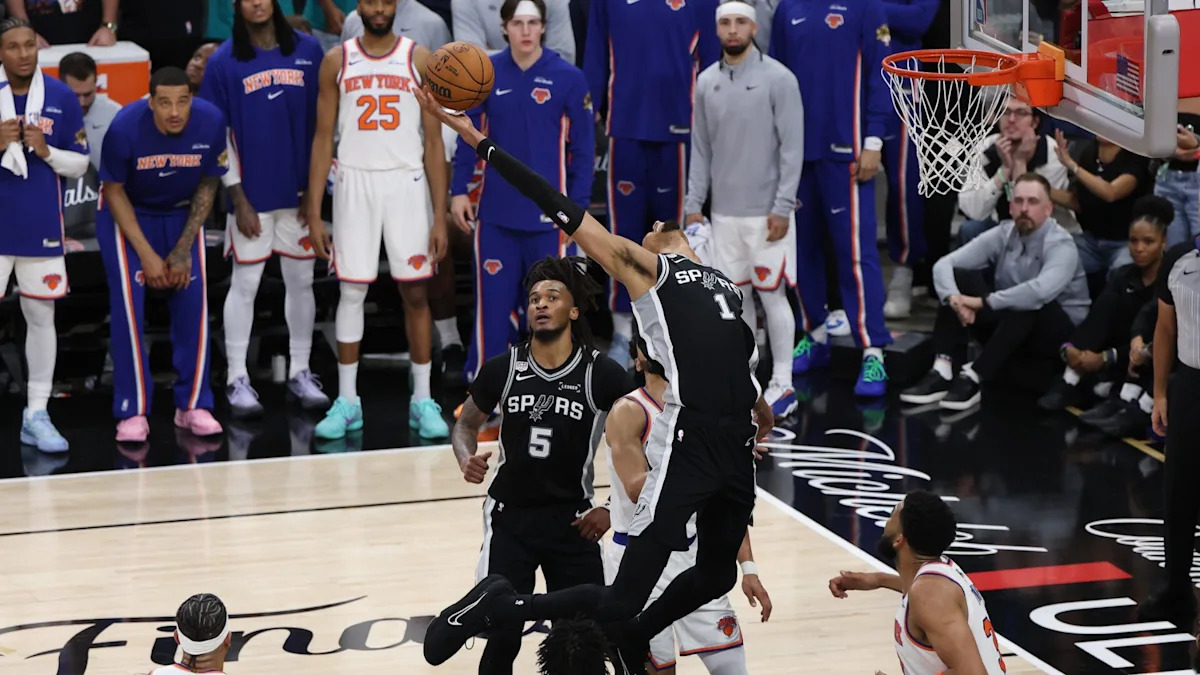
SAN ANTONIO — Victor Wembanyama wasn’t sure what just happened. He was a jumble of emotions after Game 2.
He understands that is the issue.
“I’m still very blurry. That’s the whole problem. I need to have more poise, more control over the game,” Wembanyama said from the podium.
Advertisement
Wembanyama is learning that poise in these biggest of moments is earned, and the path to it can be a painful one to walk.
Wemby was born with incredible gifts — size, athleticism, touch — and has worked relentlessly to hone and master them. Wembanyama has challenged himself mentally and works as hard on his mind and that side of the game as he does on the physical side.
However, poise on the biggest stage in basketball is often earned through painful lessons. In that way, these NBA Finals for Victor Wembanyama follow in the footsteps of Kobe Bryant, LeBron James and countless other legends of the game who struggled in their first playoffs and/or first NBA Finals. It’s not a lesson that can be learned in a gym or sitting with Shaolin monks. It is unique to this stage.
Wembanyama rough 12 seconds
Through six quarters of these NBA Finals, Karl-Anthony Towns and a physical Knicks defense that bumped Wemby on every roll to the rim, bodied him up, threw different looks at him and generally just made him uncomfortable. Wemby was still putting up counting stats, but he wasn’t putting his imprint on the game the way he did from the start against Oklahoma City in the Western Conference Finals (a more familiar opponent).
That changed in the third quarter of Game 3, not coincidentally when Towns went to the bench with four fouls (a couple of them questionable, considering how the rest of the game was being called). Wemby found space to operate.
Advertisement
After taking four shots in the entire first half, Wembanyama took double that in the third quarter alone and four of them at the rim. He scored a dozen points in the frame, but could not totally close the gap against the Knicks as a New York lineup of Mikal Bridges and four bench players outplayed the Spurs and had New York up nine entering the fourth quarter.
That lead stretched out to 14 midway through the fourth quarter, when Wembanyama really took over and led a run — with Dylan Harper and De’Aaron Fox making plays, too — that tied the game, and the Spurs ultimately took a two-point lead with 57 seconds left on a Wembanyama and-1. Brunson tied the game with a jumper, setting up the final seconds.
San Antonio got the stop it needed thanks to a Wembanyama contest, then — as only he can do, he covers so much ground — Wemby recovered, grabbed the rebound and started up court. The other Spurs players on the floor quickly recognized that coach Mitch Johnson was not going to call a timeout (and let the Knicks sub offense for defense), and so they sprinted to their lanes while Fox hung back as the outlet for Wemby. Then Wemby threw a look-ahead pass to Stephon Castle, who had his back turned and never saw it. Brunson picked up the loose ball, and in rushing to try to grab the ball to make up for his mistake, Wembanyama bumped Brunson and fouled him.
“Yeah, I threw that one away. I messed up,” Wembanyama said, taking ownership of the moment.
Advertisement
The Spurs still had a chance. Brunson hit just one of two free throws, a bucket gets San Antonio the win. Mitch Johnson called for a Fox/Wembanyama pick-and-roll, Fox made a perfect pass when both defenders shifted to cut him off, and Wembanyama got as clean a look as could be hoped for in that moment, he just missed it off the back of the rim.
“Of course I liked the shot. I feel like in this moment you need to shoot to score,” Wembanyama said. “In moments like this, it’s like results matter more than process, if you know what I mean. We just need to score. I just need to score.”
Hard lessons on biggest stage
Victor Wembanyama is walking a path many other legends of the game have walked before.
Advertisement
Kobe Bryant wanted to be the man in his first NBA playoffs, but he airballed a jumper in Game 5 of a second-round series against the Utah Jazz, sending the game to overtime, where the Lakers lost (and ultimately were eliminated). In Kobe’s first trip to the NBA Finals in 2000, he averaged just 15.6 points per game on 36.7% shooting and 20% from 3 against Indiana (fortunately, he had peak Shaq on his team to utterly dominate and the Lakers got the ring).
In LeBron James first trip to the NBA Finals — where he lifted a Cavaliers team to a moment it was not fully ready for — he shot just 35.6% from the floor and 20% from beyond the arc as San Antonio swept Cleveland.
The list goes on and on, and it doesn’t take reaching the NBA Finals to learn those lessons.
“I have been on the other side where you’re a young team and you’re trying to do a lot to win the game,” Towns said, referencing his years in Minnesota, and showing empathy for Wemby and the Spurs, but also recognizing that his past pain fuels how he has played in these Finals. “I think that for us, we keep leaning on experience and we keep leaning on the word ‘execution.'”
Advertisement
Wembanyama gets the big picture, too.
“We didn’t play great as a team. We needed to win that game. This game was ours,” Wembanyama said. “But at this point, it’s done. Yes, am I going to regret it? Yes, of course. Am I going to use that to fuel me and to fuel us next game? Absolutely.”
That’s what should scare the rest of the league. Wembanyama — and Dylan Harper, and Stephon Castle, and coach Mitch Johnson, and on down the line — are soaking up some painful, hard lessons in these Finals. Ones that will fuel them in the future. Ones that will make them better. It’s all part of the process that so many legends had to go through before.
That doesn’t make the present any less painful in San Antonio.
Read the full article here