




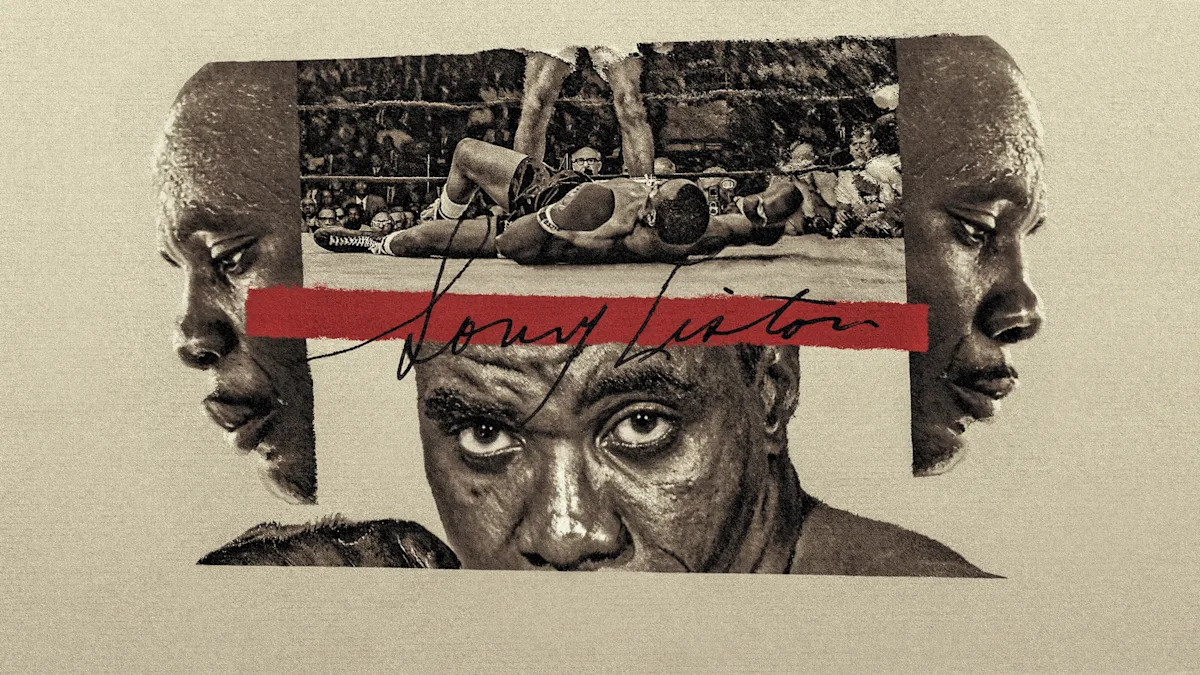
Nobody knows for sure exactly when Sonny Liston was born or when he died. He’s the only heavyweight champion of the 20th century about whom this can be said.
It’s fitting, that type of mystery. It’s as if Charles L. Liston came from nowhere, was simply spit out upon the earth as a fully-formed instrument of joyless destruction, only to disappear again when no one was looking.
Advertisement
At least with his death, people felt like they could reliably pinpoint the correct year, if not the actual day. It was likely some time in those final hours of 1970.
In his obituary for Liston in The Village Voice, Joe Flaherty called him “the menacing black man who invaded the subway of our souls at four in the morning.” The poet Amiri Baraka wrote that Liston was “the big black Negro in every white man’s hallway, waiting to do him in, deal him under.”
Muhammad Ali, who took the heavyweight title from him in 1964 and then, in the rematch, towered over the downed Liston in arguably the most famous boxing photo of all time, was more succinct when talking with sports writer Mark Kram years later.
“Liston was the Devil,” Ali said.
May 25, 1965: Ali stands over the downed Liston after knocking him out in the first round of their title rematch.
(Bettmann via Getty Images)
He sometimes gave his hometown as Pine Bluff, Arkansas, other times Little Rock, other times Memphis, Tennessee — even if all three of them were wrong and he knew it. The state of Arkansas did not require birth certificates at the time. Liston was born at home, with help from the local midwife, so none was issued to mark the exact day. In time, even the year got muddled.
Advertisement
In 1950, Liston claimed that he’d been born in 1928. Testifying before the U.S. Senate a decade later, he said it was 1933. At one point he firmly insisted that he’d been born on May 8, 1932 — and anyone who said otherwise was “calling my mama a liar.” But then his mother said no, it was Jan. 8, 1932.
She seemed most certain of the January part. She remembered it being so cold when he was born, there on an Arkansas plantation in a shack with cardboard in the walls to keep the bitter wind out. She remembered that the same way she remembered his big hands, even as an infant, even right out of the womb. Later, police from St. Louis to Philadelphia to Chicago to Denver would remark upon those same hands as they struggled to fit cuffs onto Liston’s thick wrists. Later still, Vice President Lyndon Johnson would pose next to Liston, holding up his own fist to show how it was dwarfed by the champ’s.
In that photo, taken in 1963, Liston almost looks like he could pass for a man in his early 30s. In another photo taken less than two years later, while he sat in the back of a police wagon on Christmas Day, 1964, he looks decades older.
In “The Devil and Sonny Liston,” the excellent biography written by Nick Tosches, his final opponent, Chuck Wepner, recalled a man who “looked like he’d been around the block quite a few times.” That was 1970, about six months before Liston’s death. If the 1932 birth date is correct, he’d have been 38 at the time of the fight. Wepner recalled extending his glove before the fight for a friendly touch and seeing Liston sneer down at it with a mixture of disdain and disinterest. The man who then proceeded to pummel him for nine full rounds, Wepner said, “looked like he was maybe 50.”
Advertisement
His death was easier to pin down. It was probably around Dec. 30, 1970. The condition of his body, the dates on the newspapers inside his Las Vegas home, they all pointed in that direction. The cause was trickier. Maybe an undiagnosed heart condition. Maybe a heroin overdose. Maybe a mob hit designed to look like an overdose. Or maybe the body that still bore scars on his back from a father who, as Liston once put it, “whupped me every day,” had simply had enough.
There would be “no requiem for this heavyweight,” Howard Cosell said on the nightly ABC news broadcast after Liston’s death was confirmed. He was too bad a man for that, in every sense of the word. He’d been a goon, a strong-arm mugger, an illiterate sports star, a belligerent drunk and inmate No. 63723 at the Missouri State Penitentiary.
He’d also been a world champion. He terrified opponents and crowds with his brooding silhouette and his cold, dead-eyed stare. He was boxing’s ultimate problem — too good to ignore, too awful to embrace.
When he died at an indeterminate age, in a lonely Las Vegas home, maybe this country was glad to see him go. The facts of his existence served as a reminder of the ugly, dark corners of the American experiment. With Liston gone, maybe now we could tell ourselves that he’d taken the darkness with him.

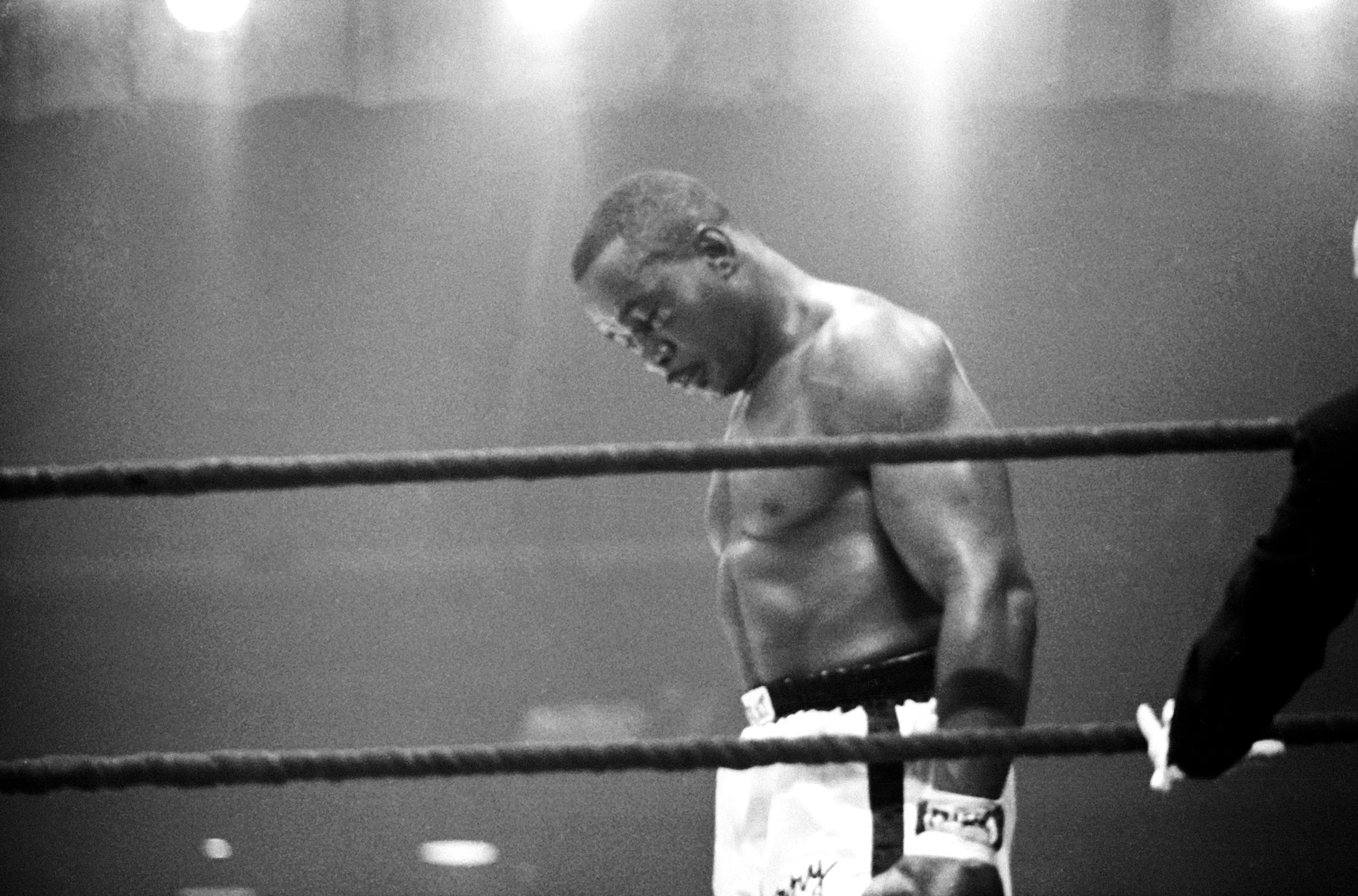
Sonny Liston died in late 1970 under mysterious circumstances. He was still a world-ranked heavyweight at the time of his death.
(Mark Kauffman via Getty Images)
‘I didn’t mind prison’
It’s difficult to be certain, but the first known photo ever taken of Liston may well have been his prison mugshot from June of 1950.
Advertisement
His childhood years were spent in rural Arkansas, where his family had been tenant farmers on what had once been a slave plantation. As a teenager he fled to St. Louis. He was looking for his mother, who’d relocated there a couple years earlier. The story he told later was that he’d woken up early one morning, knocked the pecans off his brother-in-law’s tree, then took them to town to sell so he could buy a train ticket to St. Louis with the money. He didn’t even know where in St. Louis his mother lived, but he didn’t let that stop him.
“I figured the city would be like the country, and all I had to do was to ask somebody where my mother lived and they’d tell me she lived down the road a piece,” Liston later said.
It didn’t work out exactly like that, but he did find her eventually. When she asked why he’d come, she said, he told her he “got tired of that cotton patch.”
In St. Louis, Liston quickly fell in with a rough crowd. He gave his profession as “laborer.” He had supposedly worked a few odd jobs, but his primary occupation became robbery. Soon he was the prime suspect in a string of muggings and holdups. Sometimes it was Liston who emerged from an alleyway, according to police reports, knocking some poor sucker into the dirt before grabbing his wallet. Other times his accomplices did the talking while he appeared from behind to snatch the victim in a chokehold.
Advertisement
One January night, a cop recognized the yellow shirt Liston was wearing — one that matched the description in several of the police reports — and took him in at the point of a .38 revolver. Liston would later plead guilty to first-degree robbery and larceny, and was sentenced to five years at the state prison in Jefferson City.
It was in prison where Charles L. Liston became Sonny, though no one could reliably say why or exactly when the change had taken place.
“I didn’t mind prison,” Liston said later. He got regular meals. People mostly left him alone and, when they did, he offered them the same courtesy. When they didn’t, he could be a lot less courteous.
He enrolled in the prison’s educational system but, still unable to read or write, soon quit. He received minor disciplinary infractions for things like shooting dice and wasting food, but mostly stayed out of trouble.
Advertisement
The prison chaplain, Reverend Edward Schlattmann, was the man who first squeezed boxing gloves onto Liston’s enormous fists. Liston knew nothing at all of the sweet science beyond that the goal was to hurt. Right away he found he had a talent for it.
“After four weeks of fighting, nobody in the penitentiary would get into the ring with Sonny,” Schlattmann later told Tosches.
It’s not a stretch to say that Liston boxed his way out of prison. Word spread about the hulking inmate with the prodigious, powerful fists. Soon a loose confederacy of Catholic priests, local sports media types, and at least one boxing manager had all banded together to assure the parole board that they would help Liston find meaningful work and training as a boxer upon his release.
This is how it came to be that, in October of 1952, Liston was released into the care of his first handlers. They would later be muscled out of the Liston operation by more dangerous men, the kind with experience in this arena. Then others would come in for a percentage of Liston’s earnings. Then still others. By the end, as one commission official estimated, Liston owned about only 10% of himself.

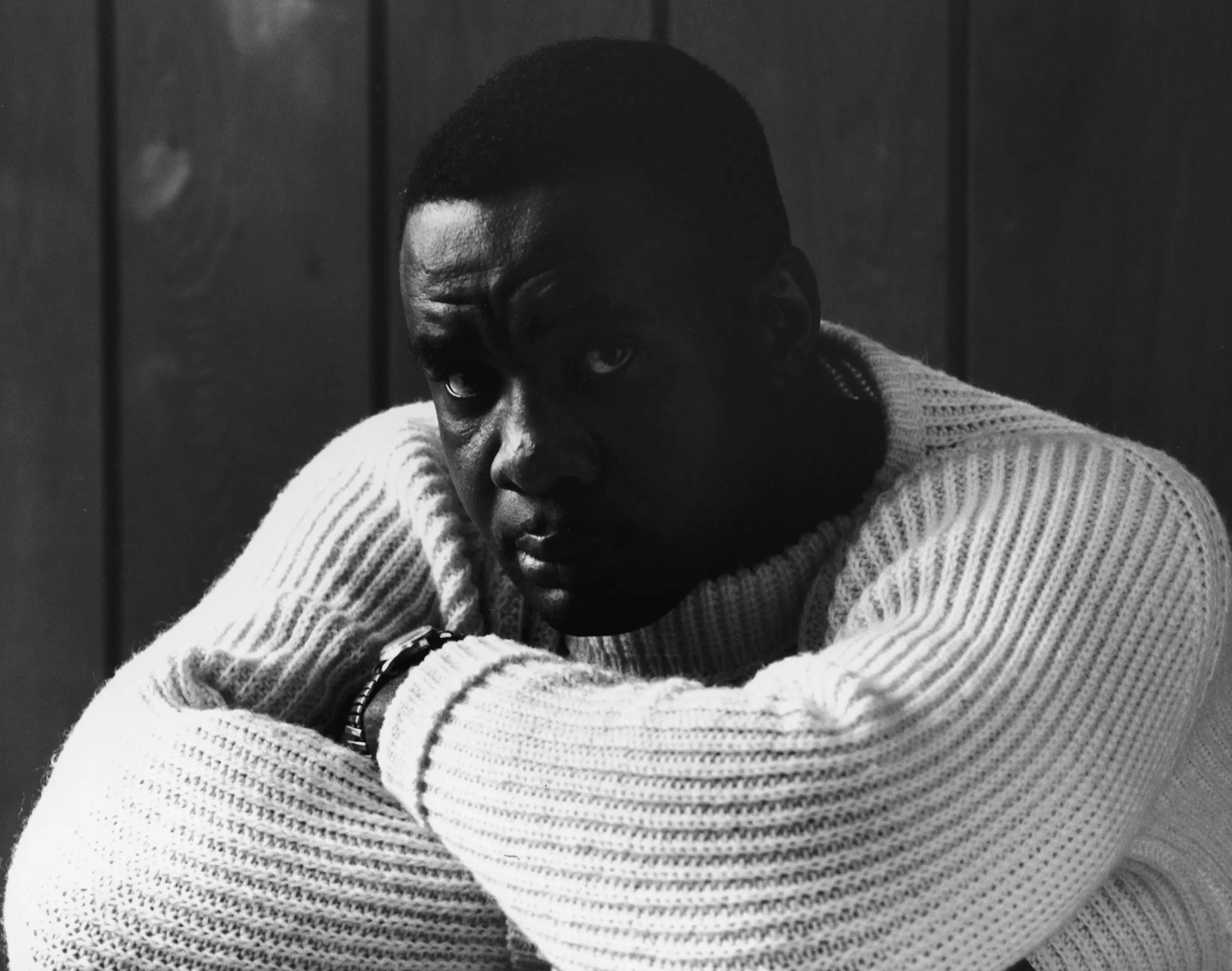
Portrait of American boxer Sonny Liston in the early 1960s.
(Robert Riger via Getty Images)
‘He hurts when he breathes on you’
Liston’s first handlers put him in the Golden Gloves tournament as soon as possible, despite the fact that he still had much more brawn than craft. Jim Lubbock, a reporter for the St. Louis Globe-Democrat, wrote that Liston “had absolutely no right hand at all,” but did possess “a left like a pile driver.”
Advertisement
The piston-like jab in front of a wild right was all Liston needed back then. He easily won the heavyweight and openweight divisions of the Golden Gloves tournament in St. Louis, then went to Chicago and won the Midwestern Golden Gloves title with a victory over the 1952 Olympic heavyweight gold medalist Ed Sanders. He later defeated Hermann Schreibauer, a European champion from West Germany, in the first round of an international Golden Gloves competition. When Schreibauer was asked if he wanted a rematch with Liston, he replied simply: “No.”

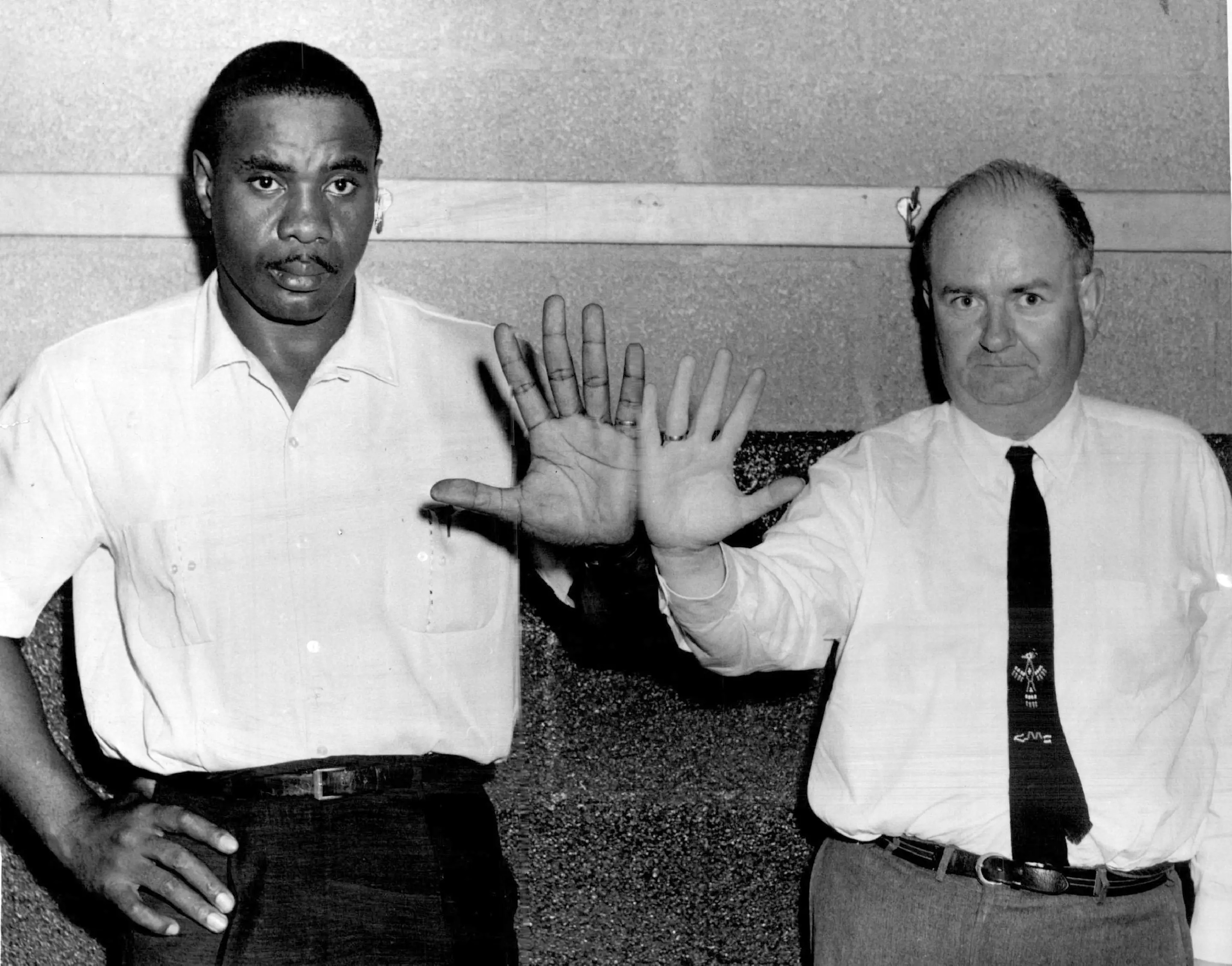
July 8, 1960: Liston’s hand dwarfs that of a Denver Post boxing writer Jim Graham.
(Denver Post via Getty Images)
Liston went pro in 1953 and won seven fights in 11 months. But even then, there were rumors of unsavory connections helping to pave his path. Coming out of prison, Liston had been ushered into union cement-finishing jobs, and may have even worked on the renovation of what would much later become Busch Stadium.
But according to Tosches, his co-workers understood that on days when he was absent, it was because he was working as a combination chauffeur and bodyguard for a local union leader who was rumored to be connected to organized crime.
Advertisement
“You’d hear stories of what he did,” one co-worker said. “Break people’s legs and stuff like that.”
The cop who’d arrested Liston for the string of robberies and muggings recalled seeing him shortly after his release from prison, driving a black Cadillac and flashing a wad of cash.
“I said, ‘Hey, don’t I know you?’” recalled the policeman, David Herleth. “He said, ‘Get out of here, you know me, man. I’m Charles Sonny Liston.’ I said, ‘Uh, oh. Keep your nose clean.’ He didn’t.”
Liston lost his first professional bout in September of 1954, a year after his pro debut. He had his jaw broken early in the fight by Marty Marshall, a journeyman heavyweight with a reputation for crowd-pleasing antics, and wound up losing via split decision after eight rounds.
Advertisement
Liston later claimed the left hand which broke his jaw had caught him by surprise because he was in the process of carrying Marshall at the request of unnamed parties.
“I was told to take it easy for a couple rounds,” Liston said. “Marshall’s a clown, they told me, who’d bounce around and flick punches from all sides.”
Liston’s trainer and handler, Frank Mitchell, corroborated that version of events, saying Liston told him that “he was told to carry the boy three or four rounds.”
Told by whom is the part that was never mentioned. But as Liston’s career progressed, it became common knowledge that the real managing interests behind his career were Frank Carbo, sometimes known as “The Gray” or “That Party,” along with Philadelphia mobster Frank “Blinky” Palermo. Together, they were rumored to have fixed fights and curated whole careers during the time of “Sugar” Ray Robinson and Jake LaMotta.
Advertisement
Carbo and Palermo were later subpoenaed by a U.S. Senate committee investigating the mob’s control of boxing. Liston was also among those called to testify. He initially denied knowing anyone named Frank Palermo, but when pressed repeatedly, he replied: “You mean ‘Blinky?’ Yeah, I know ‘Blinky.’ Everybody knows him.”
It was also during these televised Senate hearings that Liston was forced to admit, publicly and before the entire country, that he was illiterate. While being questioned about a letter he had allegedly dictated, which referred to plans Palermo had to put him in a title fight, Liston was asked why he wouldn’t write the letter himself.
Liston tried his best to talk around the subject until Senator Everett Dirksen asked him directly: “Do you read at all?”
“No, sir. I don’t,” Liston replied.

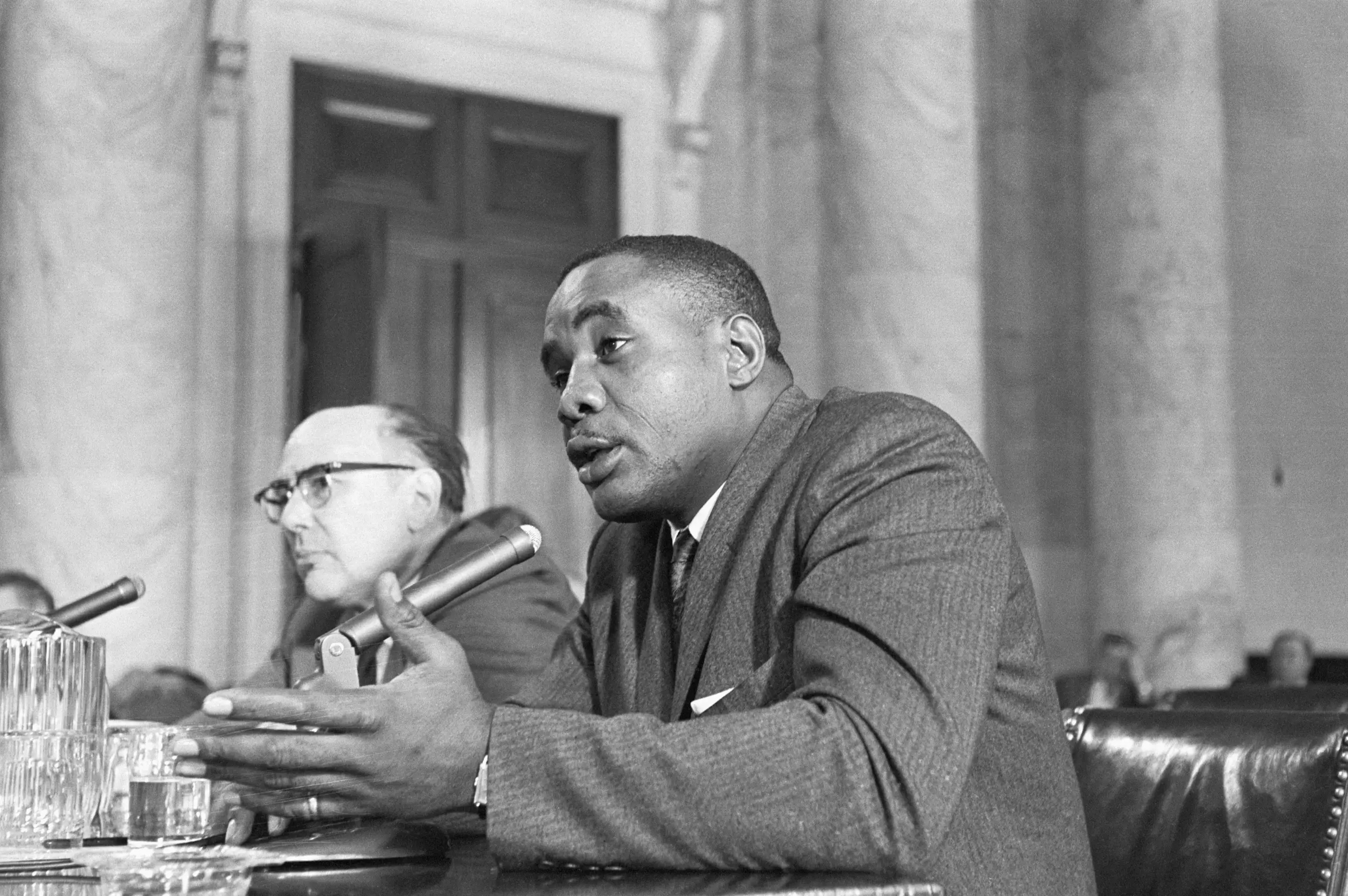
Dec. 13, 1960: Liston speaks before the U.S. Senate.
(Bettmann via Getty Images)
Carbo and Palermo were later convicted of extorting welterweight champion Don Jordan. Robert F. Kennedy, who had prosecuted Carbo in his role as U.S. Attorney General during his brother’s administration, said in a statement that Carbo had been “a sinister figure behind the scenes in boxing for more than twenty years.” Carbo was sent to Alcatraz. Palermo did his time at the Federal Correctional Institution in Lewisburg, Pennsylvania. But even behind bars, law enforcement officials said, they still considered themselves part owners of Liston’s boxing career.
Advertisement
As for Liston, he got his first rematch against Marshall, the man who’d broken his jaw, in 1955. Though he later denied it, Liston was reportedly knocked down early in the fight.
“I’m sorry to this day about that,” Marshall said later of the knockdown. “Man, am I sorry. He hit me after that like — nobody should be hit like that. I think about it now and I hurt.”
Liston and Marshall would fight three times, with Liston winning all but the first. As Marshall later put it: “He hurts when he breathes on you.” Liston didn’t lose again for 10 years, a streak finally broken when he met a young Cassius Clay in Miami. According to writer George Plimpton, journalists gathered for that event were given an opportunity to meet Marshall and “shake the hand that broke Sonny Liston’s jaw.” It was an invitation many couldn’t resist.
“Since Marshall is an honest man and it was a left hook that did the business, his left would come out, and one had to consider whether to take it with one’s own left or with the right, before getting down to the questions,” Plimpton wrote. “There was almost always a circle around him in the bar.”

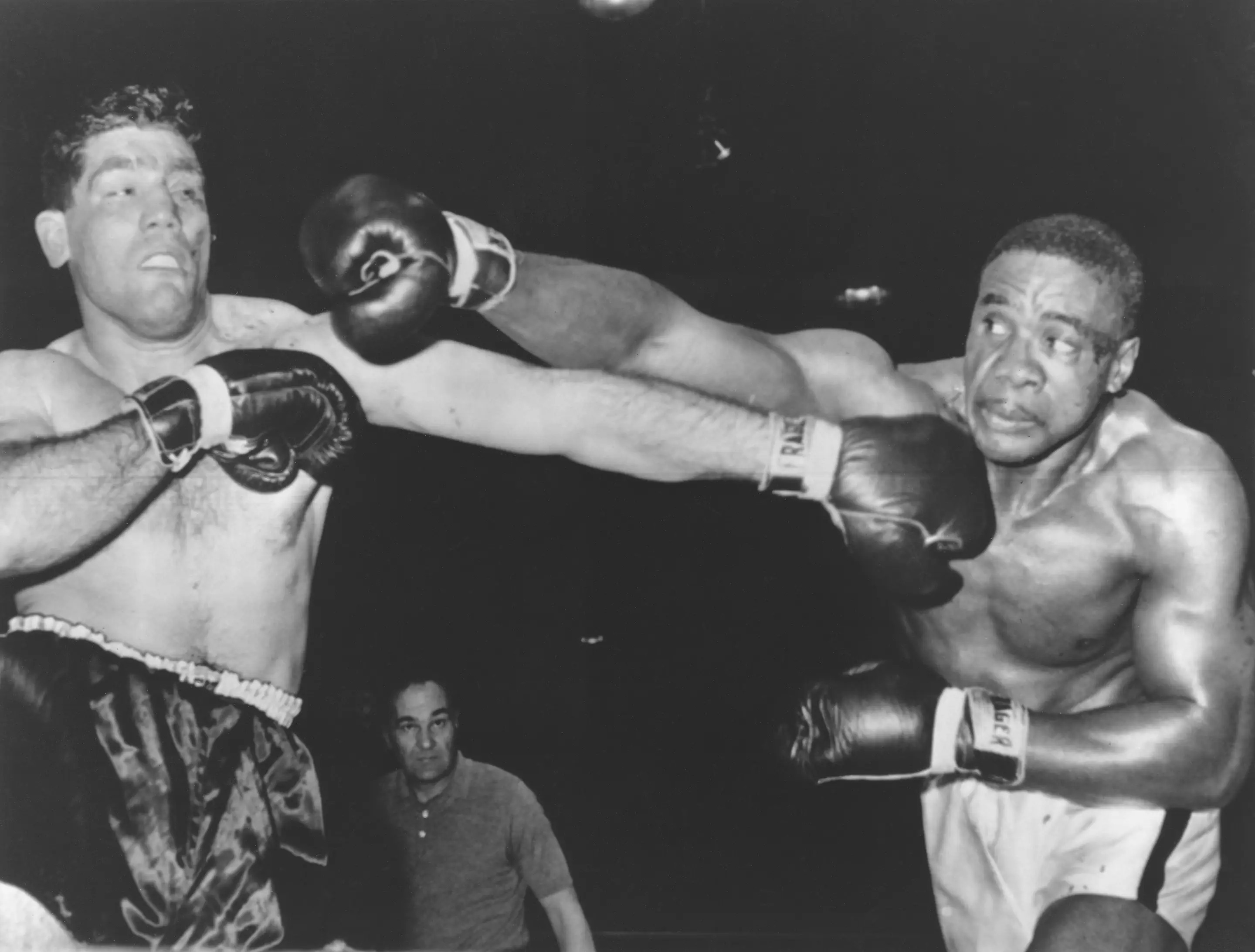
Dec. 9, 1959: Sonny Liston stops German heavyweight Willie Besmanoff in the sixth round. Liston’s won 28 fights in a row from 1955 to 1964.
(Camerique via Getty Images)
‘A boxing match is like a cowboy movie’
By the early 1960s, it was starting to seem like Liston might never get a crack at the heavyweight title. It didn’t matter that he’d won 26 straight fights, most of them by knockout. The stink of his association with mobsters still clung to him.
Advertisement
Floyd Patterson had become the youngest heavyweight champion in boxing history when he won the vacant title at the age of 21, and his trainer, Cus D’Amato, said they would refuse to fight Liston until he shed himself of questionable management. (Side note: Mike Tyson, also trained by D’Amato, would later break Patterson’s record by becoming heavyweight champ at age 20.)
It didn’t help that Liston had continued to run afoul of the law. Another way of putting it was that he had never really stopped.
He was released from prison in 1953, and was subsequently arrested 14 times over the next five years. Many of those were petty beefs that led to nothing in the end, but some were more serious charges stemming from Liston’s binge drinking. One night in 1956, he allegedly punched a St. Louis police officer while drunk and took his gun, which was later recovered from the home of Liston’s sister. He pleaded guilty to assaulting a police officer, resulting in a sentence of nine months in the city’s workhouse.
That incident led to licensing problems for Liston. He was suspended by the St. Louis boxing commission, though later reinstated after police captain John Doherty is said to have asked the commission: “What do you want to do, give him a license so he can get in a ring and fight, or a gun so he can go out and rob? Those are the only two things he knows how to do.”
Advertisement
Liston’s run-ins with police in St. Louis got to be so frequent and so volatile that he said he was finally warned to leave town for good. According to Liston, the same Captain Doherty later told him that “his men was going to put me in the alley.” Liston took that to mean that his choices were to relocate or be killed by the St. Louis police.
Some of Liston’s troubles may have been the result of police harassment — but not all of them. Over the years, he was arrested several times for drunk driving. He was accused of at least two separate sexual assaults, including one involving the wife of a training partner. The FBI kept a file on him, and distributed copies to other law enforcement agencies. Moving from St. Louis to Philadelphia did little to alleviate these troubles. Even one policeman who regarded Liston as a friend once described him as “something of a thug.”
Advertisement
“He has no finesse, tact whatsoever,” said Mitchell, the early manager who helped spring Liston from prison. “He doesn’t realize that he has to keep his name out of the paper. He’s kind of mean, too. He hates policemen; they hate him.”
His criminal record, along with mob ties that had been well-publicized in Senate hearings, made Liston an unpopular choice as a heavyweight title contender. The problem was he kept knocking out those who might otherwise have drawn the assignment. At a certain point, there hardly seemed to be anyone else worth Patterson’s time.
Liston eventually caved to demands that he sign a new manager, though he was unhappy with the terms of these new arrangements. Still, many remained opposed to a fight between Liston and Patterson, who was generally seen as a kinder, gentler sort of Black heavyweight champ, the kind white America could more easily accept. Even the NAACP came out against the bout, with president Percy Sutton insisting that Patterson, a painfully polite, soft-spoken, almost tender-hearted champion, “represents us better than Liston ever could or would.”
According to Patterson, President John F. Kennedy had personally advised him against fighting Liston, citing Liston’s lengthy criminal record.
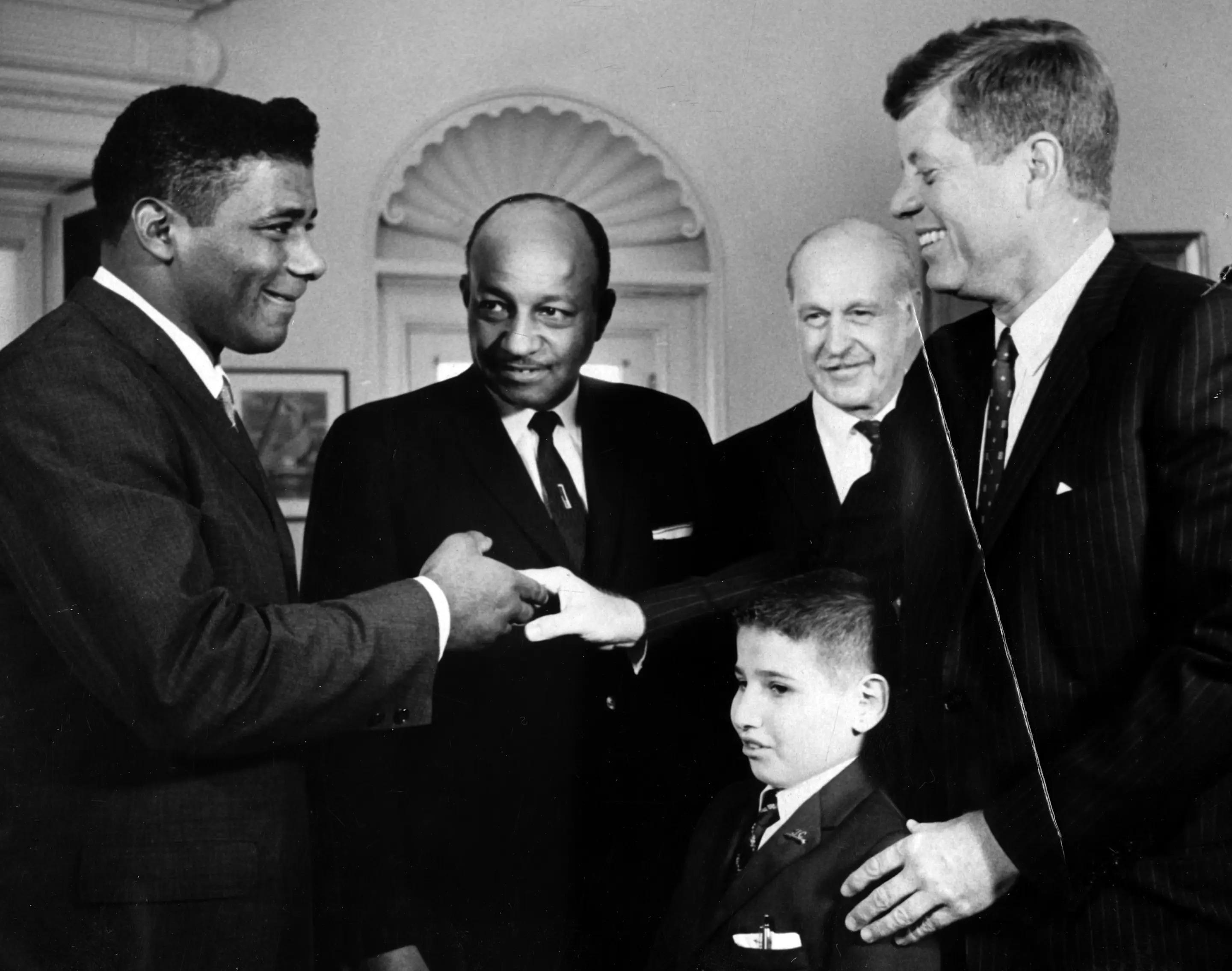
1961: Heavyweight champion Floyd Patterson shakes hands with U.S. President John F Kennedy.
(Afro Newspaper/Gado via Getty Images)
“I met the president of the United States, and he even said to me, ‘Make sure you keep that championship,’” Patterson told author Peter Heller in 1970. He offered this not as a brag, but as proof of the kind of pressure he was under. Almost no one but Liston and the most hardcore boxing fans wanted him to take this fight, but Patterson never felt right about avoiding it.
Advertisement
“One night in bed, I made up my mind,” Patterson told the writer Gay Talese, who wrote profiles of him before and after the Liston fights. “I knew if I’d want to sleep comfortably, I’d have to take on Liston even though the NAACP and the Kefauver [Senate] committee didn’t want me to take on the fight.”
The fight was made and set for Chicago’s Comiskey Park on Sept. 25, 1962. Leading up to it, both men continued to be very much themselves, entirely unswayed by the other.
“I have met Sonny Liston several times and I believe there is much good in him,” Patterson said from his training camp. “Should he be fortunate enough to win the heavyweight championship, I ask that you give him a chance to bring out the good that is in him.”
Liston returned none of this goodwill. He described Patterson as “the first fighter I have ever met that I actually have been mad at,” and said he would “like to run him over in a car.” He knew he was reviled, and that most of America — regardless of race — wanted to see him lose. He insisted that none of this bothered him.
Advertisement
“A boxing match is like a cowboy movie,” Liston told Time. “There’s got to be good guys, and there’s got to be bad guys.”
Liston always knew which one he was. He also knew that, in real life, being a good guy didn’t guarantee you anything.
Patterson never really seemed to believe that Liston’s professed animosity toward him could be genuine. He had also grown up poor and Black in America. He described his feeling of humiliation and helplessness at seeing his father, a longshoreman, come home so exhausted he could barely stay awake through dinner. As a child, he resolved to steal anything he could to alleviate the powerlessness of poverty. Before long, like Liston, he was caught and sent away to be punished. But unlike Liston, he grew into a fighter known far more for his art than his savagery.
“It was my decision to take the fight,” Patterson told the writer James Baldwin, who covered the fight for the magazine Nugget in 1962. “You gentlemen disagreed, but you were the ones who placed [Liston] in the Number One position, so I felt that it was only right. Liston’s criminal record is behind him, not before him.”
Advertisement
Over in Liston’s camp, Baldwin found a very different mood. Liston, Baldwin wrote, “seems to me that he has suffered a great deal. It is in his face, in the silence of that face, and in the curiously distant light in his eyes — a light which rarely signals because there have been so few answering signals. And when I say [he is] inarticulate, I really do not mean to suggest that he does not know how to talk. He is inarticulate in the way we all are when more has happened to us than we know how to express; and inarticulate in a particularly Negro way — he has a long tale to tell which no one wants to hear.”
The fight would be one of the shortest in heavyweight title history, just two minutes and six seconds. Liston was almost 25 pounds heavier than Patterson, and he put all that bulk behind a left hook that floored the champ in the first. Liston had won the heavyweight title while barely breaking a sweat. In this cowboy movie, the bad guy was the one left standing.
The pair fought again the following year and the story didn’t change. This time Patterson was knocked down twice in the first round before finally succumbing at the 2:10 mark of Round 1. He’d made it just four seconds longer than in the first fight.
Advertisement
“I know I can do better,” Patterson later told Talese, in a story printed in Esquire Magazine. “Oh, I’m not talking about a rematch. Who would pay a nickel for another Patterson-Liston match? I know I wouldn’t. … But all I want to do is get past the first round.”
He never got the chance.
Liston was disappointed to find that America did not warm to the idea of him as champion. For all his talk about how the public would just have to get used to him until boxing produced a challenger capable of beating him, deep down he’d expected at least a little fanfare about his big title win.
In his book, “Once There Were Giants: The Golden Age of Heavyweight Boxing,” Jerry Izenberg wrote that Liston had prepared a speech to give when he returned to Philadelphia, which he called home at the time.
Advertisement
“It was a speech he never delivered,” Izenberg wrote. “Liston dreamt of hosting a celebration that would never happen. When he landed, there was nobody present but a handful of reporters. He never got over it. [Frank] Rizzo’s police force had targeted him and, in truth, his behavior had made it easy for them. He drank heavily. It was almost inevitable that he would soon leave town. Denver, for a time, would be his new home. His first statement upon arrival was: ‘I’d rather be a lamppost in Denver than the mayor of Philadelphia.’”

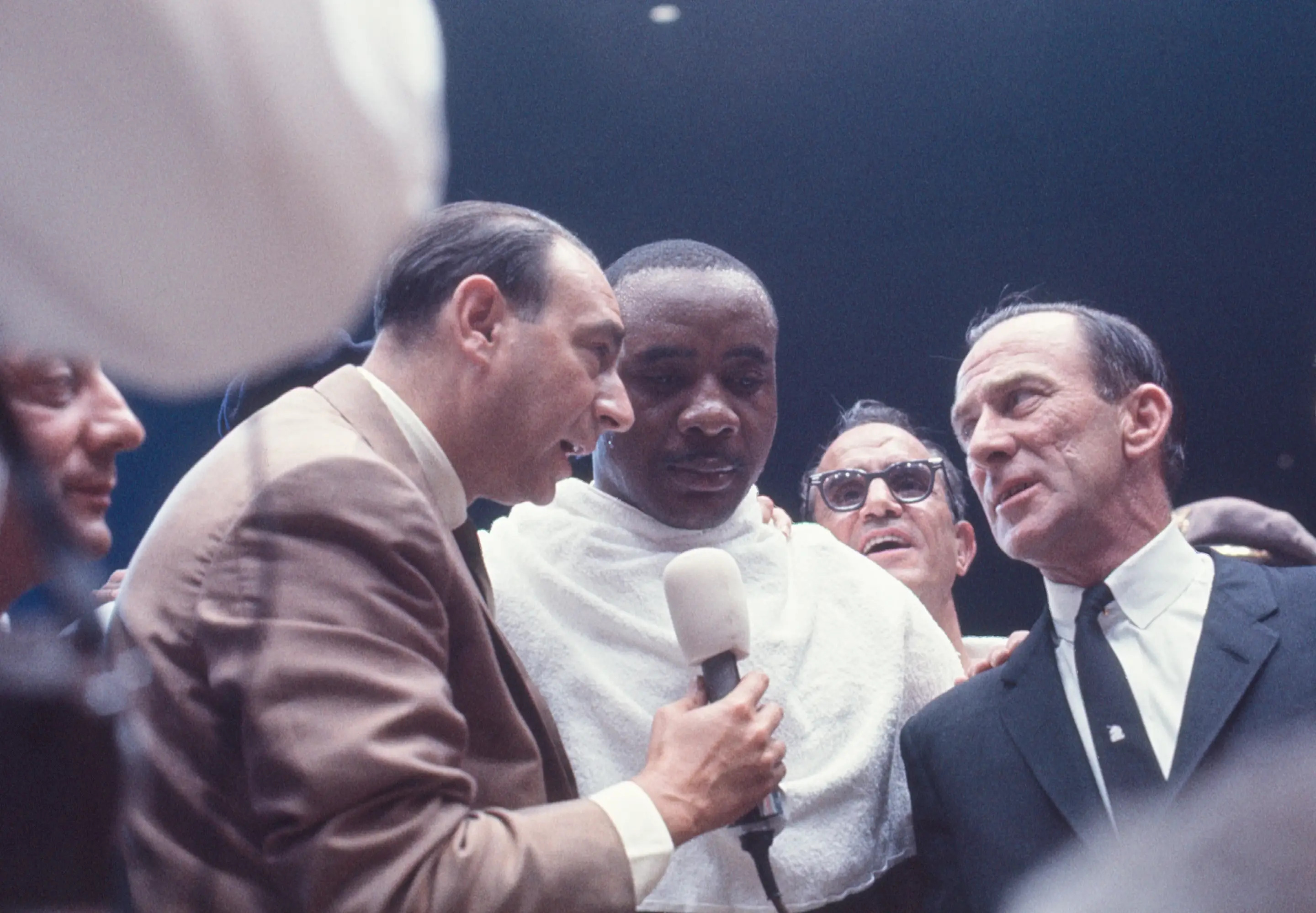
July 22, 1963: Howard Cosell interviews Sonny Liston in the ring after he knocked out Floyd Patterson in the first round.
(James Drake via Getty Images)
‘A lucky fluke’
Over 60 years later and you still keep running into that photograph. You see it in dorm rooms and strip mall gyms. It’s on the wall in bars, restaurants and waiting rooms. It’s a great moment in sports photography, the way Ali is captured at the exact peak of his dominance. The fact that it was, in all likelihood, an ugly and ignominious day for boxing has been smoothed down to almost nothing by the sands of time.
Advertisement
If you start to ask questions — even just a few basic ones — about the iconic scene from the heavyweight title rematch between Ali and Liston on May 25, 1965, that’s when the picture comes into better focus.
Q: Where did this fight take place?
A: In a small civic center in Lewiston, Maine.
Q: Wait, didn’t their first fight take place at a much larger arena in Miami Beach?
A: Yes it did. And organizers had originally targeted Las Vegas for the rematch, but there were enough suspicions about the legitimacy of the fight that Art Laurie, then the chairman of the Nevada commission, later told Tosches that he’d been warned away from it by U.S. Senators who told him “not to have anything to do with that fight, because our industry here was gaming, and that fight was going to stink out the place.”
Q: At what point of the fight was that picture snapped?
A: Slightly past midway of the first round.
Q: How many other heavyweight title fights did Ali win via first-round knockout?
A: Zero. He had only one other first-round knockout win in his entire pro career, and it came in his fourth professional fight, against Jim Robinson, a man who finished his career 8-25, with 16 losses by way of knockout.
Q: How many other fights did Liston lose via first-round knockout?
A: Zero. Liston was knocked out only one other time, in his second-to-last fight against Leotis Martin, just one year before his death. Prior to that, he’d withstood punishment from the hardest hitters in the division, such as Cleveland Williams, who finished his career with 62 knockout wins but went 0-2 against Liston.

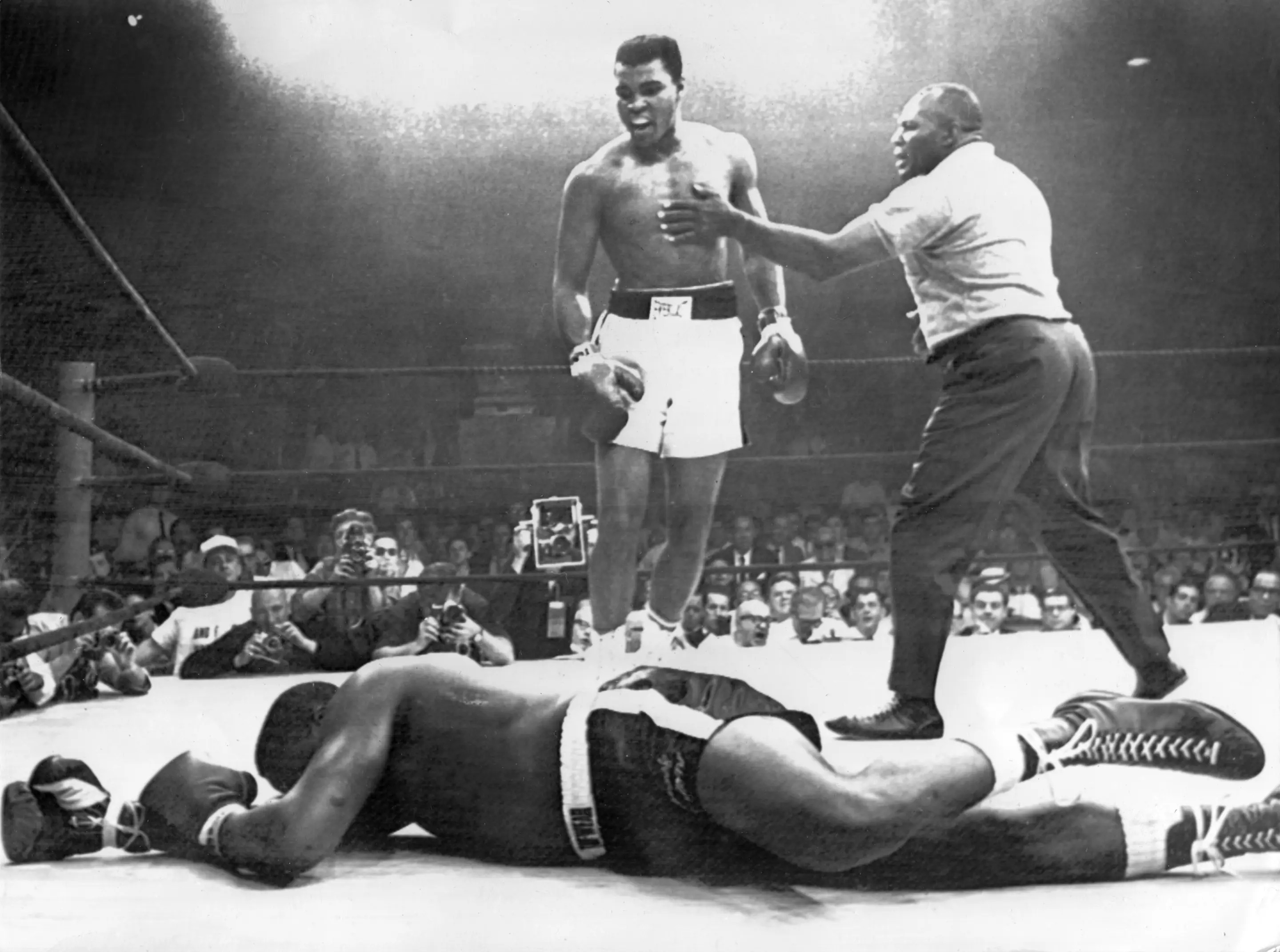
May 25, 1965: Muhammad Ali roars over Sonny Liston following his first-round knockout win.
(picture alliance via Getty Images)
An inconvenient truth lost amid the Ali lore is that even their first fight, Ali’s coronation as heavyweight champion in 1964 (back when he was still known as Cassius Clay), was not above suspicion. Headed into that one, few people saw Ali as a serious threat to the champion. He’d won an Olympic gold medal as a light heavyweight at the 1960 Games, but was thought to be too short on power to ever stand up to a monster like Liston. His fights against Doug Jones and Henry Cooper, just before he finally got a crack at the title, had left many observers even less optimistic about the young man’s chances to dethrone Liston.
“At this stage of his fistic development, Clay must be regarded as no more formidable an antagonist for Liston than was Patterson,” noted boxing writer Nat Fleischer wrote in the lead up to the first Ali-Liston fight. “In fact, were Clay to fight Patterson I would pick Floyd to knock him out in six rounds or less.”
Former light heavyweight champ Billy Conn predicted that Liston would win with one good punch.
“Clay can’t fight now and he’ll never be able to fight,” Conn said. “He hasn’t the experience. The only experience he’ll get with Liston is how to get killed in a hurry.”
But for Liston, there were no other options that seemed nearly as profitable. He made for a terrifying champ, but not a popular nor beloved one. He was booed against Patterson, even in victory. Without marketable antagonists, his title reign seemed destined to bring in meager returns at the box office.
Liston came in as a 7-to-1 favorite in that first fight. According to Paul Gallender’s book, “Sonny Liston: The Real Story Behind the Ali-Liston Fights,” there were FBI reports detailing concerns that mob insiders might have conspired to take advantage of that lopsided line by backing Ali. The fact that he won the title after Liston quit on the stool after the sixth round, complaining of a shoulder injury, heightened those suspicions.
During a meeting of a Senate subcommittee on antitrust and monopoly regulations, Gallender wrote, Sen. Charles Keating floated the possibility that, even behind bars, people like “Blinky” and “The Gray” had influenced this title fight.
“I do not believe that with the possible exception of deaths in the ring, there has been another single occurrence that has contributed more to bringing professional boxing into widespread public disrepute than the Clay-Liston bout and the antics that both preceded and followed it,” Keating said.
At least some of Keating’s concern, it was later revealed, had to do with Ali’s public announcement of his conversion to Islam.
There was also the matter of a strange and somewhat suspicious contract, which came to light only after the first fight. Inter-Continental Promotions, which Liston was a partner in, had paid the Louisville Group, which managed Ali at the time, $50,000 for the rights to promote his next bout following the Liston fight. This had been done months prior to the first fight. Though Liston’s manager would later assert that it was “a lucky fluke” that they found themselves so well-positioned to profit off the rematch, many wondered why the backers of a man so heavily favored to win would bother paying for the rights to promote a fighter who was widely expected to get annihilated in the ring.
This version of the past has largely been left out of the Ali story. In the 2001 film “Ali,” starring Will Smith, we see a glowering, menacing Liston not only trying his best to win that first fight, but even resorting to underhanded tactics, like rubbing a chemical agent into his glove and then using it to temporarily blind Ali.
The video footage of that fight, as well as ringside accounts, do suggest that Ali’s vision was impacted at one point. But that could also have been due to an astringent that Liston’s corner used to slow the bleeding from a cut, which then got on Ali’s face and into his eyes during a clinch.
The rematch, however, was a different story. The post-fight recap in The New York Times described Liston collapsing “slowly, like a falling building, piece by piece, rolling onto his back, then flat on his stomach, his face pressed against the canvas.” Multiple ringside observers reported that fans in the small civic center almost immediately began chanting “Fix!”
The blow that supposedly felled Liston was dubbed “the phantom punch.” While Ali stood over his foe, yelling and gesturing in that moment immortalized on film, what some at ringside later reported hearing was Ali berating Liston, demanding he get up, telling him no one would believe this. The video footage from the fight shows Ali even interrupting the referee’s count as he continued yelling at Liston, seemingly in no hurry to see the fight ended.
Later, Ali would do his best to explain and justify the strangeness of that finish. It was just that his hands were so fast, he said. As fast as the human eye can blink, that’s how fast he could punch.
“The minute I hit Sonny Liston, all of those people blinked at that moment. That’s why they didn’t see the punch,” Ali said later, playing the moment for laughs. One got the impression, hearing the comedic faux-sincerity in his voice, that he was doing the best with the material he had.
There’s another obvious reason that the fix allegations, which sucked up so much of the air in the room at the time of these fights, haven’t clung to their memory all these decades later. It’s because, for contemporary audiences, Ali is so clearly the greater fighter, possibly the greatest ever. Many people in the present day, if they’ve heard of Liston at all, know him only for his supporting role in Ali’s story.
Who would need to bother with fixing those fights? Why spend the money or take the risk to ensure that the greatest boxer of all time won? Wasn’t it obvious that Ali, who would go on to dominate the heavyweight ranks for the better part of the next 12 years, was always going to beat Liston, who never again glimpsed any meaningful version of the heavyweight title?
That’s the benefit of hindsight. That’s us knowing who Ali became. Of course that future was unknown to those who might have been hoping to cash in on the huge underdog line attached to that skinny, loud-mouthed Cassius Clay back in 1964.
According to Foneda Cox, one of Liston’s longtime friends and sparring partners, Liston always knew this day was coming. He knew what kind of people were backing him. He was indebted to them in a million little ways. There were even rumors that mob money paid off and hushed up the first sexual assault accusation, leveled at him by the wife of a training partner. That story only briefly appeared on a newswire, just long enough to frighten Liston, then vanished again. Whoever had control of that story, Tosches wrote after several interviews with Cox, had control of Liston.
“He told me, he said, ‘Foneda, I’m gonna tell you. I’ve got to lose one, and when I do, I’m gonna tell you.”
Cox never got any such advanced warning. He later said it was the only thing that he still held against Liston.
It’s possible that two things are true here. Nefarious forces may have conspired to fix one or both the Ali-Liston bouts, and it also might have been entirely unnecessary. It seems very likely, knowing what we know now about the careers of both men, that Ali would have defeated Liston anyway. (Though, it must be said, a first-round knockout victory for Ali, who was never much of a power puncher, still seems far-fetched.)
If either of the bouts were fixed, Ali didn’t seem to be in on it. Why would he need to be? One of the things that makes boxing so susceptible to this kind of skullduggery is that you really need the cooperation of only one person, and it’s the guy taking the dive. Liston may have felt he had no choice. He was the betting favorite in both bouts, even after his loss in the first one. He may have accepted that the people in charge, at least as far as his own career was concerned, wouldn’t turn down this opportunity to cash in on their investment in him.
Liston fought 16 more times, winning all but one. But his drinking picked up and the years seemed to show in his face. He lived in Las Vegas, and his wife Geraldine would tell people who came to the house looking for him that they should go down to the casino. If they didn’t see him when they walked in, she said, just wait five minutes. He’d be through there soon enough.

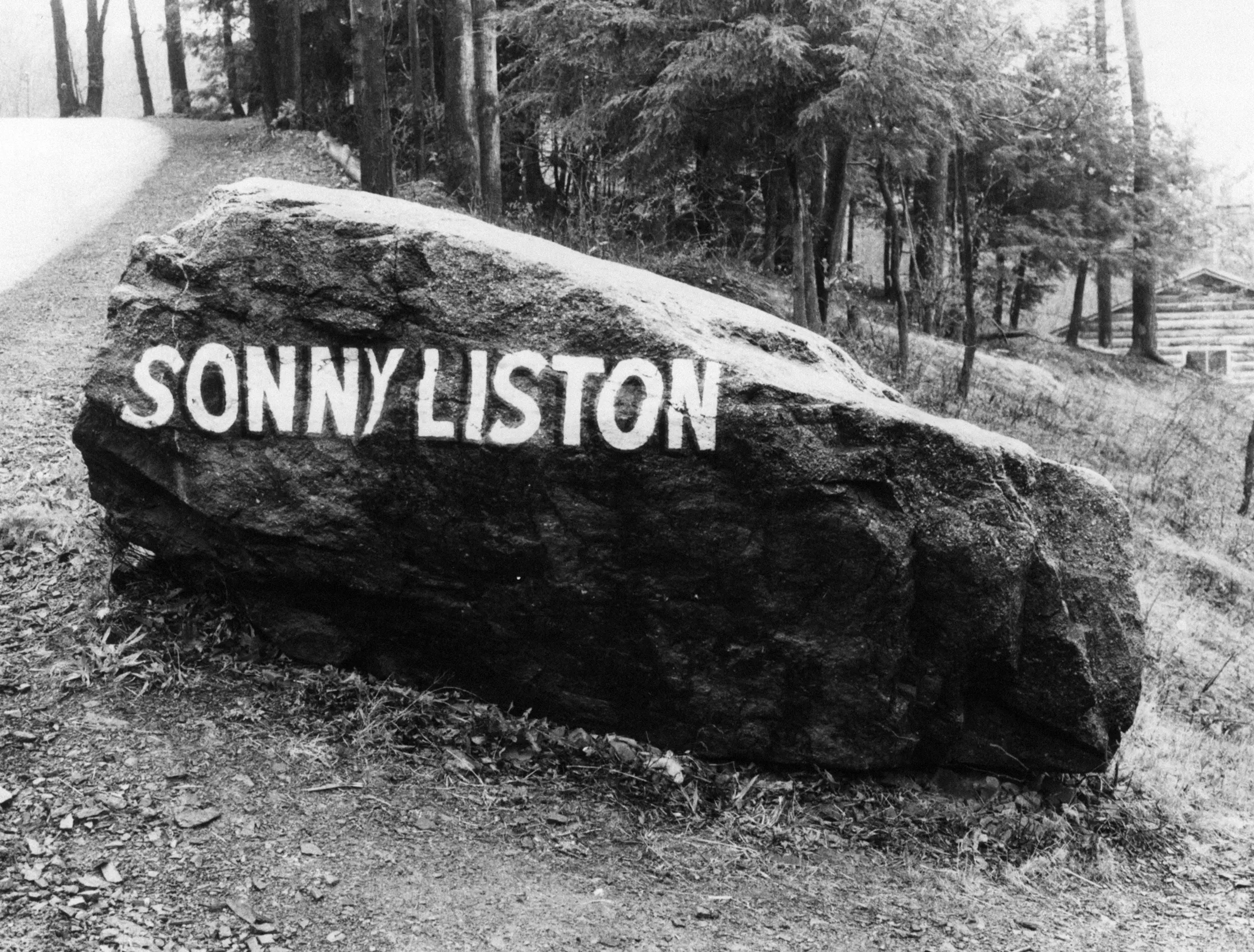
June 8, 1980: Boulder with Sonny Liston name painted on at Muhammad Ali’s Training Camp in Deer Lake, Pennsylvania.
(Mirrorpix via Getty Images)
Just like he’d done when he moved to St. Louis as a much younger man, Liston fell in with a bad crowd. He was rumored to be doing some street-level drug dealing and possibly using drugs himself. When his wife went out of town to visit family and couldn’t reach him on the phone for over a week, she began to worry. What she found when she returned to their Las Vegas home on Jan. 5, 1971, only confirmed her worst fears.
Liston was lying on the bench at the foot of their bed in his underwear, his shoes and socks on the floor next to him. He’d been dead for some time. A newspaper inside the house was dated Dec. 28, 1970. The same date appeared on a piece of mail.
According to the report issued by the Clark County Sheriff’s Office, a quarter ounce of heroin was found in the kitchen and a small bag of marijuana was in the pocket of Liston’s pants. There was a glass of vodka on the nightstand and a .38 revolver resting in a holster. There were no signs of a struggle or forced entry. The autopsy ruled out the possibility of homicide, instead attributing the death to “probable” heart failure and lung congestion.
Traces of morphine and codeine were later found in his body, but not in lethal amounts. The toxicology report attributed them to the possible breakdown of heroin inside the body. The autopsy noted what could have been an old track mark on his arm, though Liston’s friends would later swear that he had a lifelong fear of needles, at times going to great lengths to avoid them.
It didn’t take long for the conspiracy theories to start up. A troubled boxer with known mob ties turns up suddenly dead? People are bound to have ideas about that. Some suggested that maybe it was a mob hit made to look like a heroin overdose. But no needle was found, and anyway why kill Liston now? Whatever may or may not have happened around those Ali fights, it’s not like there were any authorities still asking about it in 1970. It had all blown over by then.
Maybe the simplest explanation — that years of drinking, drug use, and all-around hard living had finally caught up with him — was truly the right one. But maybe that was also unsatisfying, to think that a life like that, which seemed to come from nowhere and wind through all the darkest alleys of the American experience, could end quietly and alone, without violence or mystery.
He was laid to rest in Davis Memorial Park, not far from the Vegas Strip. The dates on his grave stone say 1932-1970, but don’t get into any more specifics than that. There’s no mention of his boxing career or the heavyweight title. Just his name, followed by those approximations of the years of his life, finishing with the simplest of epitaphs: “A MAN.”

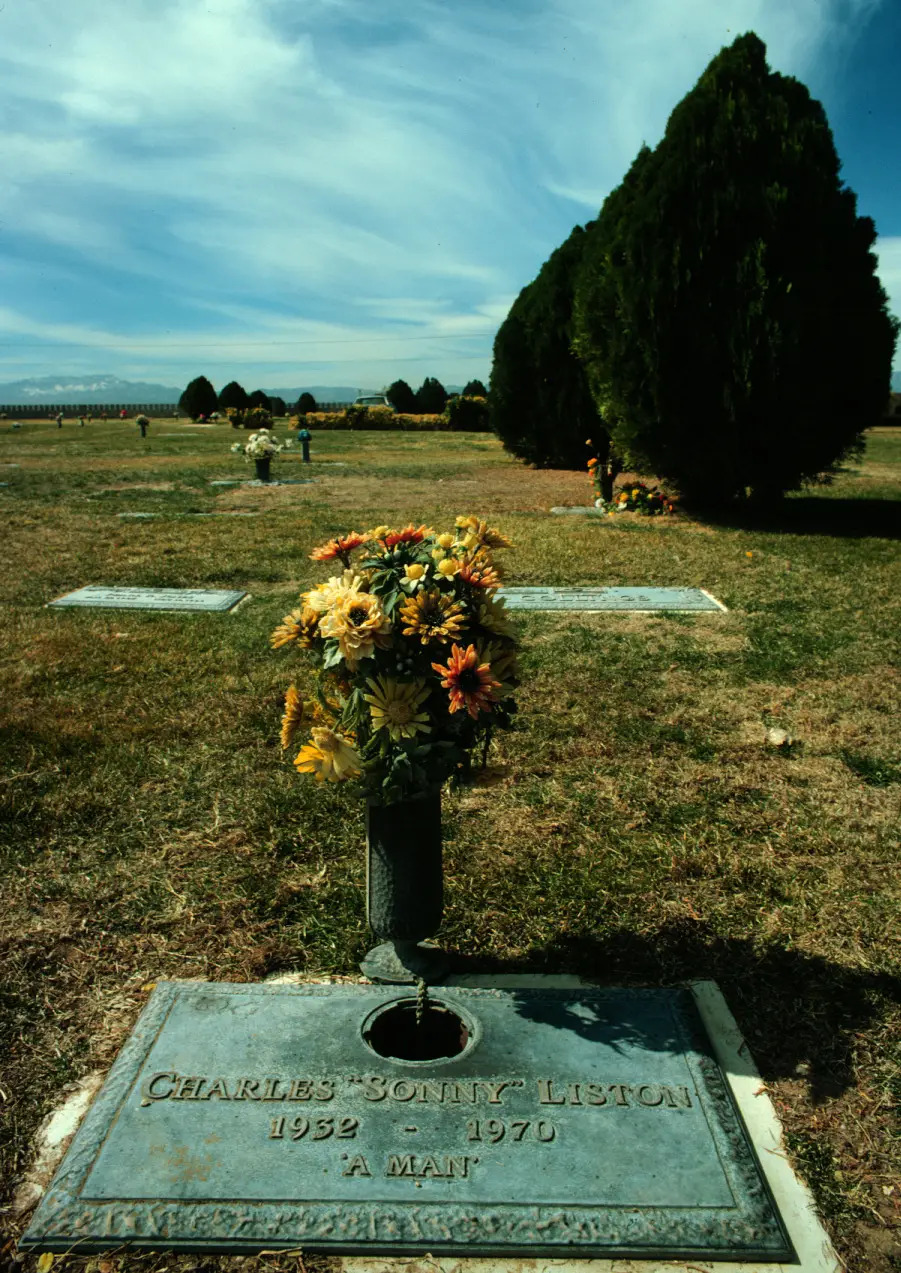
November 1979: The grave of former world heavyweight champion Charles “Sonny” Liston in Las Vegas.
(Michael Brennan via Getty Images)
Author’s note: A great debt is owed to the following texts, all of which are highly recommended for readers who wish to know more about this chapter of boxing history:
“The Devil and Sonny Liston” by Nick Tosches
“Sonny Liston: The Real Story Behind the Ali-Liston Fights” by Paul Gallender
“Once There Were Giants: The Golden Age of Heavyweight Boxing” by Jerry Izenberg
“At the Fights: American Writers on Boxing” edited by George Kimball and John Schulian
Read the full article here


