




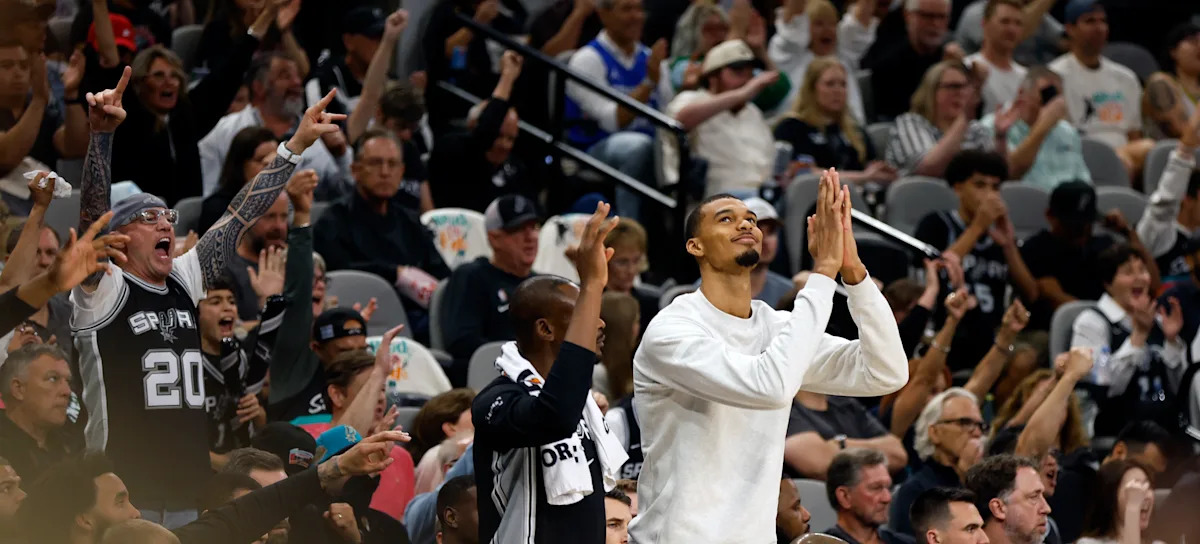
The Western Conference’s second-seeded San Antonio Spurs will take on the seventh-seeded Portland Trail Blazers in the first round of the 2026 NBA playoffs. It’s the first time these teams have squared off in the postseason since the 2014 Western Conference semifinals, which the Spurs won in five games.
San Antonio’s other starting big man in that series, lining up alongside Tim Duncan? A Brazilian guy by the name of Tiago Splitter — who’s now the interim head coach of the Trail Blazers. It’s a small world, after all.
East previews: 76ers-Celtics • Hawks-Knicks • Raptors-Cavaliers
West previews: Timberwolves-Nuggets • Rockets-Lakers • Trail Blazers-Spurs
Series schedule (all times Eastern)
Game 1: Portland at San Antonio on Sunday, April 19 (9 p.m., NBC)
Advertisement
Game 2: Portland at San Antonio on Tuesday, April 21 (8 p.m., NBC)
Game 3: San Antonio at Portland on Friday, April 24 (10:30 p.m., Prime Video)
Game 4: San Antonio at Portland on Sunday, April 26 (3:30 p.m., ESPN)
*Game 5: Portland at San Antonio on Tuesday, April 28 (time and network TBD)
*Game 6: San Antonio at Portland on Thursday, April 30 (time and network TBD)
*Game 7: Portland at San Antonio on Saturday, May 2 (time and network TBD)
*if necessary
Everything to know for the NBA playoffs: Predictions, series previews, X-factors
Series odds
(Via BetMGM)
San Antonio Spurs (-2500)
Portland Trail Blazers (+1000)
What we know about the Spurs
They’re arguably the NBA’s most balanced team — third in offensive efficiency and defensive efficiency, according to Cleaning the Glass, joining the Celtics as the only teams in the top five on both ends of the floor. They’re also the league’s hottest squad, going a scorching 30-4 and outscoring opponents by nearly 15 points per 100 possessions since the start of February.
Advertisement
Everything starts with Victor Wembanyama, the 22-year-old world-breaker whose ascent returned San Antonio to the ranks of the league’s elite.
After missing the final two months of the 2024-25 season following the discovery of a blood clot in his right shoulder, Wembanyama returned with his sights set on establishing himself as one of the NBA’s most dominant forces. The 7-foot-4 (allegedly) center did just that, averaging 25 points, 11.5 rebounds, 3.1 assists, a league-leading 3.1 blocks and 1 steal in 29.2 minutes per game. He traded in some of his more speculative 3s for more physical play in the paint; he smothered even more of the half-court on defense; he bent the game around him, cementing his standing as not only a lock for Defensive Player of the Year and All-NBA First Team, but a likely top-three finish in MVP voting.
What makes the Spurs so dangerous, though, is that while their dominance starts with Wembanyama, it doesn’t end there.
Advertisement
De’Aaron Fox provided exactly the high-level No. 2 scorer and primary ball-handler the Spurs hoped he’d be when they traded for and re-signed him, smoothly shifting between focal point and complement while turning in arguably the best two-way play of his career. Stephon Castle built on his Rookie of the Year campaign by becoming a better scorer and two-way playmaker — one of just nine players in the league this season to average at least 16 points and seven dimes per game, a list replete with All-Stars. Dylan Harper, the No. 2 pick in the 2025 NBA Draft, immediately got into the lane like a 10-year vet and smashed through the rookie wall, averaging just under 13-4-4 in 24 minutes per game on 57/40/78 shooting splits over the final three months.
With Wembanyama at the center of the frame, the three-headed backcourt monster constantly pounding the paint and pushing the pace, and everyone from Julian Champagnie to Luke Kornet starring in their roles, everything fell into place in San Antonio. The overall record and underlying metrics say the Spurs have been the NBA’s second-best team, behind only the defending champion Thunder. But good luck telling the Spurs — who, y’know, beat Oklahoma City four times this season — that they’re second to anybody.
What we know about the Trail Blazers
After several meandering seasons, Splitter — who took the reins in Portland after Chauncey Billups was arrested and indicted as part of a federal investigation into illegal gambling — got the Blazers back to the playoffs on the strength of a simple yet effective identity: Give Deni Avdija the ball, get out of the way and get back on defense.
The offensive leap that began in the relative anonymity of Washington hit a new level, as Avdija averaged career highs in scoring and facilitating en route to his first All-Star selection. The only other players to average as many points, rebounds and assists per game as Avdija this season were Nikola Jokić and Luka Dončić … which is, y’know, pretty decent company.
Advertisement
The Blazers needed Avdija to shoulder a monster offensive workload due to a rolling raft of injuries on the perimeter. Returning hero Damian Lillard hasn’t suited up — outside of All-Star Weekend, anyway — as he rehabilitates a ruptured Achilles tendon. A right calf strain kept offseason addition Jrue Holiday sidelined from mid-November through mid-January; left Achilles tendinitis put Jerami Grant in street clothes for 14 games. A torn hamstring put Scoot Henderson on the shelf for fourth months; as soon as he got back, multiple left leg injuries cost Shaedon Sharpe the next two.
The result was extreme reliance on Avdija — top 20 in usage rate, touches per game and average time of possession, in the 99th percentile in on-ball rate — and an offense that rarely functioned all that smoothly: 20th in offensive efficiency (though league-average in Deni’s minutes), 29th in team field-goal percentage and dead last in turnover rate. Portland worked to counteract that by creating extra possessions, with center Donovan Clingan leading the way to a top-three offensive rebounding rate, and with an active, aggressive, near-top-10 defense featuring ball-pressuring menaces like Holiday, Toumani Camara and Matisse Thybulle producing the NBA’s seventh-best opponent turnover rate.
That grind-it-out style helped Portland stay afloat, finish over .500 for the first time in five years despite a negative point differential and earn a spot in the play-in tournament. From there, the Blazers went into Phoenix and blitzed past the Suns, with Avdija capping the best game of his career — 41 points, seven rebounds, 12 assists, directly producing 71 of the Blazers’ 114 points — with a signature hard drive and finish:
The Blazers are an understandably heavy underdog, but they might also be a livelier one than the full-season numbers suggest. Since February’s trade deadline, they’re 20-12 with the NBA’s fourth-stingiest defense. Their new starting lineup — Avdija, Holiday, Henderson, Camara and Clingan — is 6-2, outscoring opponents by 25 points in 94 minutes. Their second unit is starting to jell, with the now-healthy Grant and Sharpe joining Thybulle, Robert Williams III and Kris Murray in a long, athletic group with some two-way juice.
Advertisement
And, after a midseason lull while dealing with a nagging back injury, Avdija — averaging 27-7-7 over his last 10 games — is playing like the kind of star teams need to shine brightest at this time of year. Continuing to shine against this Spurs defense, though, will be an awfully tall order.
Head-to-head
The Spurs won the season series, 2-1. They knocked off Portland in November, scoring a 115-102 win that eliminated the Blazers from NBA Cup play. Fox and Avdija both starred, putting up matching monster lines: 37 points, six rebounds, eight assists. But while Avdija sputtered down the stretch, going 2-for-8 from the free-throw line in the fourth quarter, Fox shined in the clutch, scoring 14 in the final frame, including an 8-for-8 mark from the stripe to seal the win.
The Blazers returned serve in January, eking out a 115-110 win behind a 29-10-10 triple-double from Avdija, a 24-point, 12-rebound double-double from Clingan and five 3-pointers from Camara. Even with all that Portland production, though, the Spurs had a chance to take the lead with just over a minute left … but a missed pull-up by Fox, followed by a made pull-up by Avdija, helped the Blazers score one of just eight victories for a visitor to San Antonio this season.
San Antonio finished the season series last week with a 112-101 win, as Fox turned in another strong showing against the Blazers. (For the season, he averaged 27 points, 6.3 assists, 5.7 rebounds and 3 steals in 34.1 minutes per game against Portland on 48/44/90 shooting splits.)
Advertisement
But while Portland’s starters showed out — 29-6-6 for Avdija, double-doubles for Holiday and Clingan, a 20-point showing for Henderson, 18 with four triples for Camara — the Spurs emphatically won the battle of the benches, with Sixth Man of the Year candidate Keldon Johnson (20 points, eight rebounds, two steals, an assist and a block in 29 minutes) doubling up Portland’s reserves by himself.
Injuries impacted the matchups. Castle missed two of the three meetings for San Antonio. Henderson and Grant missed two of three for Portland, who were also without Holiday, Williams and Thybulle in its lone win.
The biggest literal and figurative absence, though, was Wembanyama, who missed all three games against the Blazers this season, and whom Portland hasn’t seen since Dec. 21, 2024 — a night when he lit them up for 30 points in 30 minutes and blocked a career-high-tying 10 shots:
I might be going out on a limb, but I think Wemby might change the matchup.
Matchup to watch
Avdija vs. Wembanyama in the paint.
Advertisement
The battle for the real estate in front of the rim is something that Tom Haberstroh and I discussed at length on this week’s episode of The Big Number:
Nobody in the NBA drove to the basket, generated free-throw attempts on drives or delivered assists off drives this season more than Avdija did. His relentless rim pressure is the organizing principle of Portland’s offense. The Blazers ranked fifth in the NBA this season in the share of their shots that came at the rim and fourth in the share of their shots that came from beyond the arc, according to Cleaning the Glass, and were third in fouls drawn on drives and 10th in assists at the rim per game — all of which flows directly from Avdija’s persistent attacking.
His ability to consistently bulldoze past defenders at the point of attack, get to his strong right hand and put his even-stronger-left-shoulder into a retreating would-be stopper creates a ton of scoring chances directly at the cup — one likely to end in either a bucket, a trip to the charity stripe or a reset for a Blazers squad that, led by Clingan and Williams, finished first in second-chance points per game. It also produced lots of opportunities for his teammates to feast on kickouts, with Avdija’s penetration drawing defensive attention and opening up passing lanes for either a quick catch-and-shoot launch — only five teams scored more points per game than Portland on spot-up shots, according to Synergy — or another drive past a step-slow closeout, keeping the blender whirring.
Advertisement
It’s not a particularly pretty offense, but it does have a certain brutal elegance: We’re betting that if we keep pounding our battering ram into your castle gate, eventually it’s going to smash open, and we’ll be able to come in and take whatever we want.
The thing is, San Antonio isn’t just guarded by a gate. It’s defended by a dragon.
The Blazers took more than 35% of their shots at the rim. Against Wembanyama, though, Spurs opponents took just 26% of their shots there; that would’ve been the NBA’s second-lowest mark this season. They scored just 38 points per 100 possessions in the paint and shot just 47.5% inside the arc with Wembanyama on the floor — both very, very far below what the NBA’s worst interior attacks managed over the course of the full season.
Advertisement
And as excellent as the Blazers are at generating second chances, Wemby and Co. are just as good at limiting them; he led the league in defensive rebounding rate among individual defenders, the Spurs led the league in defensive rebounding rate among teams, and they held opponents to just 13.7 second-chance points per game, fourth-fewest in the NBA.
When Wembanyama suited up against the Blazers last season, he primarily guarded Portland’s centers: either Clingan or Deandre Ayton. Johnson did dabble a bit, though, with him guarding Camara — a cross-match aimed at allowing him to roam off a not-that-threatening shooter in favor of being able to lurk around the paint and strike fear into the hearts of would-be drivers … like, for example, the league’s most prolific driver.
It remains to be seen whether Johnson decides to play it straight or switch up the matchups. If he does, it’ll be interesting to see how Splitter counters, what mismatches he thinks that might open up for a Blazers perimeter corps that, thanks to improvements from its youngsters and the arrival of Holiday, has more scoring and playmaking chops than last year’s model.
Advertisement
That, to me, is the biggest chess match on the board: Can the Blazers find a way to get Wembanyama out of the paint, whether by inviting him into the initial pick-and-roll and trying to beat him to the spot or by involving him in some prefatory screen-the-screener actions to try to make him navigate traffic away from the play? If they can’t, will Avdija — justifiably confident in his ability to bust defenses up by driving harder and harder, again and again — be able to win his share of the races to the rim against the league’s premier interior defender? And if he can’t, can a Blazers team that finished the regular season shooting just 34.8% on jumpers, according to Synergy’s tracking — 29th in the NBA, ahead of only the Brooklyn Nets — knock down enough outside shots to make this a series?
(Here’s where we note that in the Blazers’ one win over the Spurs this season, they went 19-for-45, 42.2%, from 3-point range … and in their two losses, they went a combined 21-for-73, 28.8%.)
Key question
Can the Blazers take care of the ball?
Advertisement
I mentioned it up top: The Blazers ranked dead last in the NBA in turnover rate this season, coughing up the ball on 16.8% of their offensive possessions, and allowed a league-high 21.4 points per game off those miscues. That’s a recipe for disaster for a team like Portland — one that is excellent at getting stops in the half-court, but typically very bad at getting buckets in the half-court. When you can’t really match the other guys’ firepower, you need to both maximize the chances you do get and refrain from giving them even more.
When the Blazers have been able to do that, they’ve been pretty damn good. Counting their play-in victory, in games where they’ve registered a turnover rate of 15% or fewer — which, for context, is still a below-average level of ball security; Chicago and Detroit tied for 21st in the NBA at 15% this season — they’re 19-7, according to Cleaning the Glass. That’s a 60-win pace.
Advertisement
However, that still leaves 57 games in which they’ve turned it over on more than 15% of their offensive trips. And in those games, the Blazers are just 24-33 — a 35-win pace. That’s a pretty massive difference.
(In fairness to Portland, myriad backcourt injuries that led to Avdija being on the ball a career-high 35% of the time and more than 1,000 minutes for two-way rookie guard Caleb Love help explain a lot of those elevated turnover numbers. When the Blazers have had Avdija, Holiday and Henderson on the floor, they’ve taken care of the ball at a league-best rate.)
In a series like this, against an opponent like the Spurs — who finished with the third-lowest opponent turnover rate in the NBA this season, tending toward a more conservative defensive style befitting a team that can funnel everything into the world’s best rim deterrent — coming down on the wrong side of the possession game is something the Blazers can ill afford. In two wins over Portland during the regular season, San Antonio turned 34 turnovers into 47 points; in the Blazers’ lone win, they committed just 11 turnovers, leading to only nine Spurs points.
An awful lot has to go right for the Blazers to have a chance of pulling what would be, by all accounts, a gargantuan upset. One pretty good first step? Limit your self-inflicted wounds and don’t give away extra possessions. The Spurs really don’t need the charity; they can inflict plenty of wounds just fine all by themselves.
Prediction: Spurs in five
Between Avdija’s physical driving, Clingan’s bulk on the interior, the positional size the Blazers can bring to bear across the perimeter, the quality defenders they can throw at Fox, Castle and Harper, and the quality of their depth, I don’t think this is going to be a comfortable matchup for San Antonio. I do think it’s one they’ll be able to withstand, though, finishing off a tough but quick series and moving on to bigger and better things.
Read the full article here


