
Subscribe
Demo

I asked my cellphone to play J.J. Spaun the other day, though I meant to say J.J. Cale, the Clapton whisperer from Tulsa. If I may: I was distracted, reading about Venus Williams playing U.S. Open tennis at 2 a.m. in my morning paper. The phone decided, all on its own, to play JJ Grey & Mofro — not a band I knew, but an enjoyable happenstance surprise. The internet traffics in happenstance.

My brother was born in Brooklyn in 1957, the year the Dodgers left the borough for Los Angeles. When David came of baseball age he fell under the spell of the New York Mets, and he’s been loyal to the Amazin’s (add air quotes to taste) ever since. Such devotion requires a sense of humor, and the irony gene helps, too. The internet, via its algorithmic magic, supplies him with a steady stream of curiosities, from baseball, from golf, from various cabinets. When Haotong Li went triple bogey-quintuple bogey on 12 and 13 at Augusta National on Masters Sunday this year I heard about it from David first, even though he was home and I was at the tourney.

Advertisement

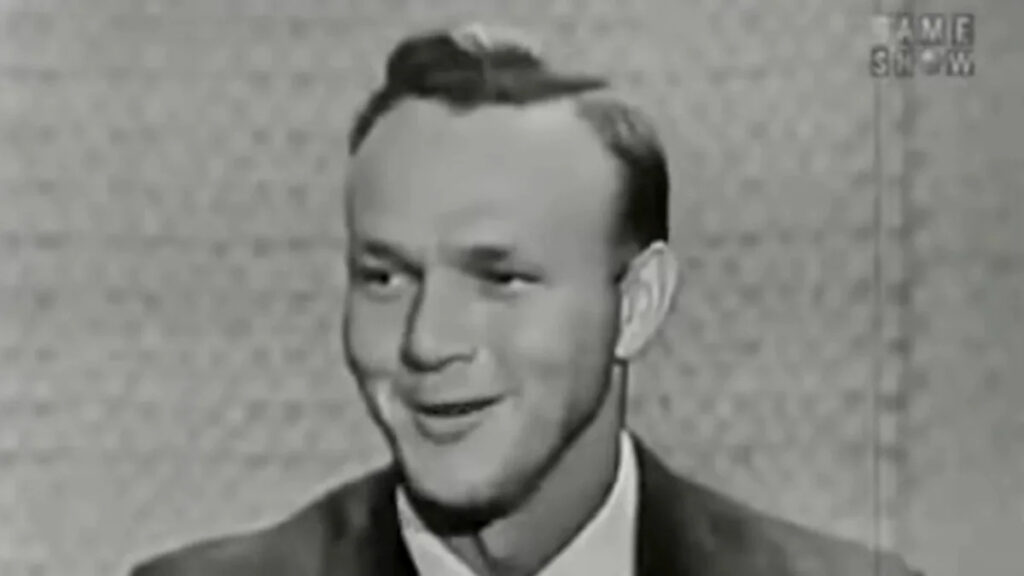
The other day David sent me a black-and-white CBS clip from 1960, with Arnold Palmer in a suit and tie appearing on “What’s My Line?” The premise of the game show was that a contestant came on and four panelists asked a series of yes-or-no questions in an attempt to figure out the contestant’s line of work. If a panelist got a yes, the questioning continued. (Our home version of this show was a dinner-table game called 20 Questions. My brother is a lawyer and I’m a reporter, and this suppertime activity maybe greased the skids to our adult lives.) In fairness to the show’s standards, I should point out that the “What’s My Line?” host, a dignified gent in a bow tie named John Charles Daly, introduced Palmer with a pseudonym, Mr. X. Still, the panelists could see him, plain as day. Nobody recognized him.

Knowing a little about Arnold’s life and times, I guessed his visit to the show came early in 1960, because in April that year he won the Masters and in June he won the U.S. Open — the National Open, as Americans called it then. I figured after those two wins Palmer’s map-of-Pennsylvania forehead, to say nothing of his foghorn voice, would be too well known to be a legitimate “What’s My Line” contestant.

But no. Palmer’s appearance was shot in August of 1960, after all four majors had been played. It was the year the modern professional grand slam became a thing. (When Bob Jones won the Grand Slam in 1930, the Grand Slam comprised the U.S. and British Opens and the U.S. and British Amateurs.) Arnold, in his 1999 biography and in other places, claimed credit for this new concept but I’m dubious. After a deep-dive of Newspapers.com a few years ago, I found that the Pittsburgh sportswriter Bob Drum used it in print on June 10, 1960, in the Pittsburgh Press. Drum spells it out, this new, pro-centric definition of the Grand Slam, the Masters, the National Open, the British Open and the PGA, won in the same year. In Arnold’s telling, he pitched the notion to Drum at 30,000 feet, as they flew to St. Andrews for the Open in early July, after Palmer had already bagged the first two majors. There’s some haze in that origin story.

Anyway, Arnold finished second at St. Andrews, and seventh at the PGA Championship, played that year at the end of July. In early August he won the Hartford stop and on that Sunday night flew down to New York City and to the CBS studio and wrote his name on a chalkboard as X.

Advertisement

Arnold Palmer, American golf’s leading money-winner, earned $80,968 in tournament play in 1960, along with a spot on “What’s My Line?” (On the show, Palmer’s two 1960 majors are cited in order of importance, not chronology: National Open first, Masters second.) When Palmer died in 2016, his estate had an estimated value of $875 million. His appearance on this popular, oh-so-civilized TV show, when he was on the verge of 31, had something to do with the immense fortune he gathered. If you watch the clip, you’ll see a person of spectacular natural modesty, along with distinct openness, honesty and a rugged, everyman charm. America liked him. America liked him!

“Have you distinguished yourself in sports?” asks a panelist, the publisher Bennett Cerf.

“You might say that,” Palmer responds, without a hint of snark.

Palmer offers one answer that I imagine he would have responded to differently, had the same question been posed to him years later. I sent the clip to Arnold’s eldest daughter, Peg Palmer, and asked her the same thing: Was there one answer that her father gave in 1960 that doesn’t ring quite right all these years later? Peg immediately identified the same response that I had checked off.

Advertisement

In the spirit of game-show fun, you are welcome to send me an email with your candidate — the response for which Arnold Palmer might want a mulligan — and I’ll send you back a wee e-thing of no particular value.

(Some unnecessary pseudo-legalistic game-show language to make this feel like more of a real thing: Prizes are not transferable, not redeemable for cash, not exchangeable, not yada-yada-yada.)

These random five minutes of network TV from 1960 are amazing. They show the upheaval in American popular culture over the past 66 years, to say nothing of the radical changes in our nation’s sporting life and our concept of celebrity, as well as matters related to manners and standards and decency. Nobody’s screaming in these five minutes, in this time-capsule from August 1960. How on brand: it’s the 11th year of the 1950s, after all, a sleepy and mannerly decade that went on for almost 14 years.

Advertisement

I’m not dismissing progress. Broadly, the world’s a far better place now, despite everything on the front page of your morning paper. This ease of connection — David to me to Peg for one thing — is a kind of miracle of technology. The actual clip, now in circulation, serves up an instant and delightful history lesson. How cool is that? When did that ever happen before?

Enjoy the show and a few random things before I sign off here:

*JJ Grey & Mofro has a gig coming up in Pass Christian, Miss., later this month.

*I haven’t learned what Mofro means but I imagine the internet knows that, too.

Advertisement

*Bennett Cerf identified Mr. X as Arnold Palmer in six questions.

*The touring pro Miller Barber became known on Tour as Mr. X about a decade later.

*The touring pro Jim Thorpe, on the scene a decade after Miller Barber’s prime, went by MoFo.

I could maybe tell you why but not in this space and not even by email. Decency standards are always changing but they’re still a thing.

Michael Bamberger welcomes your comments — and your answer to the Arnold Palmer mulligan response — at [email protected].

The post This old Arnold Palmer clip offers a delightful history lesson appeared first on Golf.

Read the full article here

Leave A Reply

2026 © Prices.com LLC. All Rights Reserved.