




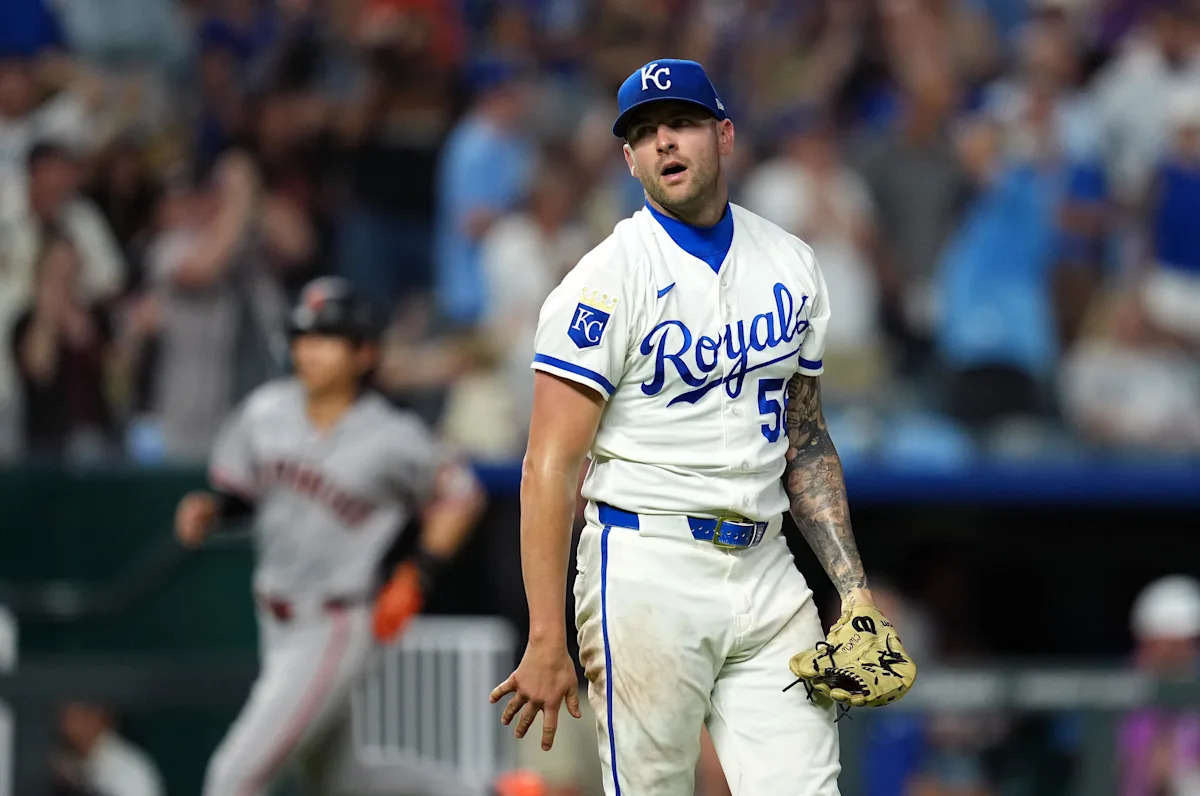
Monday evening, Royals fans rose to their feet in anticipation of Alex Lange recording the final out to seal a win over the Giants. Instead, Wily Adames deposited a sinker over the right field fence for a two-run home run to tie the game. The Royals rallied to win in the bottom of the inning, but it was the second time in a week Lange had been just one out away from victory only to cough up the lead (hey, he got the “win” Monday, reliever wins are awesome!)
In fairness to Lange, he wasn’t supposed to be the closer this year. The Kansas City native is returning from injury and was signed on a cheap deal hoping he could recapture the stuff that allowed him to rack up 26 saves for the Tigers in 2023. The closer was supposed to be Carlos Estévez, but it was clear after one awful game his arm and velocity down. He gave up six runs in his season debut, and was shut down and hasn’t been seen in a Royals uniform since. Lucas Erceg was supposed to be a solid setup man and potential closer-in-waiting, but he has hit a wall. He has given up 31 hits and 20 runs in his last 22 innings, with the second-worst strikeout-to-walk ratio in baseball over that time. The acquisition of 2024 All-Star reliever Matt Strahm was viewed as a shrewd move, but he has been extremely home run-prone, and his 7.24 ERA is second-worst among qualified relievers.
Advertisement
The Royals have gotten some solid performances by Daniel Lynch IV and John Schreiber, and some glimpses of solid pitching from Steven Cruz and Beck Way, but otherwise the bullpen has been quite terrible overall. Their 5.43 bullpen ERA is behind only the Athletics for worst in baseball, with the worst FIP (5.33), second-lowest strikeout rate (19 percent) and third-highest walk rate (11.5 percent). Only three teams in baseball have more blown saves than the 18 the Royals have, with Erceg tied for the league lead with six, and they have the fourth-highest inherited runners scored rate (36 percent).
In fact, this may be the worst bullpen in Royals history. So far, Royals relievers have an ERA of 5.43, fourth-worst in club history behind only the bullpens of the late 90s and early 2000s when offense was sky-high. 5.17
You could argue that perhaps this year’s bullpen is inflated a bit by Tyler Tolbert, the position player who has made five pitching appearances this year and has given up 13 runs. But even if you take him out, Royals relievers have a 5.17 ERA, still among the worst of the worst.
The problem isn’t that Picollo has ignored the bullpen. Quite the opposite. Few areas of the roster have received more attention. He has spent free-agent dollars, traded prospects, and repeatedly churned through veteran relievers in an effort to stabilize the back end of games. The issue is that, outside of a handful of successes, those investments have too often failed to produce lasting results.
Advertisement
In 2024 he spent $15 million to acquire Chris Stratton, Will Smith, and Nick Anderson, and they combined for a 5.45 ERA in 135.1 innings (he also acquired Schreiber, who had a solid 3.66 ERA that year). He pivoted mid-season to acquire Lucas Erceg – who as great! – and Hunter Harvey – who was injured! – to give the Royals a decent bullpen for the post-season.
Picollo invested in a two-year, $22 million deal for Estévez the next year, and he was an All-Star as the Royals finished with a 3.63 ERA from their relievers, seventh-best in baseball. Erceg was nails, Schreiber continued to be solid, and the Royals had promising performances from Lynch, Angel Zerpa, Steven Cruz, and Jonathan Bowlan.
But things fell apart this year. While injuries can hurt any club, the lack of organizational pitching depth has stuck out like a sore thumb. The Royals have cycled in 19 different relievers this year, and have been signing any veteran reliever that is available in an attempt to find a formula that works.
The repeated need to overhaul the bullpen raises a larger question. Why do organizations like Cleveland, Milwaukee, and Tampa Bay consistently build effective bullpens from inexpensive, internally developed arms, while the Royals keep returning to free agency and the trade market looking for answers? Bullpen performance is notoriously volatile from year to year, and even the best executives have free-agent signings or trade acquisitions that don’t pan out. But what separates the league’s best organizations is their ability to continually replenish their relief corps. When a reliever departs in free agency, gets hurt, or regresses, those clubs seem to have another hard-throwing right-hander or overlooked waiver claim ready to step into a high-leverage role.
Advertisement
The Royals have spent considerable resources to patch up the bullpen the last few years, with mixed results at best. Every dollar spent on veteran relievers is a dollar that can’t be spent addressing the lineup or rotation, and every prospect traded for bullpen help is one that can’t be used to acquire talent elsewhere. For a team operating with financial limitations, repeatedly investing significant resources into one of baseball’s most volatile assets is a risky strategy.
Whether that reflects shortcomings in scouting, player development, pitching infrastructure, or simple misfortune is open to debate. But after four years of cycling through free-agent signings, trade acquisitions, and bullpen overhauls, it is fair to ask whether bullpen construction has become J.J. Picollo’s biggest weakness as a general manager.
Read the full article here


