




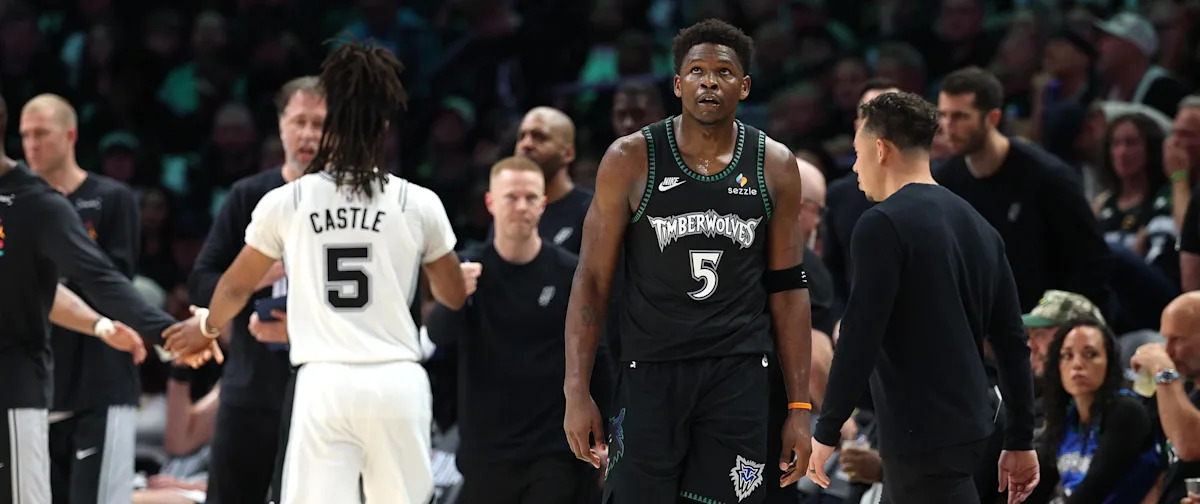
In Game 6 of their Western Conference Semifinals series against the San Antonio Spurs, the Minnesota Timberwolves season came to a thudding end as they were blown out for a third time in the series, 139-109.
In retrospect, the Timberwolves were likely dead on arrival coming into the series. The Spurs showed they were the better team. They did so in the regular season when they won 13 more games, and again during this playoff series when Victor Wembanyama proved to be a perfect counter for many of the Timberwolves’ offensive strengths.
Advertisement
The injuries to Anthony Edwards and Donte DiVincenzo in the previous round made the already tall task of upsetting the Spurs even more unlikely. In some ways, the Timberwolves did well to drag the series to a sixth game despite being outscored by a total of 97 points.
Losing to this Spurs team, by itself, should not be met with ridicule, but regardless of the factors working against them, the Timberwolves’ performance in this series was indicative of a team not well enough equipped to win four straight playoff rounds.
The Spurs are the ultimate bad matchup. That might be true for every team in the NBA, but it is certainly true for the Timberwolves, whose frontcourt lacked the shooting and offensive playmaking to pull Wembanyama away from the rim.
The truth about the NBA Playoffs is that pretty much every team will eventually come up against a team that is a bad matchup for them. Many good and even great teams have been taken out by a team that just had their number (the Denver Nuggets being a good example).
Advertisement
Championship-caliber teams, though, find a solution to every different problem thrown their way. When an opponent pokes at a weakness, they systematically find either a counter to what the other team is doing or a way to mitigate that vulnerability.
The ability to read and react to every different type of situation isn’t something that can be found during the Playoffs; it’s a skill that is cultivated during the regular season so that it becomes ingrained into the DNA of the team.
The Timberwolves never gave themselves the chance to build the necessary habits needed to win four straight playoff series. By their own admission, they did not take the regular season seriously and waited for things to change once the postseason rolled around.
While the Timberwolves’ season officially ended Friday night at Target Center, their pursuit of a championship in many ways ended months earlier. There were numerous times throughout the regular season that the Timberwolves hit rock bottom and called themselves out, only for the same issues to reappear weeks or months later.
Advertisement
“Do we care?” That was the question Rudy Gobert posed after a 24-point drubbing at the hands of a 16-19 Atlanta Hawks team on New Year’s Eve. That game came just four days after a 16-point loss to the Brooklyn Nets, who finished the season with the third-worst record in the NBA.
“Do we care?” Gobert repeated. “Does something happen when we like we played the first quarter tonight? Or is it just cool? Make a lot of money, we play basketball, do what we do, and go home and be happy. I think that’s the fine line between a team that’s playing for a championship and a team that’s full of talent but doesn’t accomplish shit.”
For most of the regular season, the Timberwolves acted like things were just cool. They had some solid games throughout the season, but they were almost always followed by an equally poor performance. At no point did they look like a championship-caliber team.
The Timberwolves did win six of their next seven games following the loss in Atlanta, but immediately lost five straight after that, including a pair of baffling losses to the tanking Utah Jazz and Chicago Bulls. The trend continued after the All-Star Break when the Wolves won five straight games before losing three straight by a combined 66 points in early March.
Advertisement
Following the season-ending loss, Edwards made it clear he understands what will be needed in future seasons: “You’re supposed to build championship habits or playoff habits during the regular season.” When asked if his team did that, Edwards responded, “No, we didn’t build the habits during the regular season.”
Pretty much every member of the Timberwolves roster felt similar to Edwards about the team’s lack of consistency during the regular season.
“The habits that we’ve built throughout a season, they matter so much,” Mike Conley explained. “It shows up when you need it most, when you need to make that extra play with two seconds left in the game or to go crash for the rebound, even when you’re tired, or getting back on defense, spacing the floor for your teammates, sacrifice runs, all that stuff. It’s something that you just don’t flip a switch for. It’s something that you have or want to do from training camp on, and it just becomes a part of you.”
Advertisement
Gobert felt similar to Conley, saying, “I just think that the habits that we build from day one of training camp, we carry over until the last day of the playoffs. I think when we decide who we want to be and we apply that every day, we get rewarded.”
Jaden McDaniels said, “Being consistent in our habits and what we do” was the lesson to be learned from the regular season. Naz Reid echoed that sentiment when asked about the team taking the next step, saying, “Probably consistency, just being able to be that team where you know we made waves, we were dominant.”
One voice that was notably absent was that of Julius Randle, who did not speak to the media following Game 6 and did not participate in exit interviews with the media the next day. Randle was the only member of the Timberwolves’ extended rotation who did not speak to the media after the conclusion of the season.
The Timberwolves as a franchise have accomplished more in the playoffs over the past three seasons than they did in the previous 34 years combined. They have also been a clear step behind the best team or two in the league over those three seasons.
Advertisement
Winning a championship is not the only barometer for success in the NBA, but it has been a stated goal of this Timberwolves franchise. With a player of Edwards’ caliber on the roster, how could it not?
Both the Spurs and the Oklahoma City Thunder both appear primed to dominate the Western Conference for years to come, putting the Timberwolves feel to be on much shakier ground than they have been in recent memory.
Regardless of the offseason moves that are sure to come in the next few months, the journey toward winning a championship for the Timberwolves begins with the start of training camp next fall. They can no longer get bored with the regular by December or rely on “flipping the switch.”
The team and their best players have said all the right things, but their actions during the 2026-27 regular season will tell the real story about whether or not the Timberwolves are actually serious about chasing their ultimate goal.
Read the full article here


