




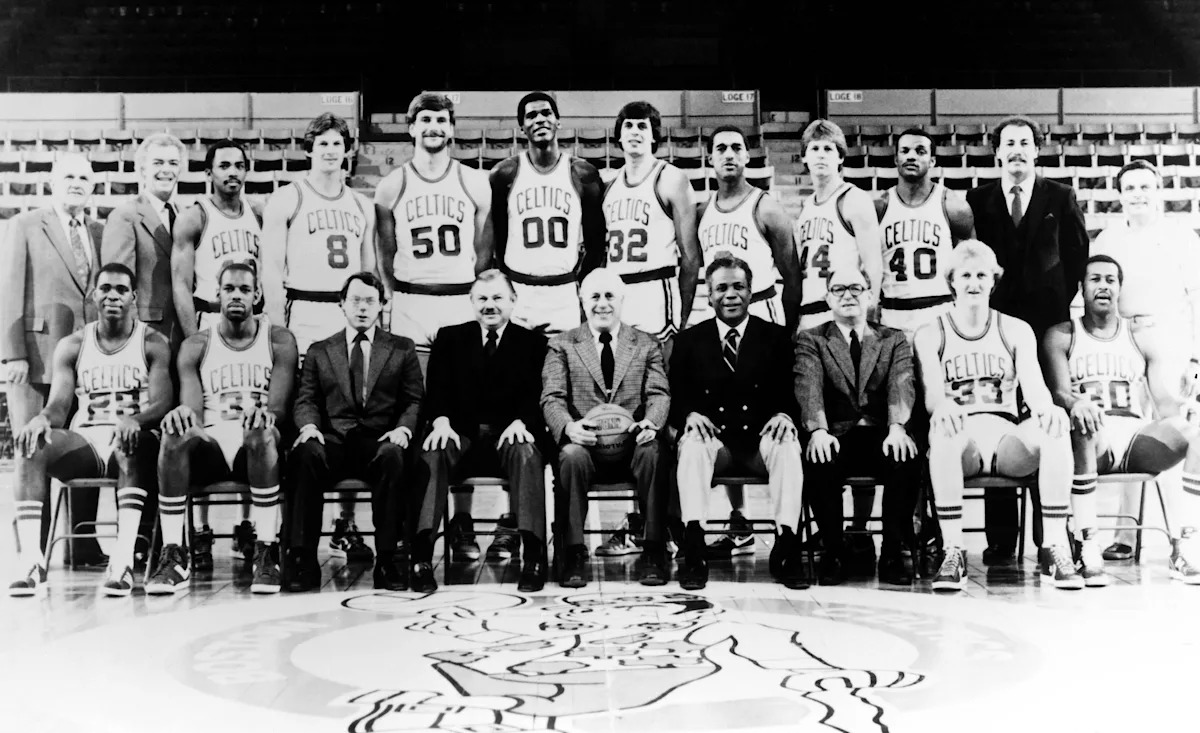
My dad was born a few years before the Boston Celtics, in 1943, and he grew up playing basketball in the small town of Forestburg, South Dakota.
His parents had traveled with his father’s construction crew in his early years, but settled down near the farm where his mother grew up when he reached school age.
Advertisement
He was a point guard for the Forestburg Buccaneers, who were coached by Quentin C. Miles, a legend in South Dakota basketball circles. Born in 1921, Q.C. grew up playing the game when there was still a jump ball after every made basket. Miles, who also taught physics and chemistry, coached Forestburg into the state’s B tournament in 1958, where my dad saw limited action as a freshman.
Dad watched basketball on TV whenever he had the chance, and that’s how he became a Celtics fan. They were televised fairly often, and dad wanted to play like Bob Cousy.
Life, of course, intervened. Dad went to Augustana College in Sioux Falls, where he took a degree in mathematics and then a Master’s in the same subject from the University of North Dakota—at the same time that a very young Phil Jackson was tearing up the hardwood there under the direction of Bill Fitch and Jimmy Rodgers.
He spent a year teaching at Minot State before being drafted into the Army. He spent three and a half years in Arlington, Virginia, where he met my mom, before returning to Minot State.
Advertisement
Things didn’t work out in Minot, and my dad ended up looking for work back home in South Dakota. He would later joke that the typical response at job interviews to his Master’s in math was, “so you’re an accountant…?”
He eventually landed a gig with the state doing budget projections and data analysis for the Department of Social Services, and proceeded to raise a family of six kids in a white ranch style house with black trim near an elementary school on the east side of Pierre.
Mostly he was home every night a little bit after 5:00. There were occasions when he’d have to work after hours, and sometimes we’d get to go to the office and see where he worked on those weekends or evenings.
But, again, mostly his job was a 40-hour a week undertaking that left him plenty of time for the rest of us.
Advertisement
I only remember one or two business trips from those years, and the one that stands out came in January of 1984, when he had to go to Kansas City, Missouri.
He and some of his staff were put up at the Adam’s Mark near the Truman Sports Complex, a once luxurious hotel that’s fallen on hard times. It’s been fixed up for the World Cup, and the hope is that it will be the center of a mixed use development in the future, but in 1984, it was a top of the line facility.
And on Tuesday, January 17, of that year, dad and one of his work buddies traveled into Kansas City to watch the Kings play the Celtics.
The Kings were just about at the end of their run in Kansas City. These Kings were a vagabond team, starting off as the Rochester Royals before moving to Cincinnati, and then into a situation where they split time between Kansas City and Omaha and carried an awkward designation using both cities. The Kings dropped Omaha from their name after three years, although they did continue to play the occasional game there.
Advertisement
The Kings would move to Sacramento a little over a year after my dad saw them play. When they moved, I remember him saying that he wasn’t surprised because there were plenty of empty seats when he was there. In Sacramento, the Kings spent two years playing in a refurbished warehouse while waiting for a permanent home.
While in Kansas City, the Kings played at the Kemper Arena, a dimly lit venue with a bit of an old-school vibe to it, featuring a steep upper deck that provided good sightlines at the expense of leaving fans feeling like they perhaps needed sherpas to assist them in finding their seats.
The arena opened in 1974 on the former site of the Kansas City Stockyards. It was named after Rufus Crosby Kemper, Sr., a member of a wealthy banking family who donated $3.2 million to the construction of the $22 million arena.
Exterior view of the Crosby Kemper Arena (now Hy-Vee Arena) in Kansas City, Missouri, September 8th 1975. (Photo by UPI/Bettmann Archive/Getty Images) | Getty Images
From the exterior, the arena is dominated by three huge structural assemblies that carry the roof; there were no windows to speak of in 1984, and no principal entry point, just four facades covered in white steel panels. There were luxury suites on the concourse level, a relative novelty for the time, and a total capacity of 16,659 for basketball.
Advertisement
Its roof collapsed in 1979, and it hosted the NCAA’s Final Four championship round in 1988; the winner, Kansas, was effectively the home team, hailing from Lawrence, not even an hour down the turnpike from the arena.
What is now the Hy-Vee Arena is listed on the National Register of Historic Places, being the first major U.S. commission for noted architect Helmut Jahn. It’s currently a multipurpose facility that targets youth sports. The arena has basically been split in half, with a floor added between the upper and lower decks creating two arenas stacked on top of each other.
But for one night in 1984, it was the place where my dad got to see Larry Bird play.
It was cold out, and dark, with temps in the teens and a light snow falling as my dad and 11,477 other fans trekked into the West Bottoms neighborhood off I-670 where the Kings played, just about a stone’s throw from the Kansas state line.
Advertisement
The Celtics were coached by KC Jones—his first year in that role—and the Kings were coached by Cotton Fitzsimmons, a Hall-of-Famer whose best years were coming up in a second stint coaching the Phoenix Suns. Cotton was in his last year with the Kings, with whom he managed to eke out a slightly better than .500 winning percentage over a six-year run—and this was no mean feat, by the way, as just five of the Kings’ 32 coaches have winning records.
The Kings were led by Eddie Johnson, Larry Drew and Mike Woodson (now an assistant coach with Sacramento), and were on their way to a 38-44 record.
The Celtics… well, the Celtics were on their way to another championship and another banner.
Boston was wrapping up a three-game road trip. They had just suffered their worst loss of the season, a 106-87 drubbing at the hands of the Milwaukee Bucks, on Sunday. In that game, Bird hit just three shots on thirteen attempts.
Advertisement
Kansas City was coming off a win against the hapless San Diego Clippers, who were themselves just about to relocate to Los Angeles.
My dad had been watching the Celtics play on TV for more than half his life by this point in time, and he was finally going to get to see them in person.
They did not disappoint.
Larry Bird hit 15 of 21 shots and finished with 38 points, nine rebounds and thirteen assists, while Dennis Johnson, Robert Parish and Kevin McHale finished with 20 points apiece. As a team, the Celtics shot 59%.
They shot 67% in the first quarter and established their final nine-point margin of victory by the close of that quarter.
Advertisement
To their credit, Kansas City kept Boston honest despite enduring a poor shooting night from the team’s stars, Eddie Johnson and Larry Drew (a combined 11-32 from the field). On the offensive end of things, they were led by reserve center Lasalle Thompson and Mike Woodson, who finished the game with 21 and 18 points, respectively.
The Kings made things interesting early in the fourth quarter, clawing their way back from a sixteen-point deficit to draw nearly even with the Celtics, 95-94, with just under nine minutes left in the game.
The Celtics responded with a 20-9 run.
Bird, McHale and Parish accounted for fifteen of those twenty points.
Advertisement
Bird was at the peak of his abilities in 1984, the first of three consecutive years in which he would win the league’s MVP award, and he was the unquestioned star of a game that featured four future Hall-of-Famers.
After the game, Kings rookie Dane Suttle said, “He lets people see what they came to see.”
For a kid from Forestburg, this was certainly true.
P.S. If you want to see a great photo from that game, click here. We don’t have the rights to this photo, but I can still share it from my Newspapers.com account.
Read the full article here


