




Rory McIlroy isn’t an NFL fan. The five-time major champion can watch cricket for days, but the Seahawks’ Super Bowl win over the Patriots didn’t exactly capture his attention. While McIlroy isn’t among the masses yearning for a Week 4 game between the 49ers and Rams, one part of the NFL does speak to him — how it keeps its fans hooked 24/7/365.
“It’s a short season and then once it goes away, people miss it. From a marketing perspective, it’s genius, right?” McIlroy said of the NFL at Pebble Beach. “They drip-feed things. It’s the Combine, then it’s the draft, then it’s preseason. It’s like OK, the season is short, but they drip-feed just enough to keep you really interested the whole way through the year. As we as golfers are contemplating going to more of that scarcity model, there’s certainly a lot to be learned from the NFL from that standpoint.”
Advertisement
Look at your phone for 10 seconds (we’ll wait) and you’ll understand what McIlroy is talking about.
The NFL hasn’t played a down in six weeks, and yet, it is always topic 1A in the sports world. It’s omnipresent. Every month is something new. Right now, it’s the nullified Maxx Crosby trade. A week ago, it was Kenyon Sadiq’s 40 time. Next month it’ll be about how the Chiefs have bolstered the roster around Patrick Mahomes via the draft. Then it’s OTAs, minicamp, training camp, the preseason and the real games are back. It doesn’t stop. The NFL always has something for its rabid fan base.
The “scarcity” model being discussed by new PGA Tour CEO Brian Rolapp and others is less about cutting tournaments and more about heightening the importance of every event on the PGA Tour, creating space to keep fans wanting more while ensuring no inventory is wasted. Pro golf needs a “drip-feed” of its own, in a sense, to be able to play in the same pool as the other non-NFL sports vying for our attention. For that to happen, fans need something to talk about and look forward to. Those things have to have meaning.
Rolapp, who cut his teeth at the NFL and served as executive vice president under commissioner Roger Goodell, plans to bring a little bit of The Shield to the PGA Tour, using the lessons and expertise he learned at 345 Park Avenue to grow the popularity and profitability of pro golf.
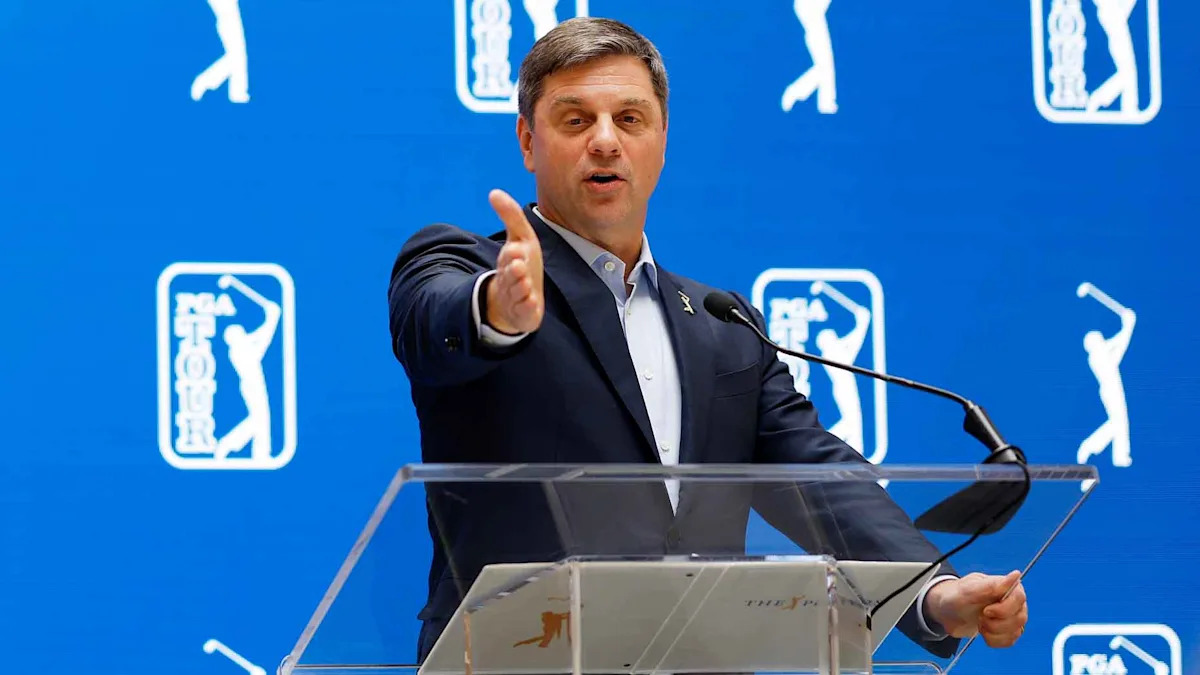
Those lessons were on display Wednesday at PGA Tour headquarters, when Rolapp gave his much-anticipated state of the PGA Tour address ahead of the Players Championship. After months of talk about a re-worked PGA Tour schedule and the potential for seismic changes to the competitive structure, Rolapp’s address was this week’s headliner at the PGA Tour’s flagship event.
Advertisement
But there were no concrete details about Rolapp’s vision, which is being aided by Tiger Woods and the Future Competitions Committee. Instead, Rolapp described six themes for the new PGA Tour, gave a broad overview of each and then explained that he would hold another press conference this summer at the Travelers Championship after further discussions and a board meeting.
“I can’t emphasize this enough; nothing has been finalized,” Rolapp said. “We are still doing our work and gathering input from our players, our partners, and other key stakeholders. No recommendations have gone to our player-led boards. Looking ahead, we expect to make more meaningful progress by this summer. … Once decisions have been made and finalized, changes will be implemented through a rolling approach.”
Drip. Drip. Drip.
Rolapp’s vision, as he outlined Wednesday, should excite fans. The top level of the PGA Tour will have 21 to 26 events, including majors and the Ryder Cup, and will be held from late January through September in Ryder Cup years. Fields will have 120 players, and there will be a cut. The Tour wants to start with a big, primetime event on the West Coast (probably Pebble Beach) and get into more big markets (New York, Chicago, Boston, etc.). There will be a promotion and relegation system and the postseason will be elevated in a way that allows the PGA Tour season to tell a cohesive story about the importance of each event and create “win-or-go-home moments.” Match play is on the table for the playoffs.
All this is designed to help the PGA Tour be in a position to compete for the non-NFL slice of the sports media pie when rights negotiations begin. There have been rumors that the NFL might look to get out of its current media deal to re-negotiate a bigger one. If true, that only enhances the urgency for Rolapp to create something others want a part of.
Advertisement
“If you start doing that math and you’re anyone other than the National Football League, you start to ask yourself the questions: Next time I go to the media market, how do I make sure I have the most compelling product for fans and for our media partners so that we can compete in what is a very complicated media ecosystem that’s changing all the time,” Rolapp said. “You see fans are changing their habits, television versus streaming. You see the companies and the economics of the media industry changing. If you are in the sports business, it behooves you to put your house in order as much as possible.”
What does an in-order house look like for the PGA Tour? Those details will come later, but Rolapp gave everyone enough meat to chew on for a few months. That’ll drive conversation and interest ahead of his next address.
Grabbing and keeping attention is Priority A, B and C in today’s screen-obsessed world. It’s something golf has to address. It can’t dominate the news cycle year-round like the NFL, but perhaps it can get to a point where, from January through September, there is a monthly tournament with defined stakes that creates a season that holds attention and builds to a crescendo before the NFL kicks off.
The NFL knows its fans want to consume it year-round, even though the season runs for only a third of the year. It created a structure that keeps it at the front of the sports consciousness with a steady IV of tentpoles that even catch the attention of fringe fans, like McIlroy.
Advertisement
“The sports business is not that hard; just think like a fan, and nine and a half times out of ten, that’s probably the right answer,” Rolapp said.
Professional golf has been trying to find (or overlooking) those answers for quite some time. But as Rolapp is already demonstrating, reinventing the wheel isn’t necessary. Perhaps all they have to do is copy off a test the NFL has already aced.
The post The latest PGA Tour-NFL theft is an old-school strategy appeared first on Golf.
Read the full article here


