





Suddenly, Micah Parsons grabbed for his left knee.
A wave of shock coursed through his mind and body.
It was Dec. 14, and the Green Bay Packers pass rusher was raring toward Denver Broncos quarterback Bo Nix. But tests would soon reveal a torn ACL.
Advertisement
For the first time across five pro seasons and two college campaigns, Parsons was facing a season-ending injury and the grueling rehabilitation process that would follow. Fear, denial and fruitless attempts to make sense of what lay ahead swirled in his mind.
“You’re just kind of in shock, like, ‘Oh wow, am I hurt for real? What’s going on?’” Parsons told Yahoo Sports by phone this week. “Maybe you get another emotion of like, ‘Oh wow, that’s not that bad.’
“And then here comes the surgery. Here comes the surgery part, and then that’s when it gets real.”
When players like Parsons initially sustain season-ending injuries, they often receive support, encouragement and a slew of messages in the initial hours. But as days, weeks, months and sometimes years elapse in their recovery journey, feelings of isolation hit even the best-supported, NFL players, coaches and executives say. Fear grips them.
Advertisement
“The fear of failure, the fear of letdown,” Parsons said. “In an instant moment, everything’s gone. And sometimes people don’t know how to get back.”
Parsons is far from the only player fighting this battle. While injury severity and recovery timelines vary, 560 NFL players were designated for injured reserve during the 2025 season, per a source with access to the data.
The NFL has long outlined meticulous plans for players’ physical rehabilitation from injury. But club, league, union leaders are increasingly emphasizing the need to plan for the psychological toll of rehabilitation, too. They say strategizing how players will compensate for lost routine and connection with healthy teammates can carry players through the most difficult portions of rehabilitation.
Washington Commanders head coach Dan Quinn has witnessed the importance of checking in with players early in their recovery processes.
Advertisement
“When it’s getting closer, that’s easier, because then there’s something close to back to returning to play,” Quinn said last week at the NFL scouting combine. “When it’s the initial start of it, and knowing, ‘I’m staring at six weeks, eight weeks, the entire season’?
“Those are harder conversations, and you just want to make sure they’re checking in.”
Team, league and union officials have worked in recent years to create year-round mental health programs that ensure resources are available and apparent long before they’re urgent. But no structure can eliminate the chance of tragedy. And days before the combine, tragedy struck.
Rondale Moore was drafted by the Cardinals in 2021 and played for the Falcons and Vikings before his death in February. (Jayne Kamin-Oncea-Imagn Images)
(IMAGN IMAGES via Reuters Connect / Reuters)
Former NFL receiver Rondale Moore, the Arizona Cardinals’ 2021 second-round draft pick, died of a suspected self-inflicted gunshot wound on Feb. 21, police in his New Albany, Indiana, hometown told the Associated Press. He was 25 years old. The death of Moore, whom the Atlanta Falcons signed in 2024 and the Minnesota Vikings signed in 2025, cannot be explained nor pinned to any single factor. But preseason knee injuries each of the last two seasons sidelined Moore consecutive years. Knowing the isolation players often feel during rehabilitation, and seeing information about Moore’s death, leaders across league circles responded to the news with conversations about the mental health challenges that heighten during times of injury.
Advertisement
“I’m not jumping to conclusions, but let me say this. Fans and media be quick to label a player ‘injury prone’ [when] we don’t choose to get hurt,” veteran safety Jamal Adams, who has been placed on injured reserve four different seasons, posted after Moore’s death. “Y’all don’t see the rehab, the pain, the mental drain it causes. The process can make you lose yourself.
“This s*** is real. No matter how support you get, you still gotta fight that battle alone.”
San Francisco 49ers general manager John Lynch said the recent deaths by apparent suicide of Moore and Dallas Cowboys defensive lineman Marshawn Kneeland (who was not on injured reserve) “makes you communicate with everyone in your organization about our opportunity to affect these young men in a positive way and to help them through things, struggles.”
Advertisement
Discussions regarding mental wellness have taken place between the league and union as recently as last week’s combine, a league source confirmed to Yahoo Sports.
Joint initiatives between the two governing bodies, as well as programs at the team level, have expanded the availability of mental health resources for players healthy and injured alike. And yet, coaches and executives say, the league still needs and probably always will need more conversations.
“Do I always do enough? I don’t know if I always do enough, I honestly don’t,” Cincinnati Bengals head coach Zac Taylor said at the combine. “And you hear players that have gone through a significant injury that, when you were there for them, or someone was there for them, they’re always very loud, [saying] ‘I appreciated that. That really helped me through the process,’ and that always resonates with me.
“That’s a tough, tough topic that we got to continue to be better at.”
Advertisement
Cleveland Browns general manager Andrew Berry said ensuring players receive professional psychological resources during rehabilitation “is a real factor” in supporting them.
“I do think that as a league that we can do a better job resourcing clubs to make sure that we have that touchpoint …” Berry said, “and I do think it’s something that we can be a lot more aware of.”
How are NFL teams currently supporting players’ mental health?
In a league with thousands of players and thousands more staff members, no single regiment or resource will best serve every member of the NFL community.
But in May 2019, the league and union expanded their formal commitment to mental health support. The NFL and NFLPA began jointly mandating that every club retain a licensed and experienced mental health clinician on-site. The clinician must be available to players at least twice weekly, for a total of eight to 12 hours each week, during training camp, preseason, regular season and (when teams advance) the postseason, according to the language written into the collective bargaining agreement (CBA). Clinicians must conduct at least two mental health education programs for all players and coaches each year, as well as voluntary sessions for league parents and significant others.
Advertisement
“We have to put an incredible amount of resources from a player wellness standpoint, which we do,” Detroit Lions general manager Brad Holmes said last week. “I don’t want to speak for the rest of the league but I know just being here at the combine and all the boards that I’m on, that’s always a major topic.”
The CBA explicitly outlines a commitment to supporting injured players’ mental health even when they’re unable to compete.
Team clinicians must, at players’ request, be available to meet with players designated for injured reserve or the physically unable to perform list “as soon as is reasonably possible in order to assess the need for any behavioral health interviews relevant to the Player’s IR or PUP status,” Section 19 of the CBA says.
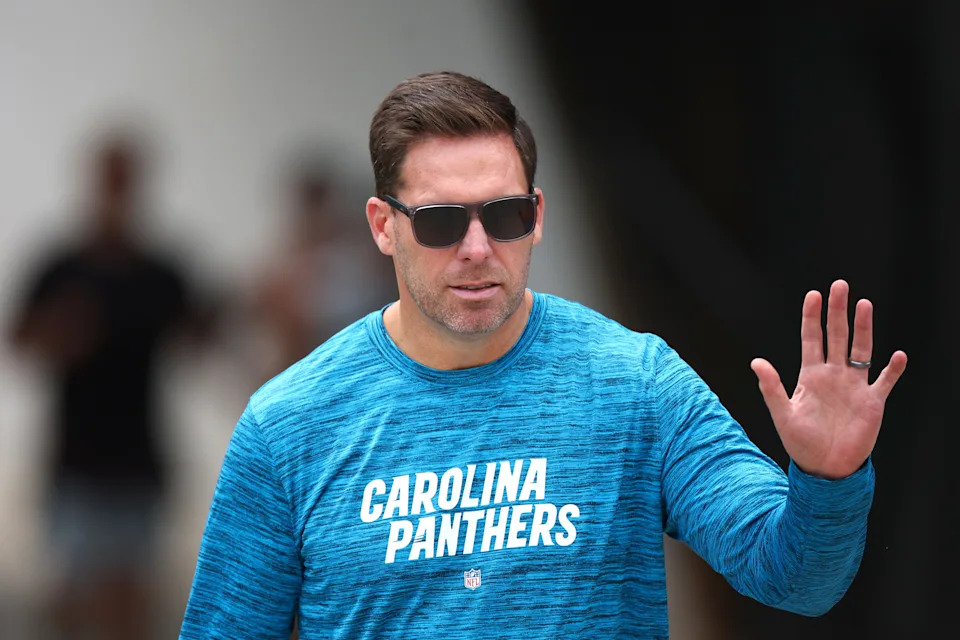
Panthers general manager Dan Morgan on the injuries he suffered while playing in the NFL: “I went through a lot of injuries as a player [and] it’s not easy,” Morgan said. “You feel alone at times. You feel like people kind of abandon you a little bit. But at the same time, that’s the advantage I have being the GM of the Panthers to where I can help these guys out.” (Photo by Jared C. Tilton/Getty Images)
(Jared C. Tilton via Getty Images)
Players who do not feel comfortable meeting with team-employed clinicians also have access to the NFLPA clinician directory, which includes more than 150 clinicians across the 30 NFL team cities, a union spokesperson said.
Advertisement
And injured players often hear from members of the NFLPA’s wellness team, who reached out to players on injured reserve 683 times last season as part of the Player Association Injured Reserve (PAIR) program, a union spokesperson told Yahoo Sports. The union has also mailed recovery materials and connected injured players with each other in recent years via the PAIR program, which was established in 2016.
Infrastructure and resources can help. They also don’t fully erode the distance injured players feel from their still-active peers.
Carolina Panthers general manager Dan Morgan, who landed on injured reserve during three different seasons while playing in the early 2000s, integrates his experience into how he supports his injured players.
“I went through a lot of injuries as a player [and] it’s not easy,” Morgan said at the combine. “You feel alone at times. You feel like people kind of abandon you a little bit. But at the same time, that’s the advantage I have being the GM of the Panthers to where I can help these guys out. I understand what they’re going through. I’m here for them. And then obviously, there are always going to be new sources.”
Advertisement
In addition to clinical resources, teams are increasingly considering how to maintain team camaraderie with injured players.
Some players prefer to undergo surgery and/or rehabilitation away from their team city in order to be near a specialist whom they trust or family members to help when they’re literally unable to stand, walk and at times — as Parsons experienced — use the bathroom on their own.
But team leaders overwhelmingly encourage players to rehabilitate at team headquarters in order to more easily facilitate formal and informal check-ins with coaches and teammates. Some clubs intentionally schedule injured players to rehabilitate on a side field during practice so injured players feel like they’re still part of a unified team, an NFC assistant told Yahoo Sports. An AFC assistant said they direct their healthy players’ attention to injured teammates sweating from exertion within sight to motivate healthy players to give full effort. And many teams encourage injured players to attend meetings as a way to feel that they’re contributing to the team in the ways they can control.
Parsons, who rehabilitated in Green Bay during the month after his Dec. 14 ACL tear, said the Packers asked for his input on third-down packages even when his torn ACL kept him from standing on the practice sideline. Parsons credited Nate Weir, the Packers’ director of sports medicine and head athletic trainer, for checking in on him “every day” whether or not he’s in Green Bay, as well as Parsons’ personal physical therapist Luke Miller for supporting the edge rusher from Dallas.
Advertisement
Parsons considers them bright spots in what’s expected to be a nine-plus month recovery process that he said includes five months without running.
“Throughout this process, majority of the time you’re alone,” Parsons said. “This process is long and lonely.”
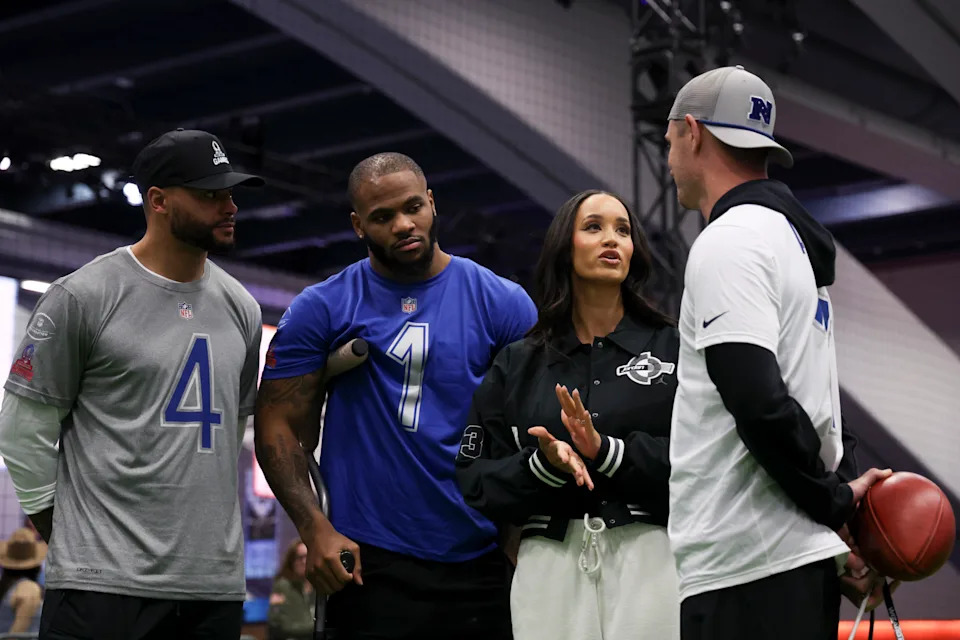
Micah Parsons (1 ), pictured next to former Cowboys teammate Dak Prescott (4) at a Pro Bowl Games event on Feb. 2, is recovering from a season-ending knee injury. (Photo by Kara Durrette/Getty Images)
(Kara Durrette via Getty Images)
As mental health conversation continues, when will NFL know it’s ‘making real strides’?
When Parsons reflects on the nearly three months since he tore his ACL, he wonders: Are the resources he’s getting the NFL standard?
Parsons has been named to the Pro Bowl in all five seasons since the Dallas Cowboys selected him in the first round of the 2021 NFL Draft. Three times, he’s earned All-Pro honors. The Packers acquired him from the Cowboys in an August trade, compensating their new edge rusher with a contract worth a record-setting $46.5 million per year with $136 million in guarantees.
Advertisement
He’s far from average in a league where players often bounce from practice squad to practice squad, hoping they can last until the roughly three-year mark of average service length for NFL players.
“For the future players, I hope that these organizations start pouring into them,” Parsons said. “Obviously my treatment is a little different because of my status, my name, how much I get paid. But everyone don’t get that status. Everybody get treated differently.
“I think all players need equal rights.”
Parsons wasn’t taking a shot at the teams who have employed him, noting that as he rehabilitates from his first long-term career injury he’s “been getting the best service I’ve ever seen in my life from Green Bay.” But he’s far from the first player to challenge the homogeneity of treatment between star players and fringe members of rosters.
Advertisement
In February 2023, weeks after the Kansas City Chiefs won a Super Bowl, the NFLPA released its first player “report card” with survey responses that criticized the Chiefs’ staff.
“Player respondents called for a more welcoming environment, and several players had negative opinions about head trainer Rick Burkholder,” the Chiefs’ Feb. 2023 report card read, “feeling that he does not treat players fairly and consistently, or with personal care.”
The Chiefs’ training staff received a league-worst D- grade that year and F the following season, the report card referencing an “overall lack of care” as “a number of players feel like the staff is not willing to provide support/treatment to all players.”
The Chiefs’ training staff received a C for its 2025 season grade, per results obtained last week by ESPN, tying the Packers and Cowboys for the second-lowest grade ahead of the San Francisco 49ers’ C-. The union did not share or comment on the results after the league won a grievance arbitration prohibiting the union from publicizing results, so this year’s grades lack context.
Advertisement
But as players’ responses to the holistic training experience reflect, rehabilitation culture varies from team to team and player to player even when league-mandated infrastructure is in place.
Team and player needs vary, too.
So while players, coaches, executives and league-wide officials are careful not to draw any specific conclusions from the death of Moore, several have reflected on his consecutive season-long injured reserve designations, as well as the circumstances of his death, to consider what comes next in the world of mental health support.
Moore’s last on-field moment left him covering his face with a towel as he was carted off a preseason game, a year after he was carted off a joint practice during training camp. How best can the NFL support the next player facing multiple years of injuries?
Advertisement
Could the broader NFL ecosystem reconsider what elements of rehabilitation need emphasis when, and how to best tailor programs to each player?
Moore’s former teammates searched for answers after learning the receiver, whom Arizona Cardinals quarterback Kyler Murray had “just spoke to” and fellow receiver Hollywood Brown had “just messaged…[a] few hours” before his death, was suddenly gone.
Pain lingered.
“You wasn’t alone bro,” Brown posted to X. “I told you I know how you feel.”
Conversations will continue, to ensure healthy and injured players alike find the support they need moving forward.
“It’s not just a physical [concern], it’s the psychological component that’s probably even more important,” Holmes said. “That’s a high priority for us.”
Advertisement
Quinn agreed.
“I’m hopeful that we get to a point that we’re not talking about mental health just when a tragedy hits, but that we are talking about it on a regular basis,” he said. “Then we know we’re making real strides.”
Read the full article here