




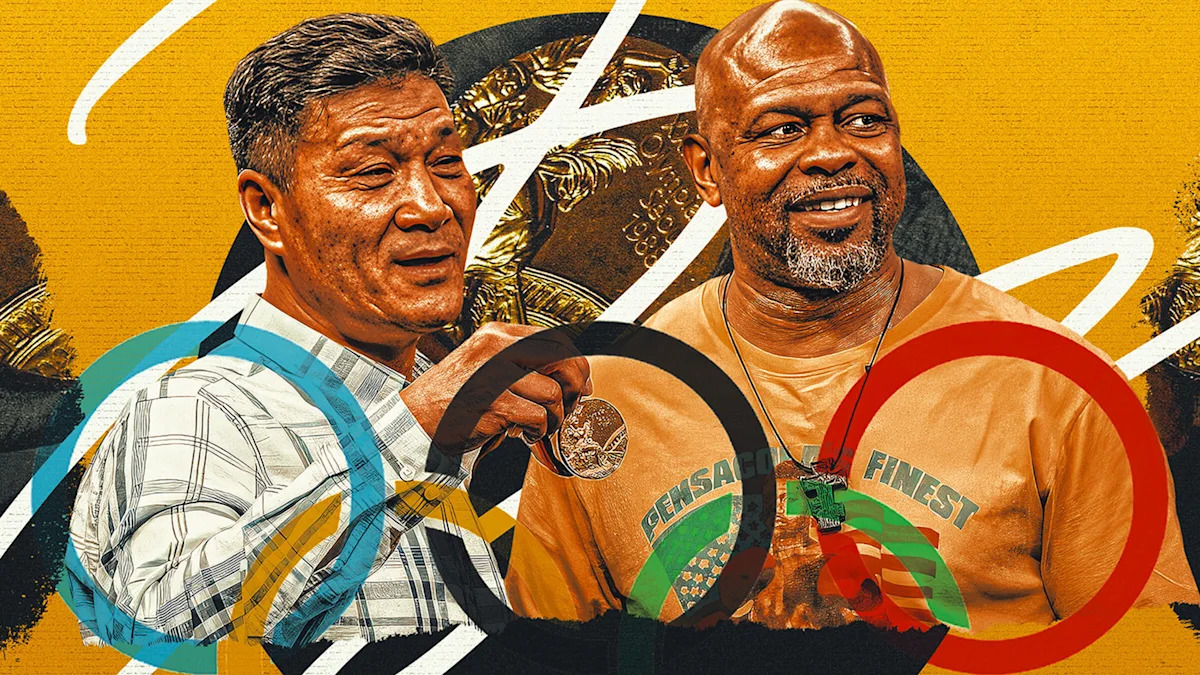
They stood there, looking at each other, just like they did halfway around the world 35 years before. By now, wisdom and hardship had carved creases on the edges of their eyes, and the pounding of countless rounds in the ring had made once hardened bones brittle. Their joints were a little creaky, too, from years of punishing repetition.
The last time they met, both were in their primes, one just embarking on a magical journey with a heart-wrenching sendoff, and the other about to get a lifetime reward he knew he did not deserve.
Advertisement
This time, Roy Jones Jr. and Park Si-Hun met as two men in the twilight of their years, with far more in common than they had in Seoul, South Korea, in 1988.
This was a healing moment, filled with the kind of backstory that stirs documentaries.
A shaping moment of a friendship forged between two broken men bonded by one broken, battered gold medal.
(Photo credit: Roy Jones Jr.)
On May 30, 2023, Park traveled from South Korea to Pensacola, Florida, to surprise his 1988 Olympic counterpart, Hall of Fame boxer Jones, with the medal the American should’ve rightfully won in their infamous gold medal match, which was called a 3-2 victory for Park despite Jones, then only 19 years old, out-landing Park 86 punches to 32.
Advertisement
It was a historic result — considered by many to be the most controversial decision in Olympic boxing history — that forced a change in Olympic boxing scoring and led to the lifetime banning of judges Alberto Duran of Uruguay and Hiduad Larbi of Morocco, who each scored it 59-58 for Park. A third judge, Bob Kasule of Uganda, had it a 59-59 draw, but awarded the gold medal to Park based on “aggressiveness”; he was also suspended for six months.
The judges’ verdict rocked the sports world. It was before the internet, and long before the thought of social media, but the unjust decision occurred on as close to a global stage as 1988 connective technology could provide. It was prime water-cooler and coffee-gathering debate fodder, even for those who did not follow boxing nor the Olympics nor had any idea who budding superstar Roy Jones Jr. was at the time. National columnists hammered the injustice they witnessed in Seoul. The decision held prime space across American sports sections. Nightly television news led with it.
It carried the kind of sports media gravity only possible in an erstwhile age.
Speculation ran rampant. Were judges paid off? Was the Olympic host nation South Korean government involved? One judge, Larbi, allegedly said, according to French-speaking reporters at the time, “The American won easily. So easily, in fact, that I was positive my four fellow judges would score the fight for the American by a wide margin. So, I voted for the Korean to make the score only 4-1 for the American and not embarrass the host nation.”


Oct. 2, 1988: One of the most divisive results in Olympic boxing history.
(John Iacono via Getty Images)
The result became a pain both Park and Jones carried. Jones wound up being awarded the Val Barker Trophy as the best boxer of the 1988 Games, despite losing that gold medal match, and went on as a professional to win world titles in four weight classes from middleweight to heavyweight, finishing with a 66-10 record, with 47 knockouts.
Advertisement
After the 1988 Olympics, Park never fought again. He spent the next 13 years as a middle- and high-school physical education teacher, living in a sort of self-imposed exile.
In the wake of the controversy, the U.S. Olympic committee and everyone associated with AIBA — the international amateur boxing governing body of the time — held out hope that the International Olympic Committee would eventually right the wrong and present Jones his winning medal, an award even Park knew Jones should’ve won.
But that did not happen.
Not until Park himself took the initiative and presented Jones with the one thing that had linked the two men for the 35 years after their fateful first meeting. His magnanimous gesture did not go public until late 2025, and came as a complete surprise to Jones.


Park Si-Hun traveled to Roy Jones’ gym in 2023 to surprise him with the gold medal from their 1988 match. (Photo credit: Roy Jones Jr.)
“It sure was,” says Jones. “It was incredibly unselfish [what Park did]. I never thought I would see that [medal]. I got emotional. I mean, how could you not? A gold medal that you thought you’d never receive in your whole life? Because once that’s done, it’s over with. You’d never thought you’d see that gold medal again and it shows up at your gym — how could you not be emotional? I sacrificed nine years of my life for that gold medal.
Advertisement
“He said for a long time, he wanted to return it. His family wanted him to return it. He’s very happy he did. He’s doing what he thought was the right thing. I was completely blown away.”
“Things like this never happen in boxing,” Jones adds. “It never, ever happens.”
Jones took the gold medal back to his Pensacola home and placed it on his mantle. He is making plans for getting the 1988 silver medal, which is at his mother’s house, and presenting it one day to Park.
But, Jones admitted, the sting of losing the gold medal — added to the anguish of how it was taken from him, knowing he won — lingered for years. Many years. Ironically, it is that major wrong that actually molded Roy Jones Jr. into becoming Roy Jones Jr.
Advertisement
“It stayed with me, of course it did, because that’s some hurting stuff that you’ll never forget,” he says. “And that is definitely what helps mold us into who we become.
“I believe, in my honest opinion, had I won a gold medal, I’d never become heavyweight champion of the world. I’d never become an overachiever. That pushed me. I would have thought everything went like it was supposed to happen. I would have did my plan instead of God’s plan, but because of how things happened, it was God’s plan that I had the career I had, instead of my plan.
“I thank God for that.”


Jan 15, 2000: Roy Jones Jr. surrounded by his many championship belts after another successful title defense.
(New York Daily News Archive via Getty Images)
Everyone knows what Jones stomached in the 1988 Seoul Olympics. It remains to this day a tragic reminder of how incompetence can swoop in and steal away a lifetime achievement. Hardly anyone knows the other side — what Park experienced. He received a gold medal he knew he rightfully did not win, and although he had nothing to do with the decision, he was still blamed by his own countrymen for what transpired. He fled from the public for years, ridden with guilt over a faulty conclusion he was not at fault for.
Advertisement
He was called “a cheater.” He was attacked by the South Korean media. He was detested in the United States and by his own people for winning the way he did, castigated globally for nothing more than putting in an honest, clean effort to the best of his abilities.
He had long bouts of depression. He couldn’t sleep. He shied away from a normal life, walking with his face turned in grocery stores and at social functions.
Rei Park, Si-Hun’s son who lives today in Louisiana, felt the brunt of that firsthand. He would see his father nervous in public settings. Si-Hun’s eyes would shift side-to-side, hoping no one would notice him. In first grade, Rei was asked, like all the other students, what his parents did. Rei, now 26, put down “gym teacher” for his dad, who at the time had returned to the sport as a South Korean Olympic boxing coach. On Rei’s Parents Day, Si-Hun, a national celebrity, kept his head down, trying to be as indiscreet as possible. The next day, a classmate approached Rei and told him that his father was a cheater, which forced Rei to look up who exactly his father was.
From then on, Si-Hun stayed away.

Park Si-Hun (gold) and Roy Jones Jr. (silver) stand atop the dais in the 1988 Olympics.
(PA Images Archive via Getty Images)
“I want to make something very clear here: I’m very proud of my father and the man he is,” Rei says. “Through time, as a man, you come to appreciate how strong he is, and what he went through. He chased a dream as a fighter. He chased a dream [afterward by] seeking a gold medal as a coach. I used to get annoyed when I was younger why he didn’t walk away from boxing. He had other job opportunities. He kept pursuing his dream. You have to admire him for staying with his passion. I wouldn’t have done that. He made the right choice for himself. I want my son to be like father, never give up on your dream.
Advertisement
“I realize now what he went through,” Rei continues. “He never really showed me how much he struggled with when I was younger. He would keep it bottled up. It wasn’t easy. It took a while for him to begin opening up to me what he went through. My father did nothing wrong. All he did was fight.”
Si-Hun had so little regard for his tainted medal that he hung it from a small makeup room doorknob. When Rei was a child, he would bite it, swing it over his head around the house, kick it across the floor. It’s why the gold medal has dings in it today.
Si-Hun speaks of Jones today in great reverence, referring to him as “Mr. Roy.” From afar, he’s kept track of Jones’ ring exploits, celebrating his victories.
The 1988 Olympics was an event Si-Hun trained his young life for, as did Jones. Yet reaching the top of his climb proved to be his nadir.
Advertisement
“I tried to hide as much as possible after, I didn’t want to bring any attention to myself,” says Si-Hun, 60, translated through his son Rei. “I just started to go through the therapy process not too long ago. I was dealing with depression. Giving Mr. Roy the gold medal relieved a lot of feelings. I had to protect my [three] children from the criticism that I faced. I knew I lost the [Jones] fight, it’s why I was confused when they raised my hand. I wanted to make it right. It’s why immediately after the fight I told the media that I lost the fight. But my country hated me for a while. My own country.

October 2, 1988: Park Si-Hun (L) boxes Roy Jones in the middleweight final of the 1988 Summer Olympic Games.
(SUNKYU IM via Getty Images)
“They called me ‘cheater.’ Every time Mr. Roy fought, my name kept coming up again. If there was something wrong or controversial in [South Korean] sports, my name kept coming up — like I did something wrong, like I always attached to this great wrong. There is no way I could do anything about it. You get attached to something like that and it never goes away.”
Spend enough time talking to Si-Hun and you find out just how courageous he was — and remains. He was crucified for an injustice he did not commit. It was not Si-Hun who rigged the fight or scored it. He was as much a victim of the judges like Jones was.
Advertisement
“It bothered me that Mr. Roy [suffered] too, waiting 35 years for something he should have received after we fought,” Si-Hun says. “I always wanted to do something about it. I always wanted to give him what was rightfully his. This was something that could have been done way earlier. I had to do this. I had to do this before I died, or before something happened to me where I could not give him what was his. I am much better now. I won the silver medal. It is an honest medal. I’m hoping we can one day get the silver medal from Mr. Roy.”
Rei eventually graduated from Northwestern State, where he received his degree in accounting. His son was born in mid-July, Mickey Joseph Park — Si-Hun’s grandson.
“I don’t think I’ll tell my grandson about my boxing career, I’m still embarrassed by what happened,” Si-Hun says. “Til this day, no one knows what really happened in that fight. I would like to know. I was not involved at all in what happened. But I was the one who they blamed for it. I went into the fight with the intention of winning and I honestly did not. I was wearing a gold medal that I did not deserve. I’m happy the person who honestly won that fight got what he finally deserved.
“I’m happy knowing that.”


Unlikely friends, more than three decades later. (Photo credit: Roy Jones Jr.)
It is unique how these two men, separated by 7,279 miles, one ocean, and deeply embedded cultural differences, are so intertwined. After Park’s boxing career ended, there were times he felt so besieged by everything around that he contemplated suicide. His wife, Sunny Cho, pulled him back.
Advertisement
“My mom was my father’s backbone,” Rei says. “My father did not want to come back to boxing for a long time, and my mother is the one that talked him into coming back. He felt the boxing world and the whole country was angry at him. A lot of things happened to my dad. One of the worst times ever was when this big South Korean TV host invited the 12 South Korean 1988 gold medalists to his show. The host shook everyone’s hand, except my dad’s. Everyone in the country was watching. My dad was really embarrassed.
“That was probably his worst moment. That’s when he realized everyone in South Korea was angry at him. I don’t know if I would have been able to go through that. I don’t know if anyone would.”
Where Park’s deep, dark depression teetered on suicide, Jones was smacked right in the face by it, when his son, DeAndre, committed suicide at age 32.
Jones called DeAndre’s sudden death the toughest challenge of his life. It forced the Hall of Famer to take a deep inventory of himself.
Advertisement
“The men in my family are wired different — they are hard men, they are very selfish, they are very controlling, and DeAndre became a grown man and I was not about to tell him how to live his life,” says Jones, who wraps himself tightly around his bridge-cable strong faith. “His life was his wife and his son. Nothing else mattered.
“Mental health is a serious issue. It’s not talked about enough, especially in the Black community. It’s a cultural thing. Black men are raised to be able to deal with anything. They’re raised to be strong. I’ve become a lot more aware of it. It does not mean you are weak if you’re talking about mental health. If you need a little talk, you need someone to talk to, and in my world today, find someone to talk to, and find those people who can talk to.
Advertisement
“When things like what happened to DeAndre happens, that is God showing me that He puts things on people that he can handle it,” he continues. “Had any of those other guys got robbed of that gold medal like I did, what would they have done? Would they have killed themselves? We don’t know. Would it have elevated them to go to another level? We don’t know. What would have happened to them? We don’t know. Why? Because it didn’t happen to them, because God knows us better than we know ourselves.
“But it hurt me. A part of me was ripped out. I have to do something about it. I want to make sure no father has to go through what I had to go through. I can’t bring my son back, but maybe I can It’s why I am speaking out more on mental health and for people to seek help. Hopefully, people will listen and my words can save lives.”
In the meantime, it seems Park and Jones have become life preservers to each other.
They are hoping to see more of one another. Now with a grandson to visit based in nearby Louisiana, and the communication channels open between the newly-formed friends, Park and Jones are considering some projects together, starting with a story grounded on a tragic, international decision. One involving a battered Olympic gold medal that improbably brought together two broken men when they needed it most.
Read the full article here


